Object Edge // Hive
Your company already knows. Its systems can’t say it.
Hive is a company brain — one connected layer across the systems you already run. Enterprise data fabrics are measured in quarters, because they ask you to model the business before you get any value out of it. Hive inverts that. Live in one to two weeks, because the engineering went into extraction and persistence instead of into your modelling homework.
What It Fixes
The answer is already in your systems. Nobody can ask the question.
Four places where that costs real money. Each one is answerable today from data you already own, and each one still takes six weeks and four analysts. The fifth is whichever one you came here with.
Revenue leakage
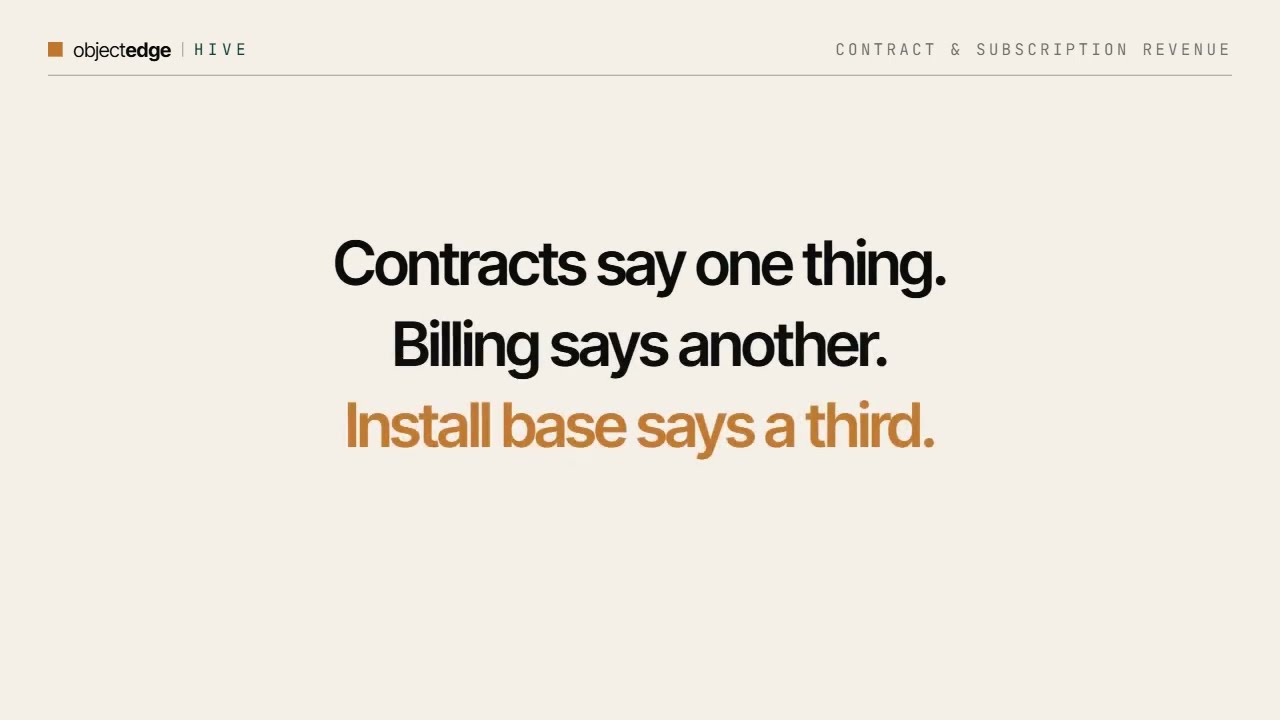
Contract renewals roll over at last year’s rate. Escalators go unclaimed. What the contract entitles you to bill and what you actually billed drifted apart three quarters ago, and the churn signal was sitting in a support ticket six months before anyone read it as one.
Lead generation
The warm path into the account already exists — in someone’s inbox, someone else’s call notes, and a relationship graph nobody has ever queried.
Sales force management
Rep performance, territory coverage, and pipeline reality live in three systems that only agree at quarter end, by which point the quarter is over.
Inventory optimization
Demand signal, supplier reality, and outstanding commitments reconcile monthly. The stockout happens weekly.
Yours
Those four are the ones we have productized. They are not the boundary. Warranty claims, field dispatch, quote-to-cash, entitlement drift after an acquisition — the engagement is identical for any problem that spans systems. Bring the one with money attached and we scope it the same way.
How a deployed engagement runs →How You Buy It
One company brain. Three ways to put it to work.
The layer underneath is the same in all three. What changes is how much of your business it spans on day one, and how you pay for it.
One named problem, taken end to end.
Pick one of the problems above — including yours, if it is not on the list. We scope it in a week and put it in production in four to eight, on a fixed bid, inside your own cloud.
Every seat you have already deployed.
Thousands of AI seats, none of which know your business. Hive goes underneath all of them at once — keep the contract you signed, or move onto our models later.
A packaged agent for your trade.
Built for how your trade actually runs, it absorbs the admin that keeps landing on your desk — orders, purchasing, scheduling, the calls only you can answer.
Or don’t buy it at all
Bring us the problem and let us bring the engineers.
Most companies do not want a platform. They want the renewal repriced and the stockout to stop. Our forward-deployed engineers work your problem directly, with the company brain as their head start rather than your purchase decision.
See how a deployed engagement runs →Definition
What is a company brain?
A company brain is a semantic layer over the systems a business already runs — one model of what the company is made of and how those things relate, kept current against the systems that change.
Underneath, that model is a knowledge graph: typed entities, typed relationships, temporal history, and provenance on every edge. It is built on your own ontology — your vocabulary, not a generic schema — so a cruise operator reasons about decks and port calls while a distributor reasons about territories and renewals.
The distinction from search is the whole point. Search returns documents that mention a thing. A company brain returns the thing itself, what it connects to, who owns it, what changed last week, and where every claim came from.
Product site: hive-os.ai ↗
Common Questions
What is a company brain?
A company brain is a semantic layer across the systems a business already runs, implemented as a knowledge graph with typed entities, typed relationships, temporal history, and provenance. It lets people and AI agents query the business as one connected system instead of a dozen disconnected ones.
How is a company brain different from a data warehouse or lakehouse?
A warehouse stores rows for analysis. A company brain stores meaning for reasoning — entities, the relationships between them, how they changed over time, and where each fact came from. Warehouses answer what the numbers were. A company brain answers who owns this, what depends on it, and what changed.
What is a semantic layer?
A semantic layer is a model of what a business is made of — its entities, their relationships, and the vocabulary it uses for them — sitting between raw systems and the people or agents asking questions. It is what lets a query be phrased in business terms rather than table joins.
Why does an ontology matter for enterprise AI?
An ontology encodes a company’s own vocabulary and structure. Without one, an AI system reasons in generic terms and produces generic answers. With one, it reasons in decks and port calls, or queues and escalations, or territories and renewals — whatever the business actually uses.
Does Hive replace Copilot, ChatGPT, or Claude?
No. Hive sits underneath whatever AI seats an organization has already deployed and gives them shared company context. Organizations that would rather consolidate can route through Hive’s own hosted models instead, but replacement is optional.
How long does Hive take to deploy?
One to two weeks to connect systems and stand up the company brain. Four to eight weeks to put a complete solution to a named business problem into production, on a fixed bid.
Is Hive secure enough for regulated industries?
Hive is SOC 2 compliant and deploys inside your own cloud. Access is role-based and enforced at the query rather than by keeping data in separate silos, and every answer carries provenance and an audit trail.
Can we use our own AI models with Hive?
Yes. Hive is model-agnostic. Sayya, the agent harness, routes through your existing Microsoft, OpenAI, or Anthropic enterprise agreement, through Object Edge’s provider keys, or through hosted models — and different queries can route to different providers.
See Hive in Action
The report writes itself. You approve it.
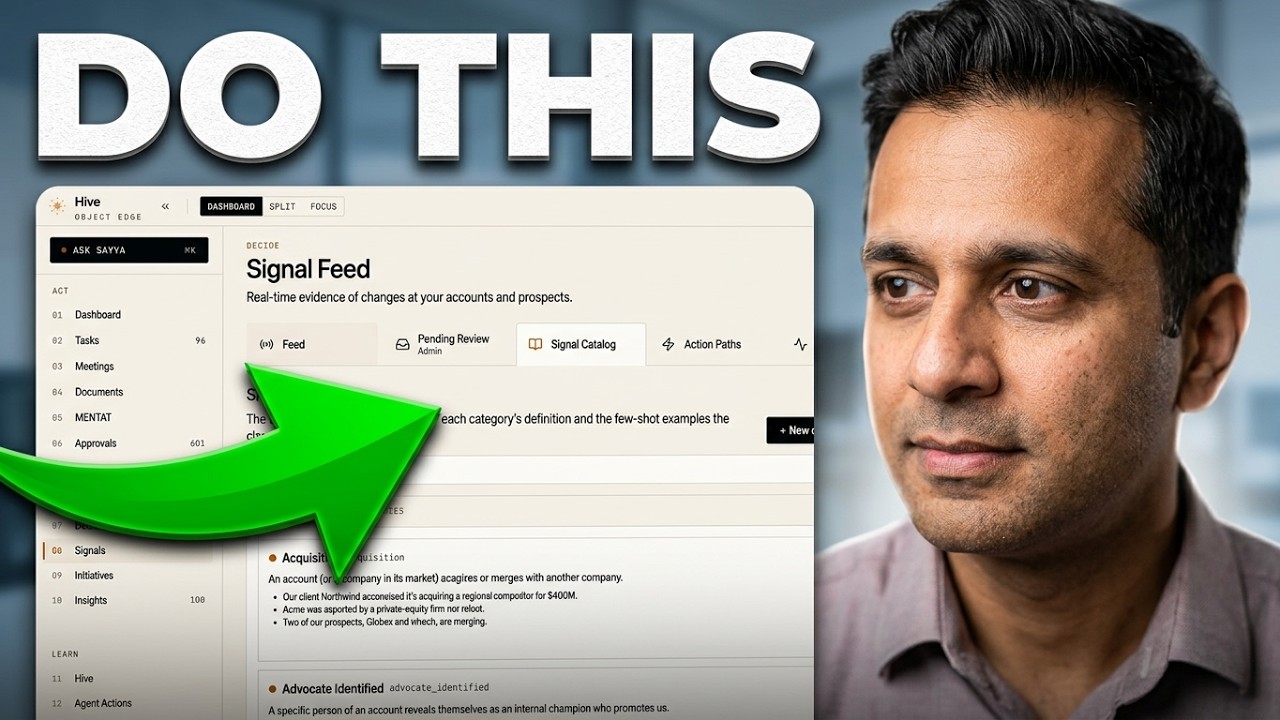
A heartbeat fires at 10 a.m. with nobody watching, reads the overnight across email and meetings, and drafts the leadership update in the CEO's own voice — every line traceable back to the meeting or thread it came from. Ninety seconds of judgment instead of an hour of writing.
Start with the definition, then Hive applied: signals, commerce, contracts

Bring us the problem
Tell us which system boundary keeps costing you — the renewal that slipped, the AI rollout that never had a foundation, or the week you can’t get back.