ai
AI copilots make teams faster — and harder to manage

AI copilots: When the job gets harder in better ways
AI copilots are not replacing PMs, delivery managers, or client-facing operators. They are changing the shape of the work. With more productivity there is a clear trade-off: more output, less clarity.
In most teams, the first measurable effect of AI is not clean leverage. It is more output in less time, often with more variation, more handoffs, and more room for misunderstanding. That is the part people miss when they frame AI as a productivity story only.
The real management problem is this: when a team can produce 2x or 3x more artifacts, drafts, summaries, and plans, the system has to absorb that speed without losing alignment. If it cannot, execution gets noisier before it gets better.
The PM who wins in an AI-enabled environment is not the one who simply accelerates task completion. It is the one who restores clarity, keeps decisions consistent, and turns faster individual execution into cleaner, more accurate delivery.
The first effect of AI is often messier execution
There is a common assumption that AI copilot adoption creates an immediate efficiency gain. In practice, the first layer is usually friction.
Why? Because AI increases the volume of work before it improves the quality controls around that work.
A PM used to spend 30 minutes writing a status update. With AI, that becomes 5 minutes, or even less. Good. But now the team has:
- 4x more status updates, each slightly different in tone and detail
- more proposed scope changes
- more versions of requirements
- more documentation being generated without a consistent source of truth
The result is not less management. It is more management with a higher mismatch risk.
This is the clarity tax: when individuals move faster, the coordination layer has to work harder to preserve a shared understanding of what is actually true.
That tax shows up in very practical ways:
- someone assumes AI-generated notes are rules when they are not
- teams approve outputs faster than they validate assumptions
- scope expands because AI makes “just one more option” too easy to produce
- reporting looks complete while the underlying delivery picture becomes less reliable
The takeaway is simple: AI does not remove the need for PM discipline. It raises the cost of weak PM discipline.
Where copilots change the PM job
1) Scoping gets faster, but the edges get blurrier
AI is excellent at producing first drafts of scope, requirements, and effort breakdowns. A PM can generate a project plan in minutes instead of hours. That sounds like pure gain until the edge cases start multiplying.
In a traditional workflow, a PM might define a feature set, confirm dependencies, and then lock the plan. With AI, it is easy to generate three alternative scopes, each slightly different, each plausible, and each missing a different assumption.
That creates a new PM responsibility: compare outputs against the real constraints, not against each other.
For example, if a delivery team uses AI to draft a 12-week implementation plan, the model may produce optimistic estimates for integration work, testing, or stakeholder sign-off. The plan looks structured, but it may be built on assumptions that have not been validated.
The PM’s job shifts from “write the plan” to:
- identify which assumptions are real
- flag where AI is extrapolating beyond known constraints
- collapse options into a single agreed scope
- make tradeoffs visible early
This is where delivery leaders gain leverage. Faster drafting is useful only if the PM can prevent scope drift and make hidden ambiguity visible before execution starts.
2) Coordination gets more distributed, which means more room for drift
AI copilots make it easier for engineers, analysts, designers, and ops leads to produce their own summaries, action items, and handoff notes. That should improve coordination. Sometimes it does.
But it also creates a new failure mode: parallel truth.
Instead of one aligned project narrative, you now have multiple AI-assisted narratives:
- the engineer’s recap
- the PM’s meeting summary
- the client’s internal notes
- the account lead’s follow-up
- the chatbot-generated action list
If those versions diverge even slightly, coordination becomes harder, not easier. One team thinks a decision is final. Another thinks it is still under review. A client thinks the timeline moved. Engineering thinks it did not.
That is why AI raises the value of the PM as an alignment engine. The best PMs will not just summarize meetings faster. They will create a single, authoritative execution frame that everyone can trust.
Practical tactics matter here:
- use one single source of truth for decisions and scope
- mark assumptions explicitly
- force a human-in-the-loop step on anything that changes commitments
- treat AI summaries as drafts, not records
The teams that do this well reduce rework, avoid unnecessary escalation, and prevent “I thought we agreed on something else” moments that can consume 10–20% of a project’s attention budget.
3) Review and approval become the bottleneck
AI can generate deliverables quickly. It cannot approve itself — thankfully.
That means the bottleneck moves from production to review. For PMs and delivery leaders, that is a major shift. The work is no longer about getting something to first draft. It is about getting the right thing through review without introducing errors, contradictions, or compliance risk.
This matters a lot in client-facing work especially. If AI helps a team produce proposals, statements of work, status decks, release notes, or customer communications 2x, 3x, even 4x faster, the risk is not speed. The risk is that the review process was built for a slower world.
A PM who adapts will:
- tighten approval criteria
- define what must be checked manually
- standardize review checklists
- route high-risk content to subject-matter owners
- separate low-risk automation from client-facing commitments
In other words, the role becomes less about making more content and more about controlling quality gates.
That is not overhead. It is how the team avoids trading speed for reputational damage — and that is the key point.
4) Reporting gets richer, but not necessarily truer
AI makes reporting easier to produce and easier to consume. Status updates, progress narratives, weekly summaries, and executive briefs can all be drafted quickly.
The danger is that polished reporting can hide weak delivery signals.
When teams can generate clean-looking updates in seconds, leaders may assume the project is healthier than it is. But reporting quality and delivery quality are not the same thing. A good AI-generated status note can still summarize a late project, unresolved blockers, or bad assumptions.
This means PMs must ask a harder question: Is the reporting helping us make better decisions, or just making the work look organized?
The best reporting systems in an AI-enabled environment do a few things:
- surface exceptions quickly
- keep metrics tied to execution reality
- distinguish fact from inference
- avoid vanity metrics
If your reporting pipeline cannot answer “what changed since last week, who owns it, and what is the actual risk?” then AI has only made the presentation better, not the operation.
The PM who wins restores alignment
The PM role does not disappear in an AI-heavy team. It becomes more important.
Why? Because AI increases throughput faster than it increases shared understanding. That means the team needs someone who can:
- compress ambiguity
- reconcile competing versions of reality
- keep scope, timeline, and approval flows aligned
- prevent fast work from becoming fragmented work
That is not administrative overhead. That is operational value.
A strong PM in this environment is less a traffic cop and more a systems integrator. They make sure that faster individual execution becomes cleaner delivery, not just more activity.
Practical takeaway for delivery leaders
So what is the practical takeaway here? If you are leading delivery, client operations, or project management, do not ask first, “Where can we use AI to go faster?”
Ask instead:
Where will faster output create confusion unless we add a stronger quality and alignment layer?
Start with three controls:
- a single source of truth for scope and decisions
- clear human approval gates for client-facing and commitment-bearing outputs
- a reporting standard that separates facts, assumptions, and AI-generated drafts
Then measure what changes:
- rework rate
- approval cycle time
- number of scope clarifications
- missed handoffs
- escalation frequency
If your AI adoption is real, you should see speed improve without a matching rise in rework. If rework increases, the issue is not AI capability. It is management design.
The teams that win with AI will not be the ones that produce the most drafts. They will be the ones that turn those drafts into reliable execution.
If this is the challenge your team is facing, talk about it now — before speed turns into noise.
Related articles
-
ai
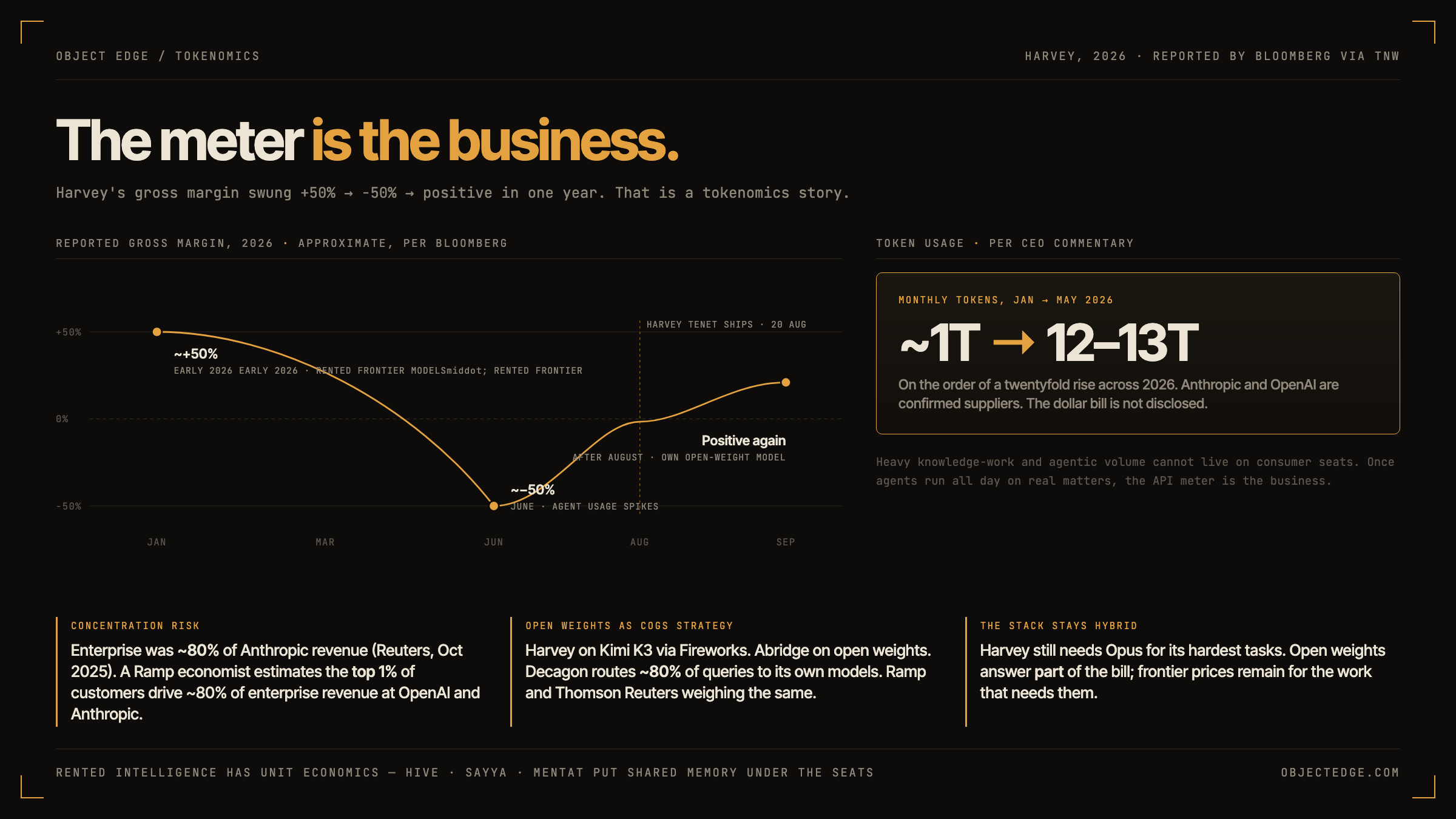
Harvey's Margin Swing Is a Tokenomics Story, Not Only a Legal-AI Story
Harvey's gross margin went from about +50% to about -50% and back positive in 2026 as agent usage spiked on rented frontier models, then moved onto its own open-weight model. What that swing says about metered knowledge work, revenue concentration at Anthropic and OpenAI, and open weights as a cost-of-goods strategy.
-
ai
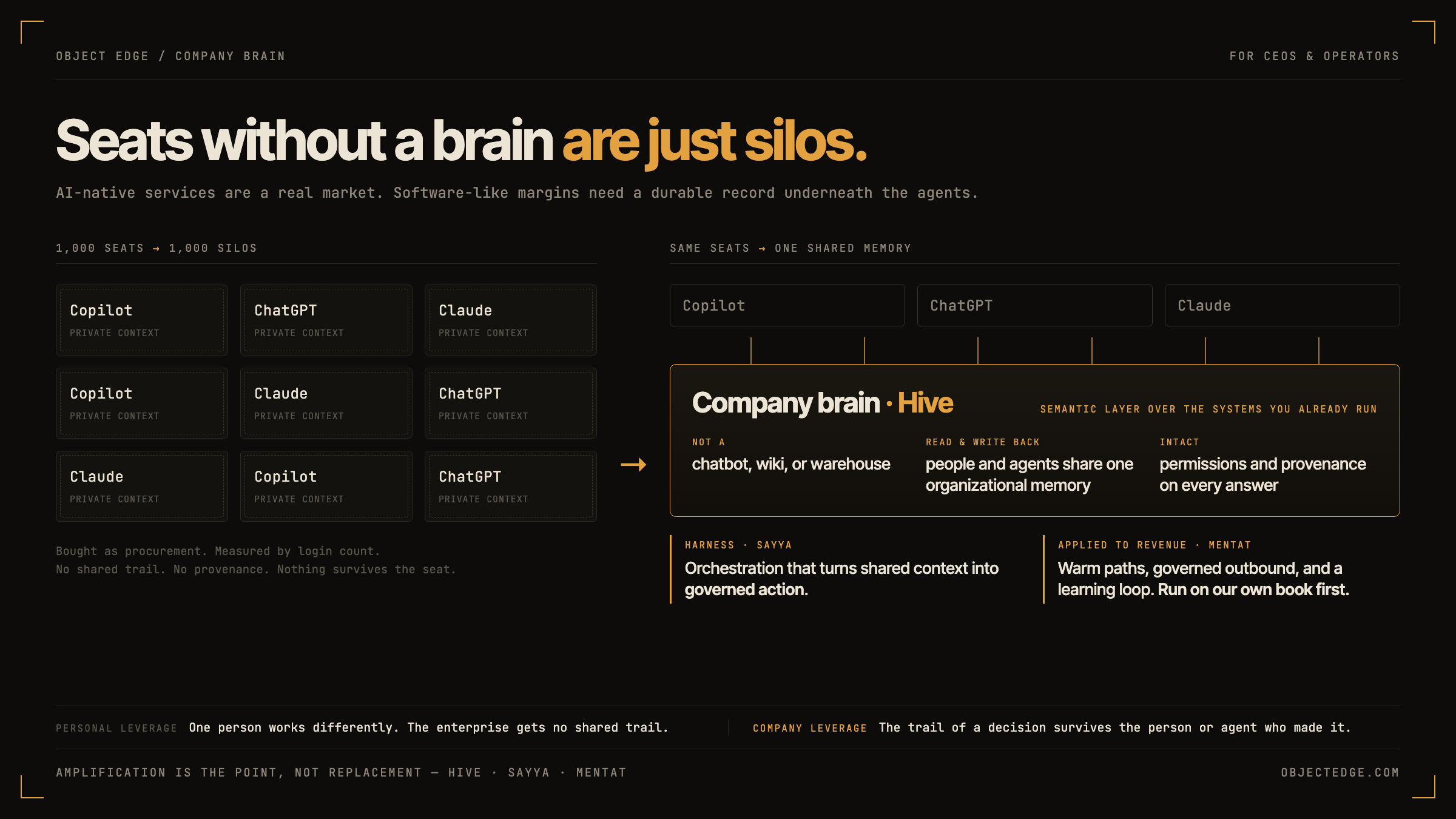
AI-Native Services Are a Real Market. Enterprise Still Needs a Company Brain.
Greg Isenberg's $100B AI-native services thesis is right about the market. The operator question is whether the enterprise keeps a durable record under its agents. Without one, a thousand AI seats become a thousand silos.
-
ai
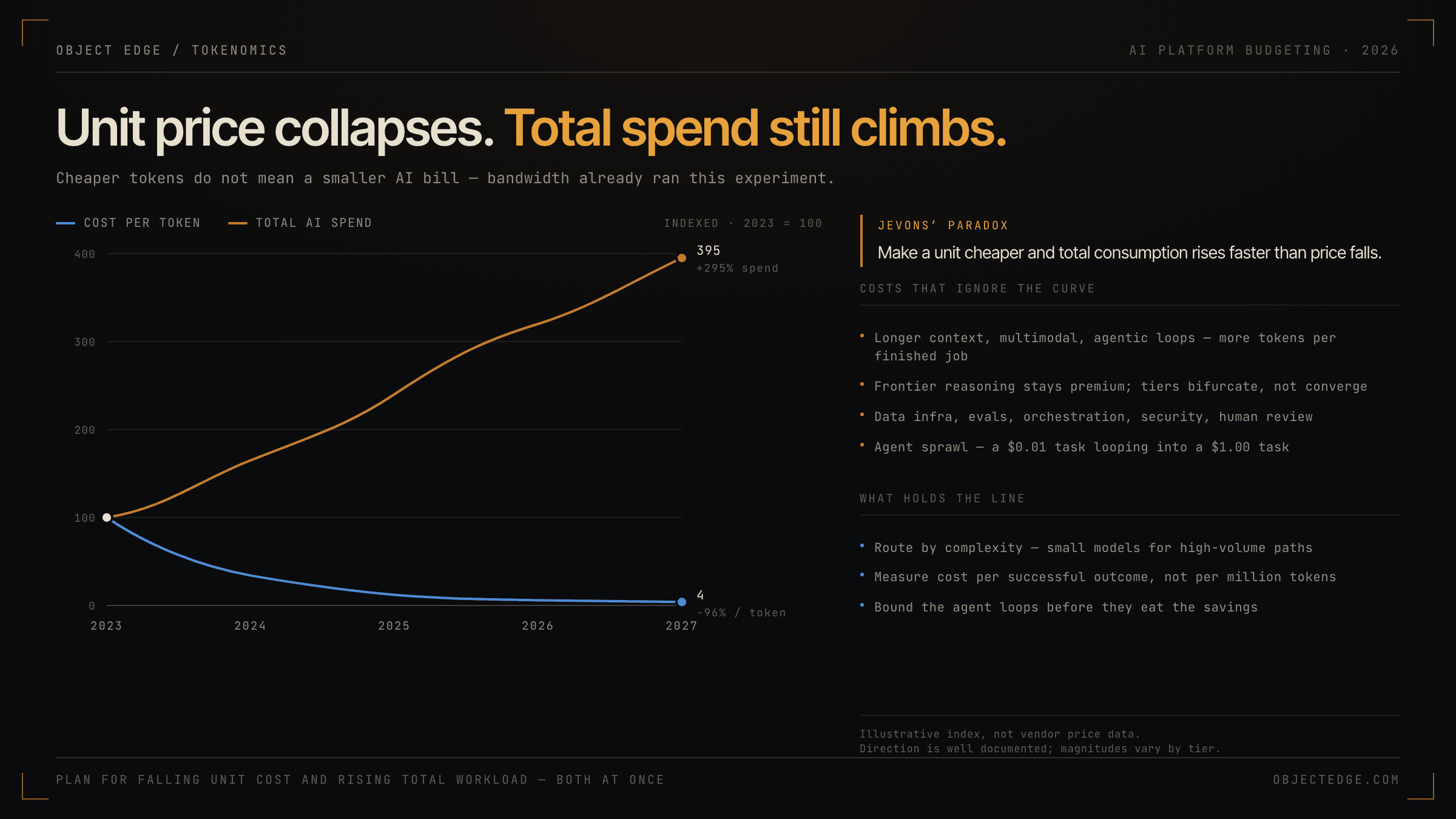
Faster, Cheaper Tokens — Why Your AI Bill Won't Fall Like You Think
LLM inference costs are collapsing along a curve that mirrors internet bandwidth pricing — but buyers who confuse cheaper tokens with lower total AI spend will get burned.