Back to Blog

Tagged

enterprise


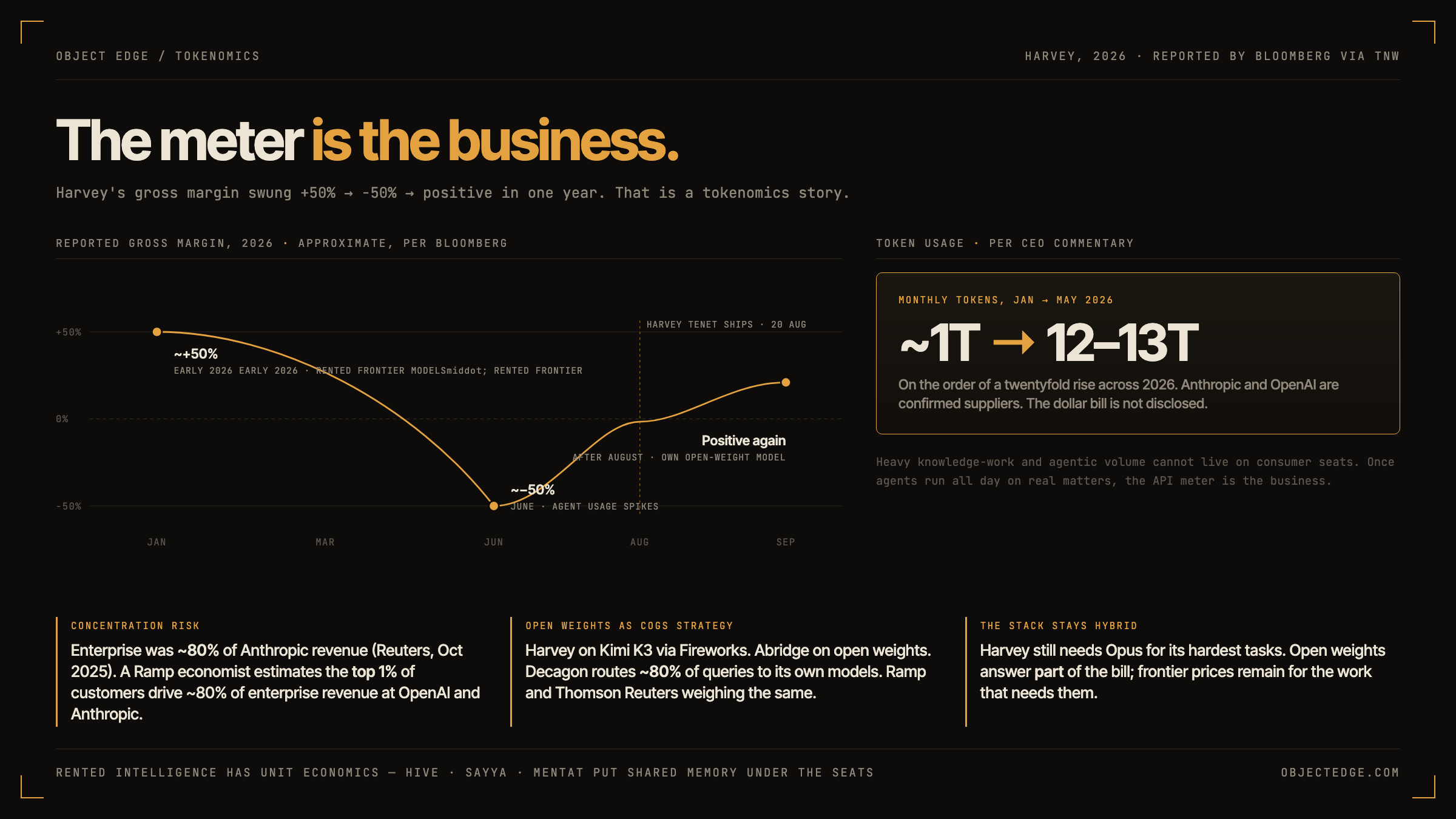
Diagram titled 'The meter is the business.' A single amber line charts Harvey's reported gross margin across 2026: about +50% early in the year, about -50% by June as agent usage spiked on rented frontier models, and back positive after August when Harvey Tenet, its in-house open-weight model, shipped. Beside the chart, a tile reads 'about 1T to 12-13T tokens per month, Jan to May 2026.' Three cards below cover concentration risk (enterprise about 80% of Anthropic revenue; top 1% of customers about 80% of enterprise revenue), open weights as COGS strategy (Harvey, Abridge, Decagon, Ramp, Thomson Reuters), and the hybrid stack (frontier models kept for the hardest tasks). Footer reads 'Rented intelligence has unit economics' and objectedge.com.

Harvey's Margin Swing Is a Tokenomics Story, Not Only a Legal-AI Story

Harvey's gross margin went from about +50% to about -50% and back positive in 2026 as agent usage spiked on rented frontier models, then moved onto its own open-weight model. What that swing says about metered knowledge work, revenue concentration at Anthropic and OpenAI, and open weights as a cost-of-goods strategy.
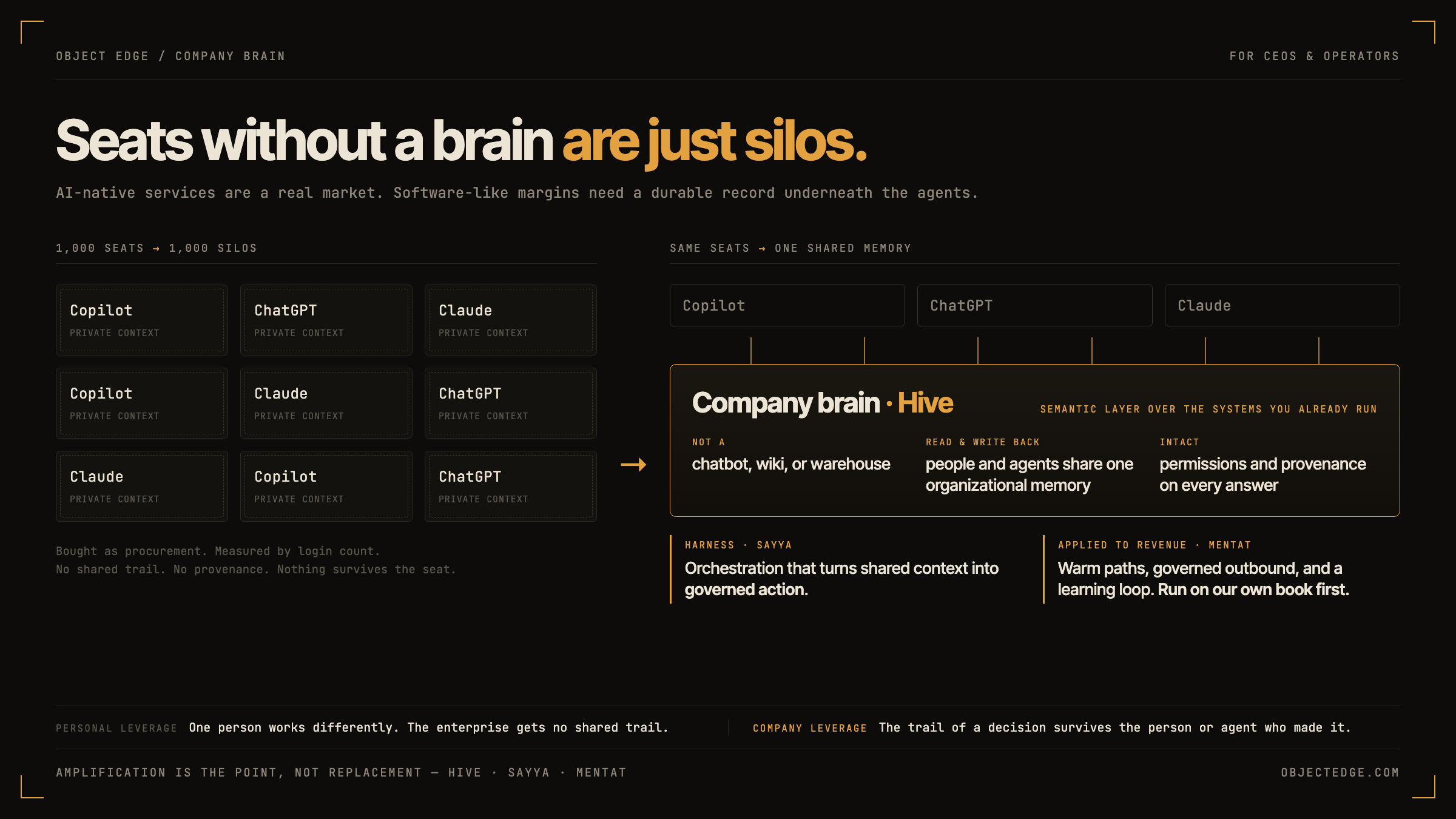
Diagram titled 'Seats without a brain are just silos.' On the left, a grid of nine small boxes labeled Copilot, ChatGPT, and Claude, each with its own private context, captioned '1,000 seats, 1,000 silos.' On the right, the same seats sit above a shared layer labeled 'Company brain: Hive' with permissions and provenance intact, Sayya as the harness for governed action, and Mentat as the company brain for revenue. Footer reads 'Amplification is the point, not replacement' and objectedge.com.

AI-Native Services Are a Real Market. Enterprise Still Needs a Company Brain.

Greg Isenberg's $100B AI-native services thesis is right about the market. The operator question is whether the enterprise keeps a durable record under its agents. Without one, a thousand AI seats become a thousand silos.
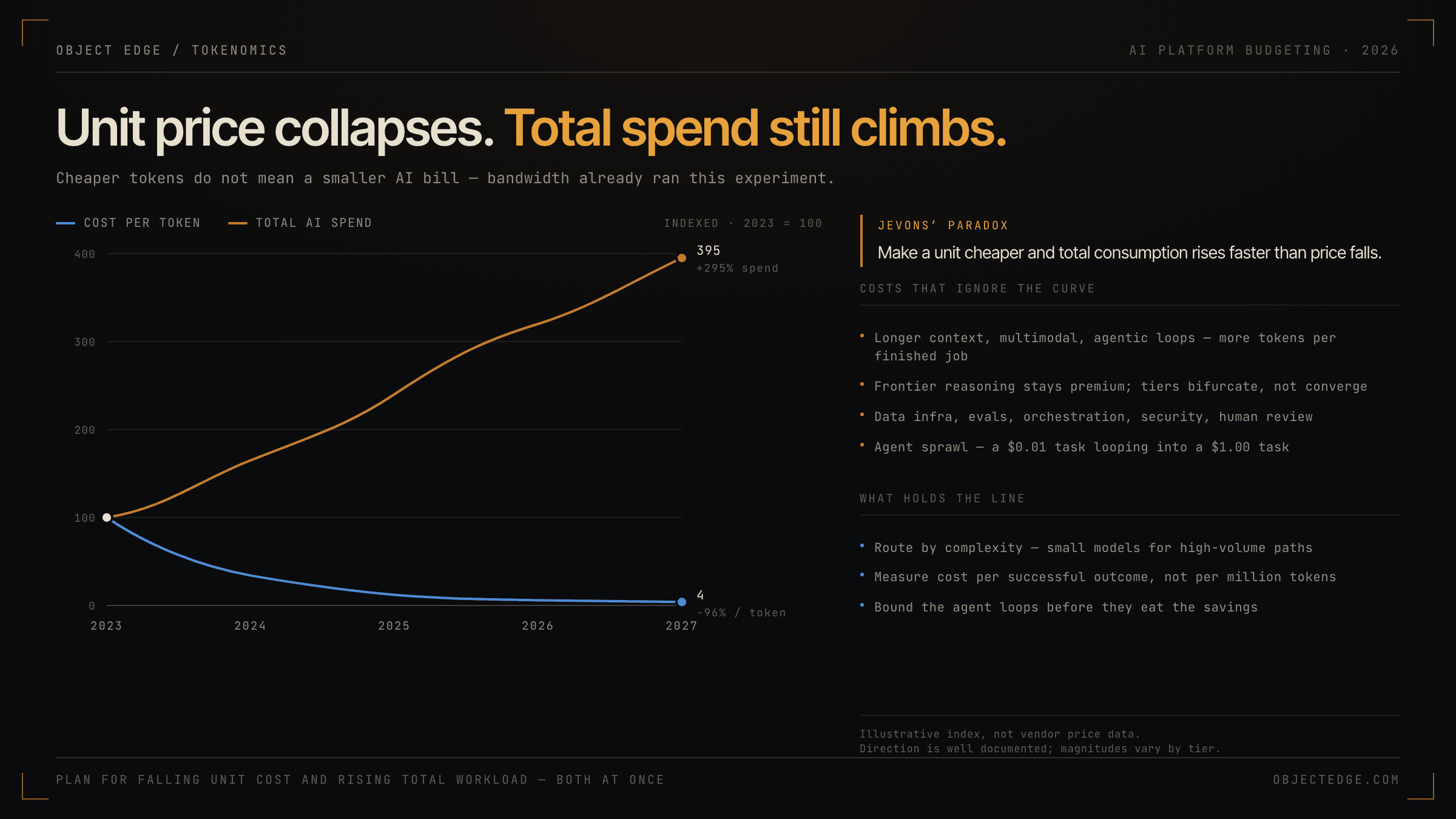
Diagram titled 'Unit price collapses. Total spend still climbs.' A line chart indexed to 2023 = 100 plots two series on one axis from 2023 to 2027: cost per token falling from 100 to 4 (a 96% decline per token) and total AI spend rising from 100 to 395 (a 295% increase). A side panel defines Jevons' paradox — make a unit cheaper and total consumption rises faster than price falls — then lists costs that ignore the curve (longer context, multimodal and agentic loops consuming more tokens per finished job; frontier reasoning staying premium as tiers bifurcate; data infrastructure, evaluation, orchestration, security and human review; agent sprawl turning a $0.01 task into a $1.00 task) alongside what holds the line (route by complexity, measure cost per successful outcome, bound the agent loops). A note marks the index as illustrative rather than vendor price data

Faster, Cheaper Tokens — Why Your AI Bill Won't Fall Like You Think

LLM inference costs are collapsing along a curve that mirrors internet bandwidth pricing — but buyers who confuse cheaper tokens with lower total AI spend will get burned.
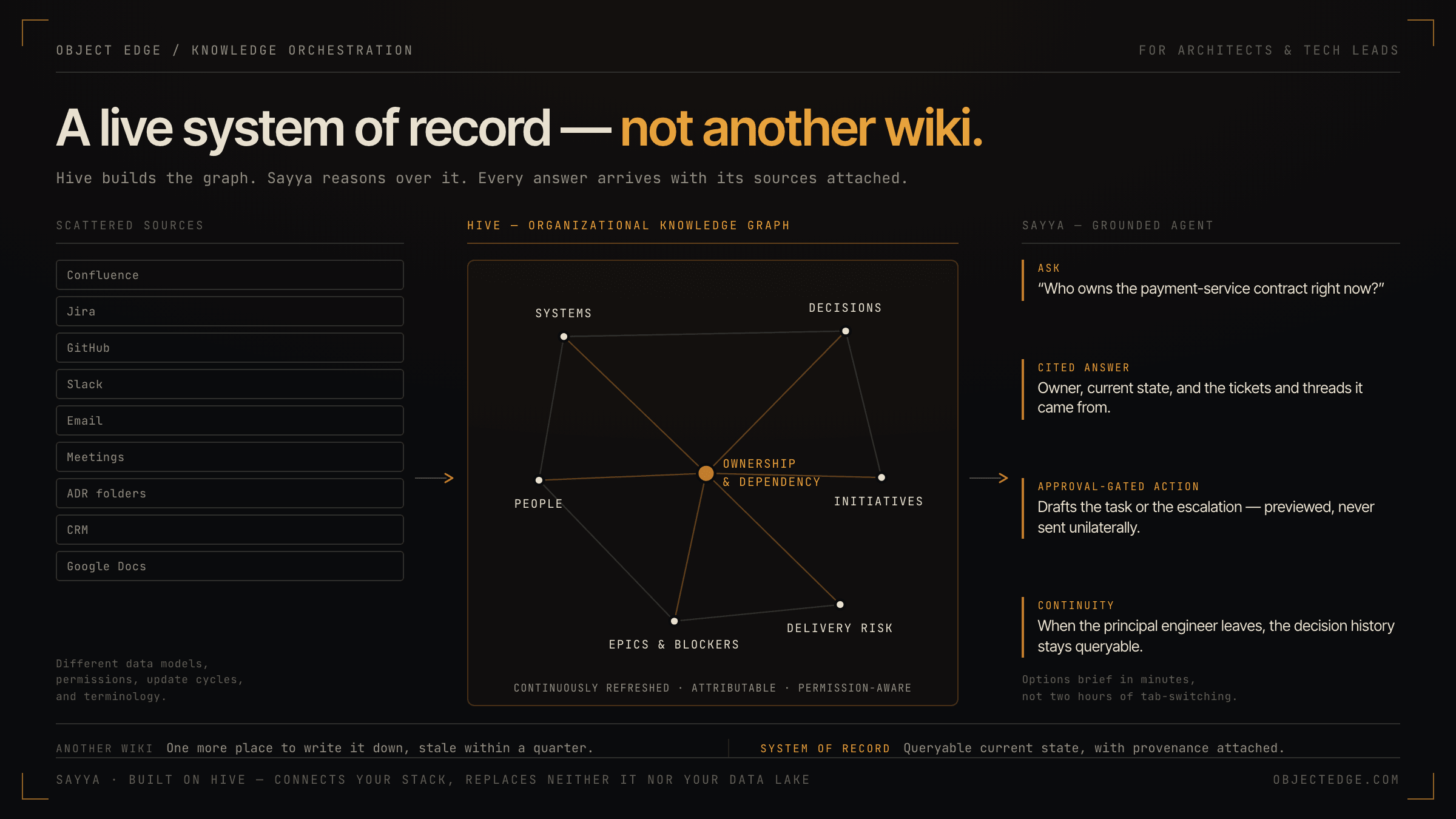
Diagram titled 'A live system of record — not another wiki' showing a three-stage flow. On the left, scattered sources — Confluence, Jira, GitHub, Slack, email, meetings, ADR folders, CRM and Google Docs — each with different data models, permissions, update cycles and terminology. An arrow leads to the centre: Hive, an organizational knowledge graph drawn as a node-link diagram whose hub is ownership and dependency, linked to systems, decisions, people, initiatives, epics and blockers, and delivery risk; the panel is labelled continuously refreshed, attributable, permission-aware. A second arrow leads to Sayya, the grounded agent, which takes a question ('Who owns the payment-service contract right now?'), returns a cited answer with the tickets and threads it came from, stages approval-gated actions that are previewed and never sent unilaterally, and preserves continuity so decision history stays queryable when a principal engineer leaves. A footer contrasts another wiki — one more place to write it down, stale within a quarter — against a system of record with queryable current state and provenance attached

How Hive and Sayya give architects and tech leads a live system of record—not another wiki

Hive builds a continuously refreshed organizational knowledge graph; Sayya is the grounded agent that queries it. Together they give solution architects and tech leads the decision context, dependency visibility, and controlled AI actions that scattered docs and tribal knowledge never could.
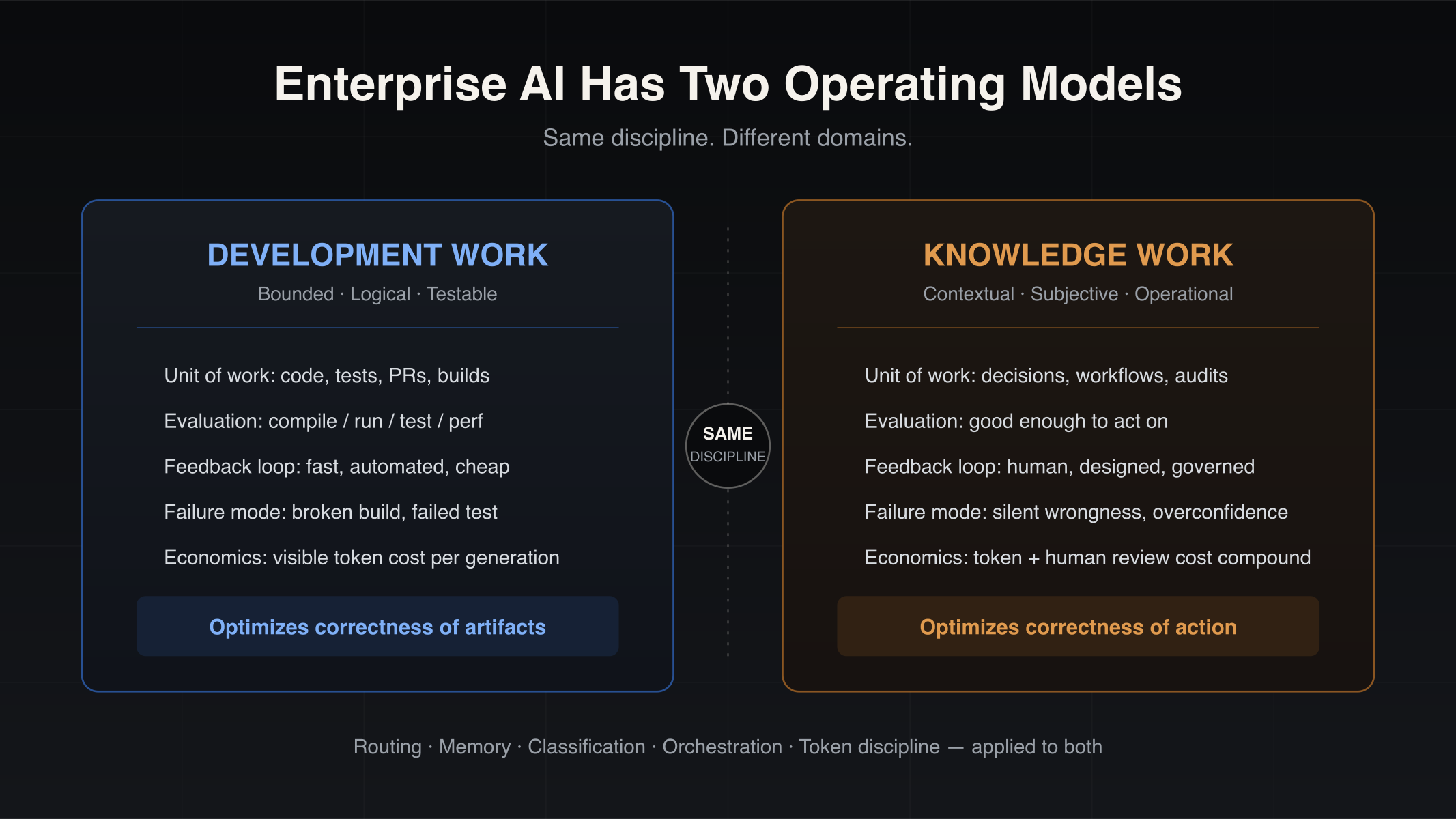
Diagram titled 'Enterprise AI Has Two Operating Models' comparing two panels: Development Work (bounded, logical, testable — code, tests, PRs, and builds evaluated by compile/run/test/perf with a fast automated feedback loop, optimizing correctness of artifacts) versus Knowledge Work (contextual, subjective, operational — decisions, workflows, and audits evaluated by 'good enough to act on' with a human, governed feedback loop, optimizing correctness of action), joined by a center badge reading 'Same Discipline' and a footer listing routing, memory, classification, orchestration, and token discipline as applied to both

Enterprise AI Has Two Operating Models: Development Work and Knowledge Work

Enterprise AI is splitting into two operating models — development work and knowledge work. Why coding-copilot playbooks stall on operational workflows, and which engineering disciplines transfer.

Laptop screen displaying lines of code

Jira-to-GitHub Issues Migration Using BMAD: Lessons from the Implementation

A practical account of migrating Jira tickets to GitHub Issues using BMAD, including lessons on planning, testing, user mapping, pagination, and content conversion.
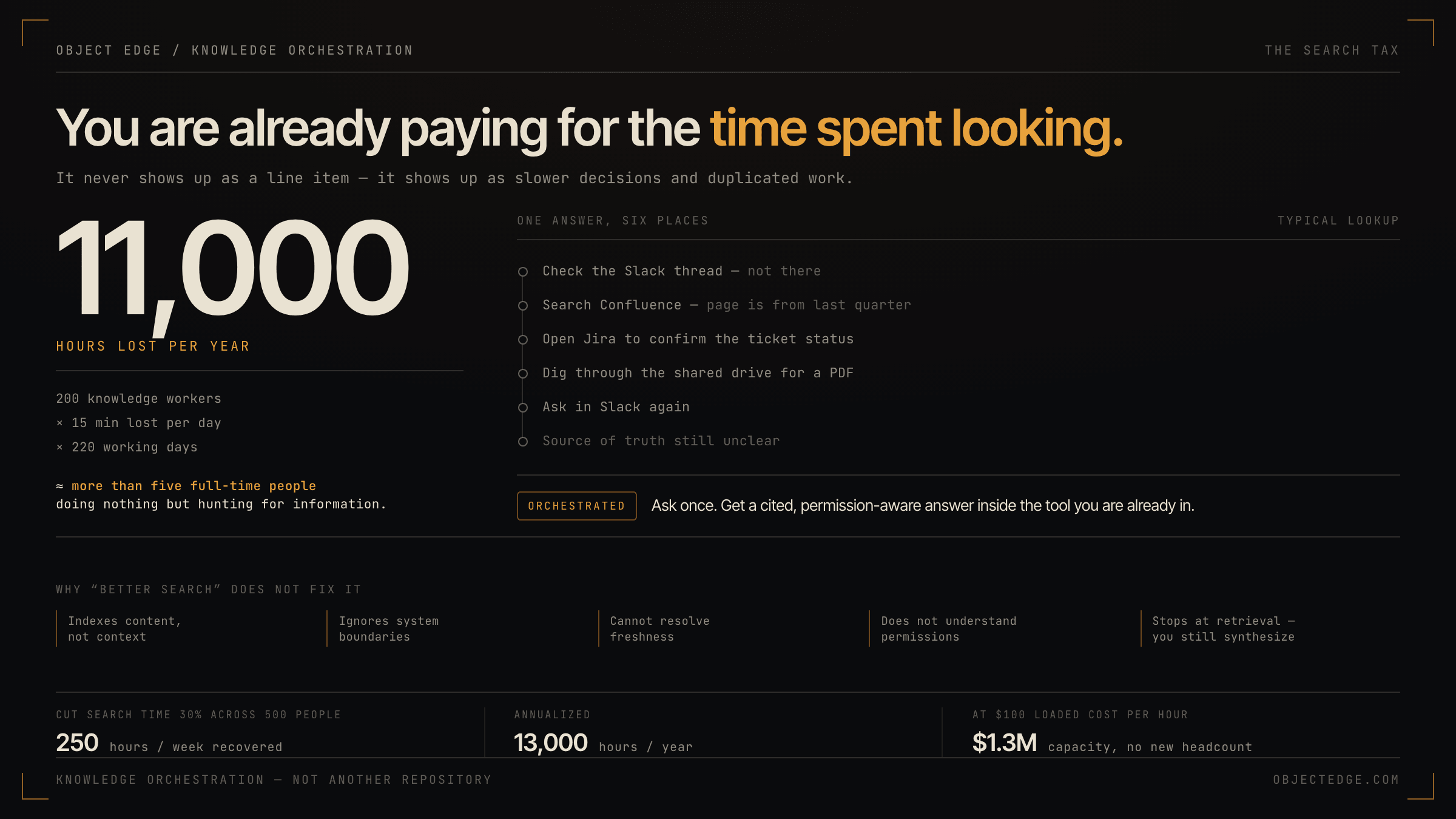
Diagram titled 'You are already paying for the time spent looking.' A hero figure of 11,000 hours lost per year is derived from 200 knowledge workers times 15 minutes lost per day times 220 working days — roughly more than five full-time people doing nothing but hunting for information. Beside it, a typical lookup is traced across six places: check the Slack thread (not there), search Confluence (page is from last quarter), open Jira to confirm ticket status, dig through the shared drive for a PDF, ask in Slack again, and still find the source of truth unclear; an orchestrated alternative asks once and returns a cited, permission-aware answer inside the tool the user is already in. A band explains why better search does not fix it — it indexes content not context, ignores system boundaries, cannot resolve freshness, does not understand permissions, and stops at retrieval. Three stat tiles show that cutting search time 30% across 500 people recovers 250 hours per week, 13,000 hours per year, or about $1.3M of capacity at $100 loaded cost per hour

Stop Losing Hours to Search: How Knowledge Orchestration Cuts Time Wasted Across Systems

Why teams burn hours hunting for answers across tools, and how knowledge orchestration reduces that friction for engineering and operations leaders.
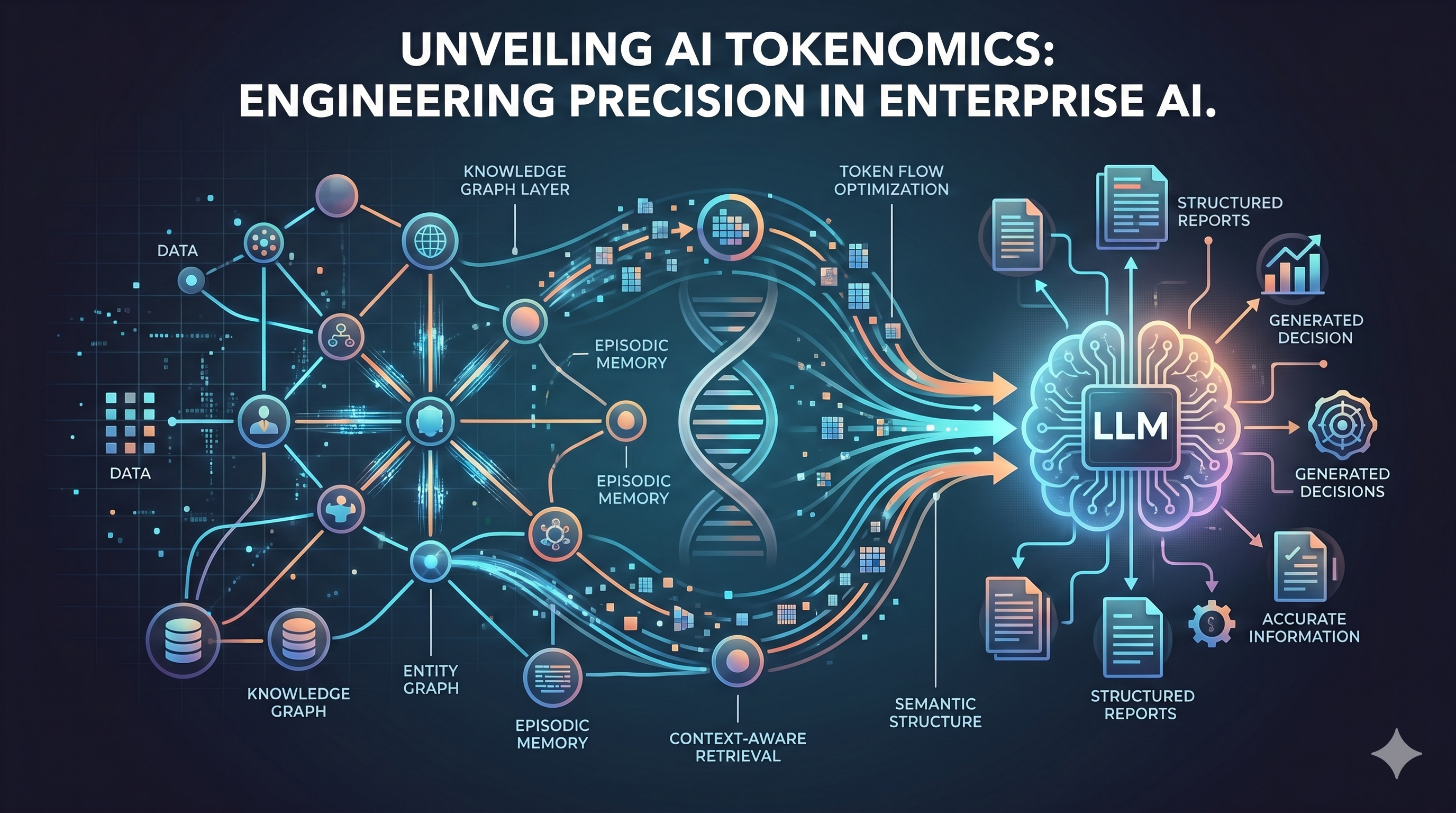
Diagram titled 'Unveiling AI Tokenomics: Engineering Precision in Enterprise AI' showing data sources flowing through a knowledge graph layer, entity graph, episodic memory, and context-aware retrieval into token-flow optimization and semantic structure, then into an LLM that produces structured reports, generated decisions, and accurate information

Tokenomics Is the New AI Efficiency Frontier — and Here's How We're Winning It

AI tokenomics is the discipline of managing token consumption at enterprise scale. Learn how semantic infrastructure, context-aware retrieval, and agent budgeting cut AI costs without sacrificing quality.
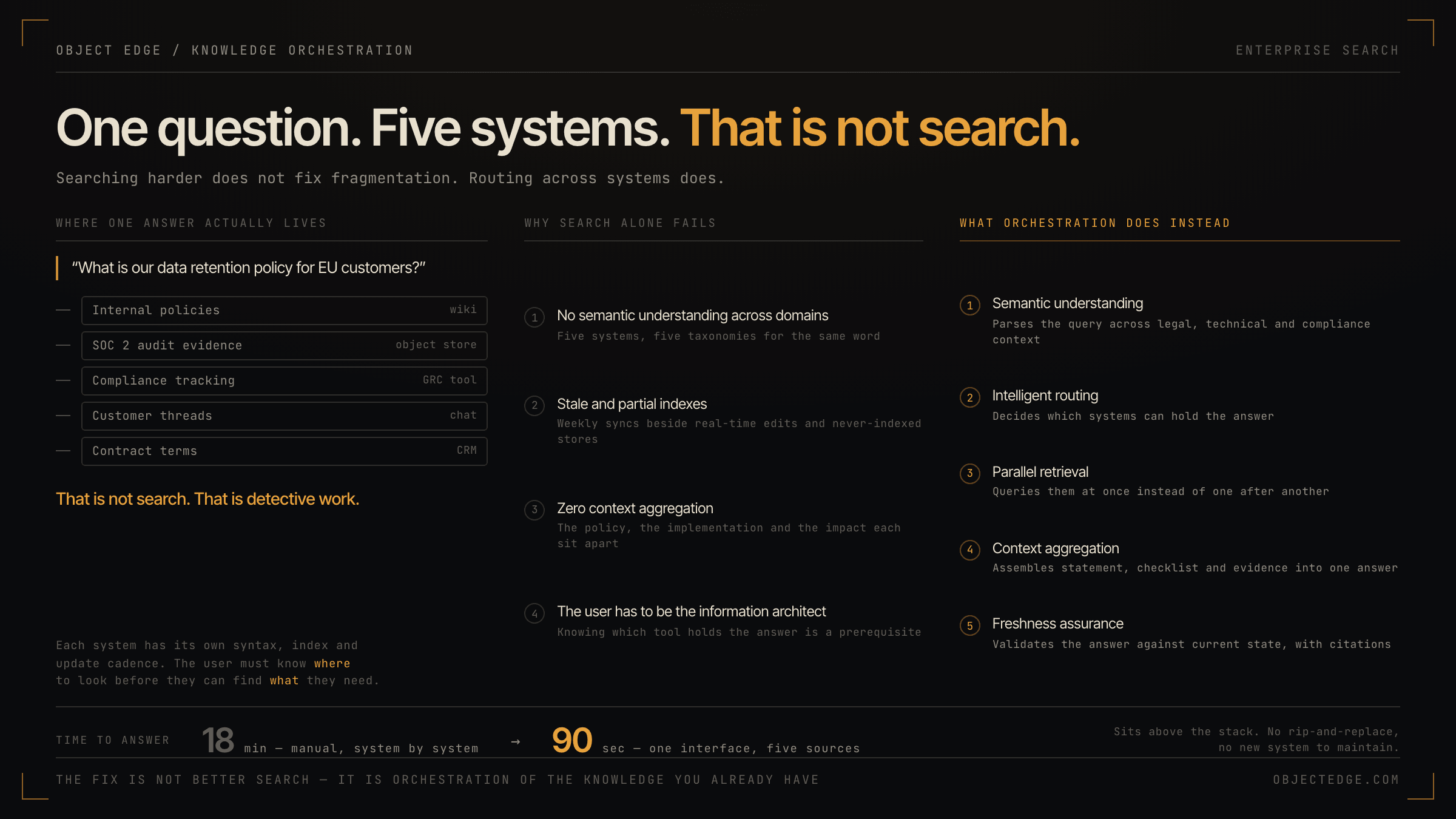
Diagram titled 'One question. Five systems. That is not search.' The left panel traces where a single answer actually lives — the question 'What is our data retention policy for EU customers?' resolves across internal policies in a wiki, SOC 2 audit evidence in an object store, compliance tracking in a GRC tool, customer threads in chat, and contract terms in the CRM — concluding that this is detective work, because each system has its own syntax, index and update cadence and the user must know where to look before they can find what they need. The middle panel lists four reasons search alone fails: no semantic understanding across domains, stale and partial indexes, zero context aggregation, and the user having to be the information architect. The right panel shows what orchestration does instead in five steps: semantic understanding, intelligent routing, parallel retrieval, context aggregation, and freshness assurance with citations. A footer compares time to answer — 18 minutes searching system by system against 90 seconds through one interface over five sources — and notes that the layer sits above the existing stack with no rip-and-replace

Why Knowledge Search Fails Inside Existing Tools — And What Actually Works

Most enterprise search tools waste 40% of user time. Here's why orchestration solves the real problem.

A dark blueprint-style background covered with faint engineering schematics, flow diagrams, and pinned notes. A single bright, clean beam of light enters from the left and fans out into dozens of diverging, tangled threads that spread and scatter across the right side — a visual metaphor for how one clear directive multiplies into many divergent, harder-to-align workstreams under AI-accelerated execution.

AI copilots make teams faster — and harder to manage

AI copilots increase output, but they also create a clarity tax that delivery leaders must solve to turn speed into accurate delivery.
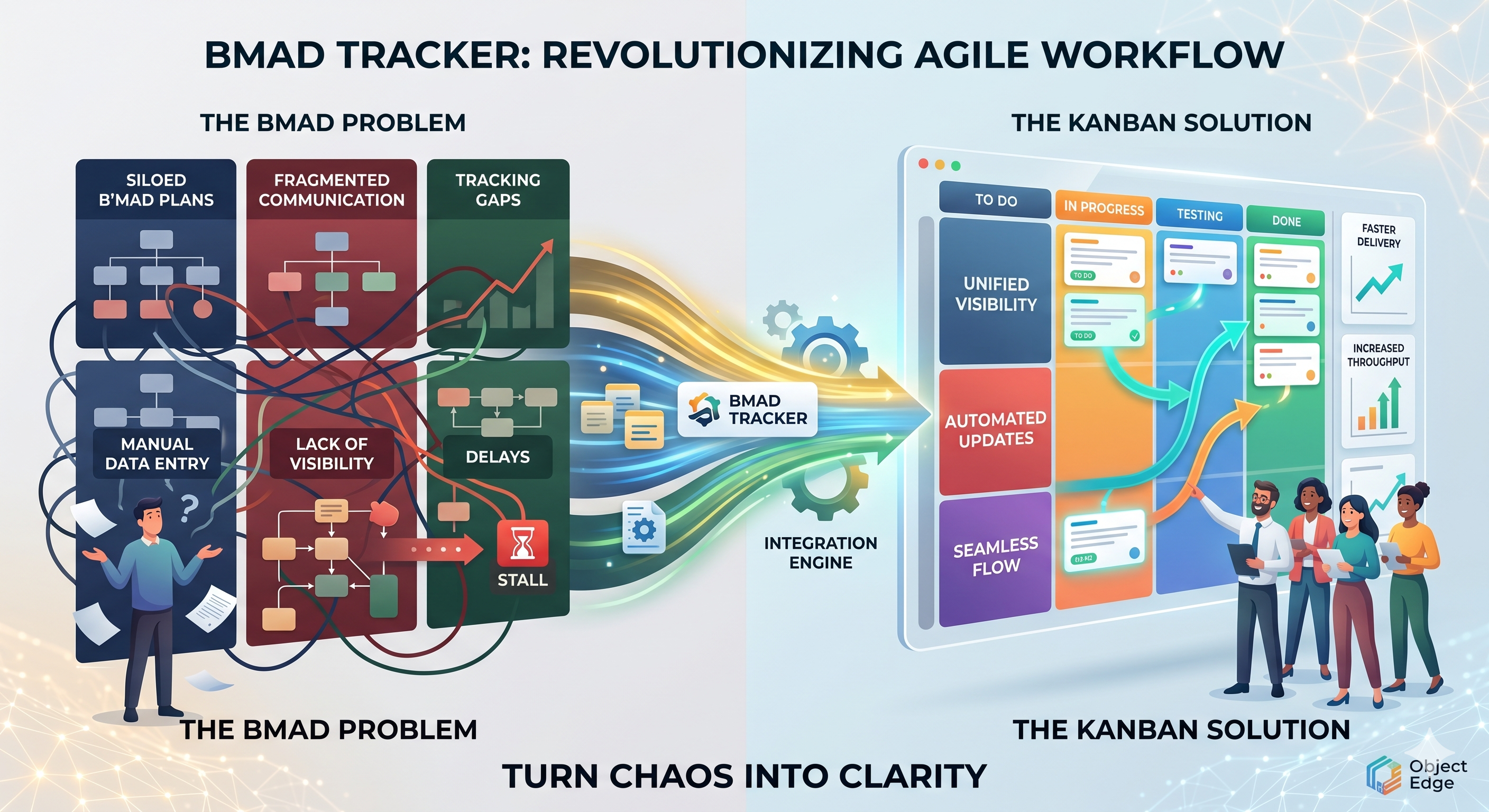
BMAD Tracker: Revolutionizing Agile Workflow — left side 'The BMAD Problem' shows siloed BMAD plans, fragmented communication, tracking gaps, manual data entry, lack of visibility, delays, and stalled work; right side 'The Kanban Solution' shows a Kanban board with To Do / In Progress / Testing / Done columns, unified visibility, automated updates, seamless flow, faster delivery, and increased throughput, connected by a BMAD Tracker integration engine

BMAD-Tracker: The Control Layer for BMAD-Based AI Software Delivery

How BMAD-Tracker operationalizes BMAD planning artifacts from GitHub into a Jira-style board, dashboard, and AI-assisted workflow for technical teams.
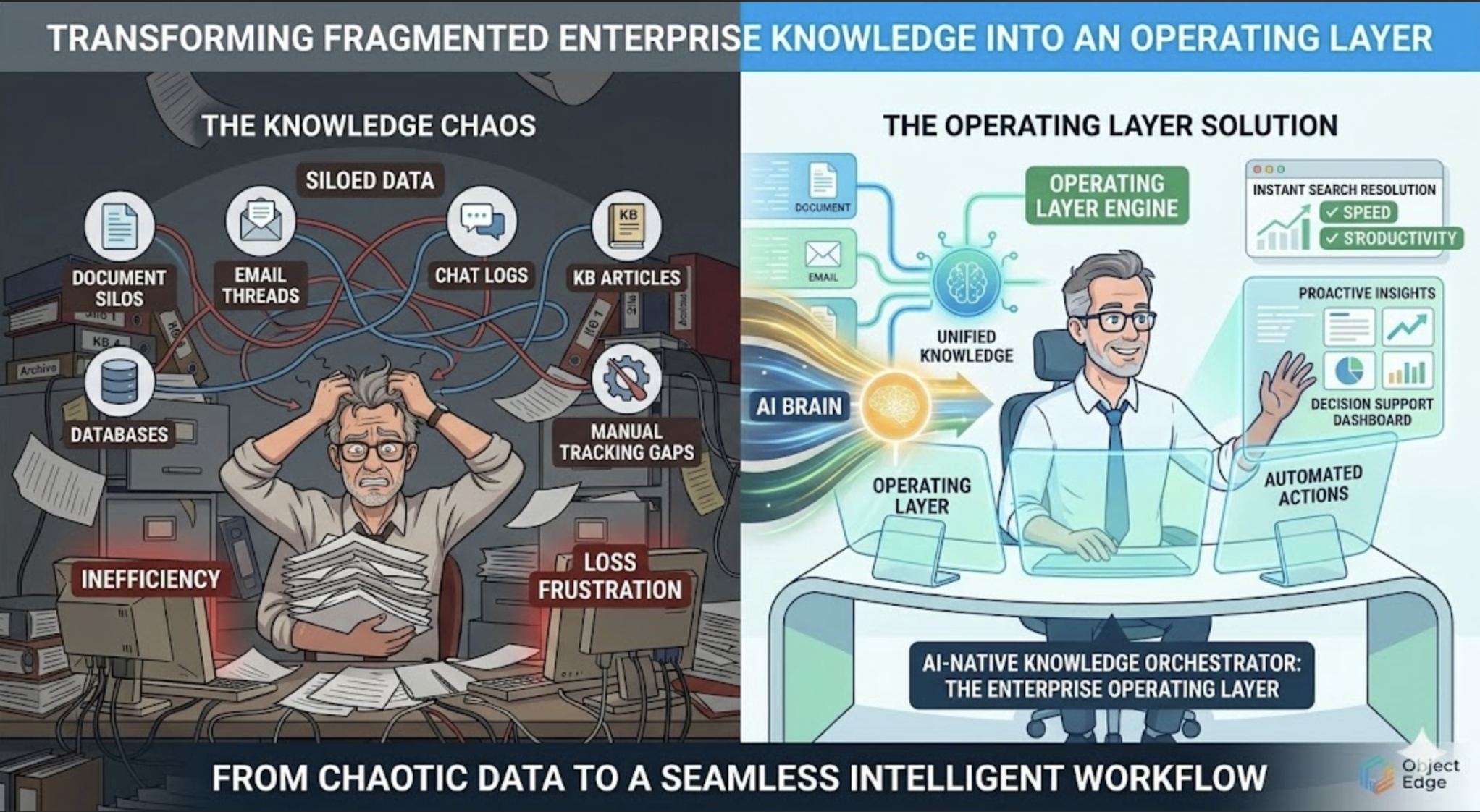
Transforming Fragmented Enterprise Knowledge Into an Operating Layer — left panel 'The Knowledge Chaos' shows a frustrated worker surrounded by document silos, email threads, chat logs, KB articles, and databases tangled in red and blue lines, with labels for siloed data, manual tracking gaps, inefficiency, and loss/frustration; right panel 'The Operating Layer Solution' shows a calm worker at a clean dashboard with an AI brain feeding into unified knowledge, instant search resolution (speed, productivity), proactive insights, decision support dashboard, and automated actions, captioned 'AI-Native Knowledge Orchestrator: The Enterprise Operating Layer — From Chaotic Data to a Seamless Intelligent Workflow'

Turn Fragmented Enterprise Knowledge Into an Operating Layer That Teams Can Actually Use

How enterprises unify scattered documents, systems, and tribal knowledge into a searchable, governed operating layer that improves speed, consistency, and decision-making.
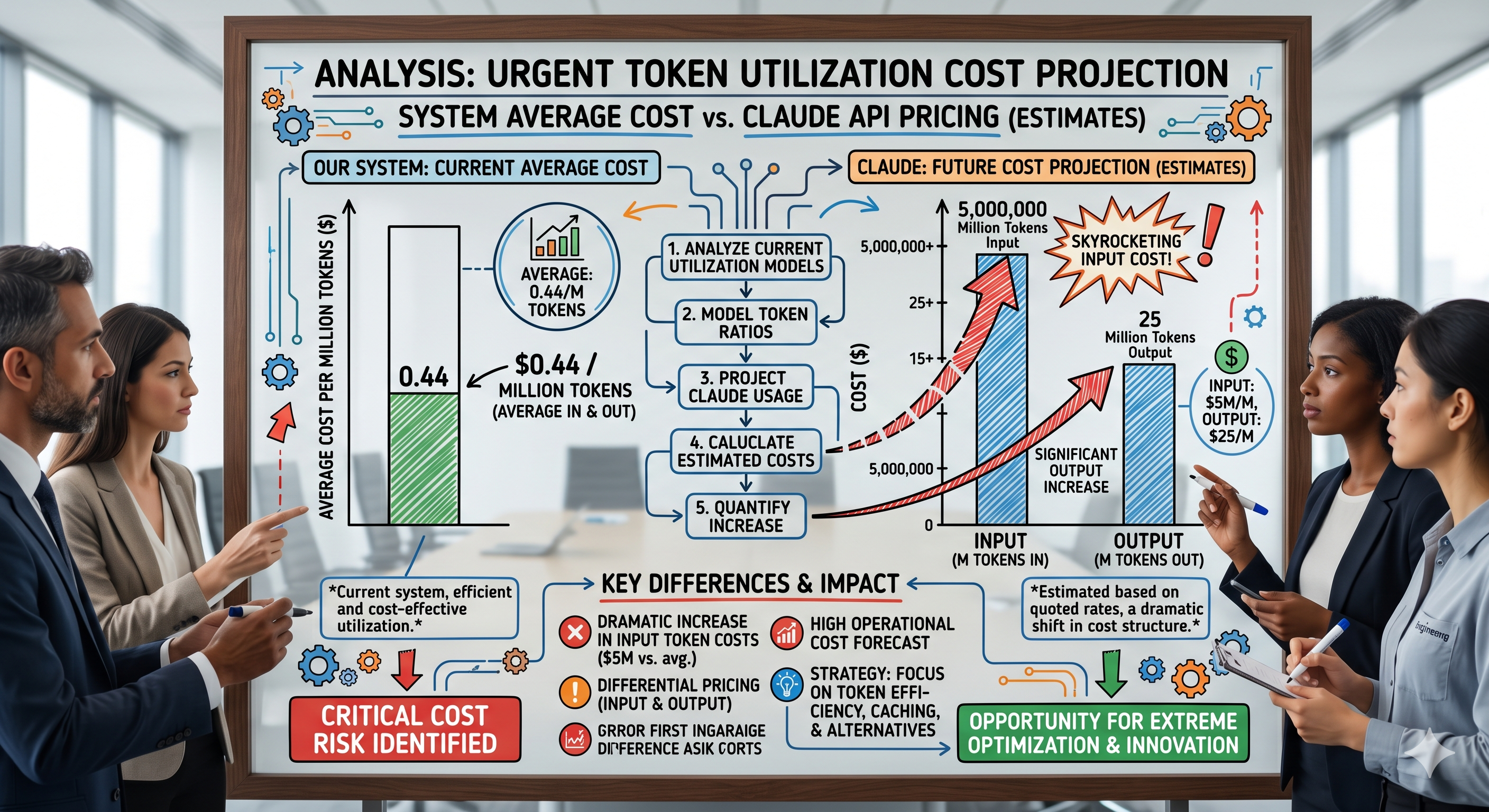
Whiteboard analysis of token utilization cost projections, comparing current system average cost per million tokens to future Claude API pricing estimates

The End of Subsidized Tokens Is Coming. Plan Accordingly.

The era of artificially cheap AI tokens is ending. Here is why token efficiency is becoming architecture, and how enterprises should plan a model portfolio strategy before prices spike.
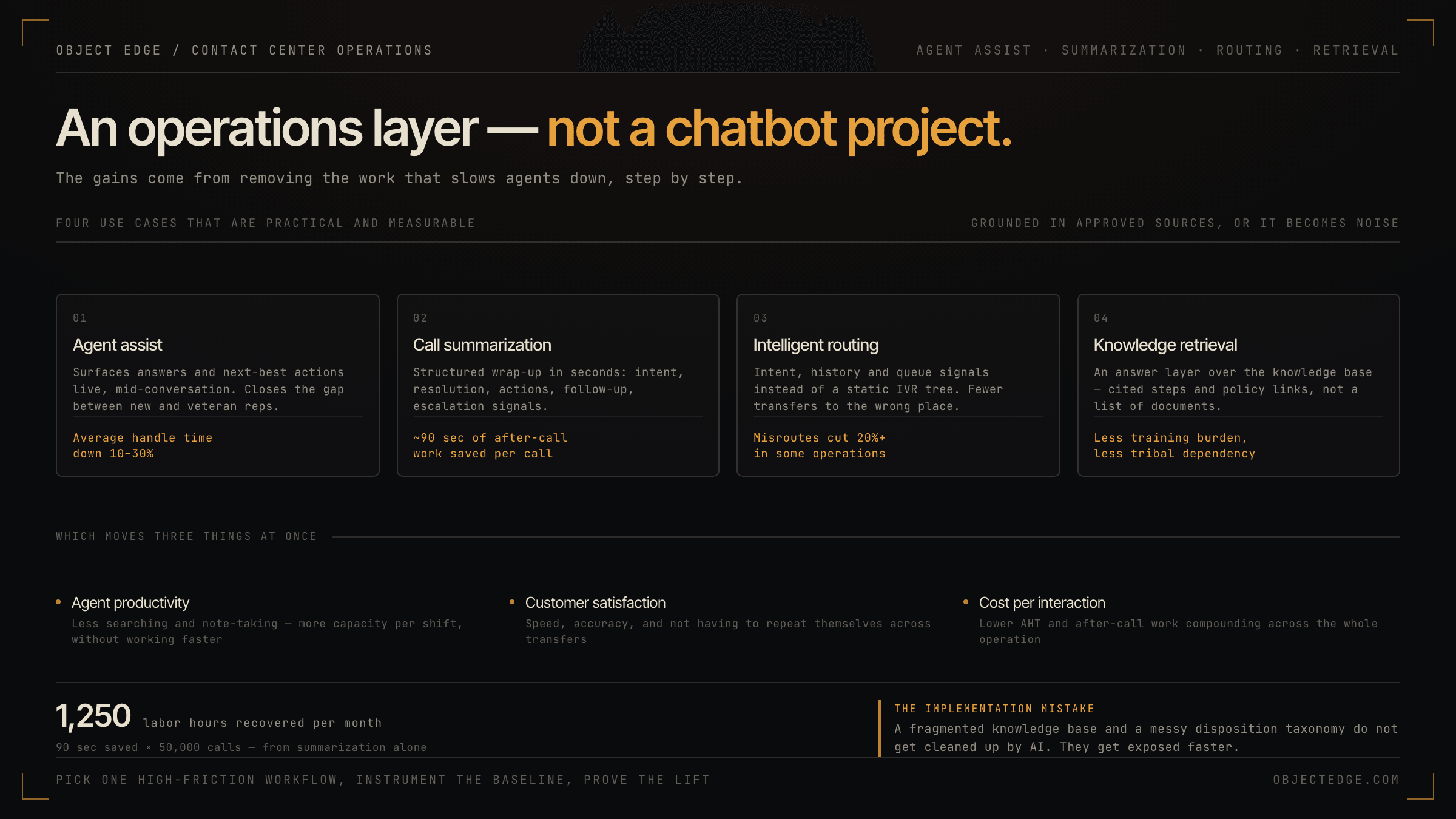
Diagram titled 'An operations layer — not a chatbot project.' Four use-case panels are shown, each with its measurable effect: agent assist, which surfaces answers and next-best actions mid-conversation and can bring average handle time down 10–30%; call summarization, which produces a structured wrap-up covering intent, resolution, actions, follow-up and escalation signals and saves roughly 90 seconds of after-call work per call; intelligent routing, which uses intent, history and queue signals instead of a static IVR tree and has cut misroutes by 20% or more in some operations; and knowledge retrieval, which acts as an answer layer with cited steps and policy links rather than a list of documents, reducing training burden and tribal dependency. Together these move three things at once — agent productivity, customer satisfaction, and cost per interaction. A footer notes that 90 seconds saved across 50,000 calls recovers about 1,250 labor hours per month from summarization alone, and warns that a fragmented knowledge base and messy disposition taxonomy are not cleaned up by AI but exposed faster

How AI Is Reshaping Contact Center Operations: Faster Agents, Better CSAT, Lower Cost

A practical look at how AI improves contact center productivity, customer satisfaction, and operational efficiency through agent assist, summarization, routing, and knowledge retrieval.
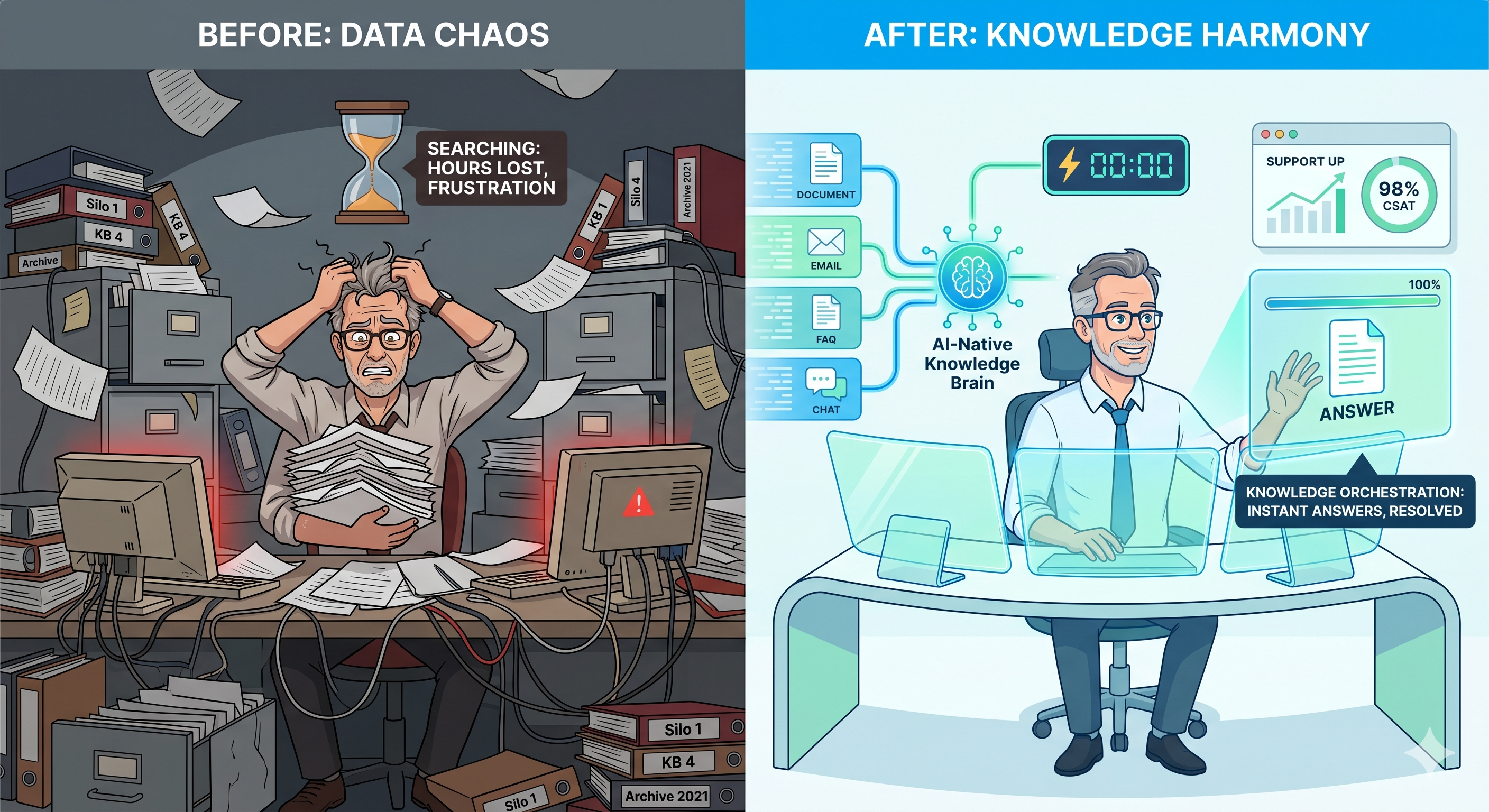
Side-by-side illustration contrasting 'Before: Data Chaos' — a frustrated worker buried in paperwork and silos — with 'After: Knowledge Harmony' — a calm worker using an AI-Native Knowledge Brain that unifies documents, email, FAQ, and chat into instant answers

AI-Native Knowledge Orchestration: Cut Search Time, Raise Support Accuracy, and Move Faster

How enterprise knowledge orchestration unifies fragmented content across Salesforce, SAP, Confluence, and email to improve search, support, and productivity.
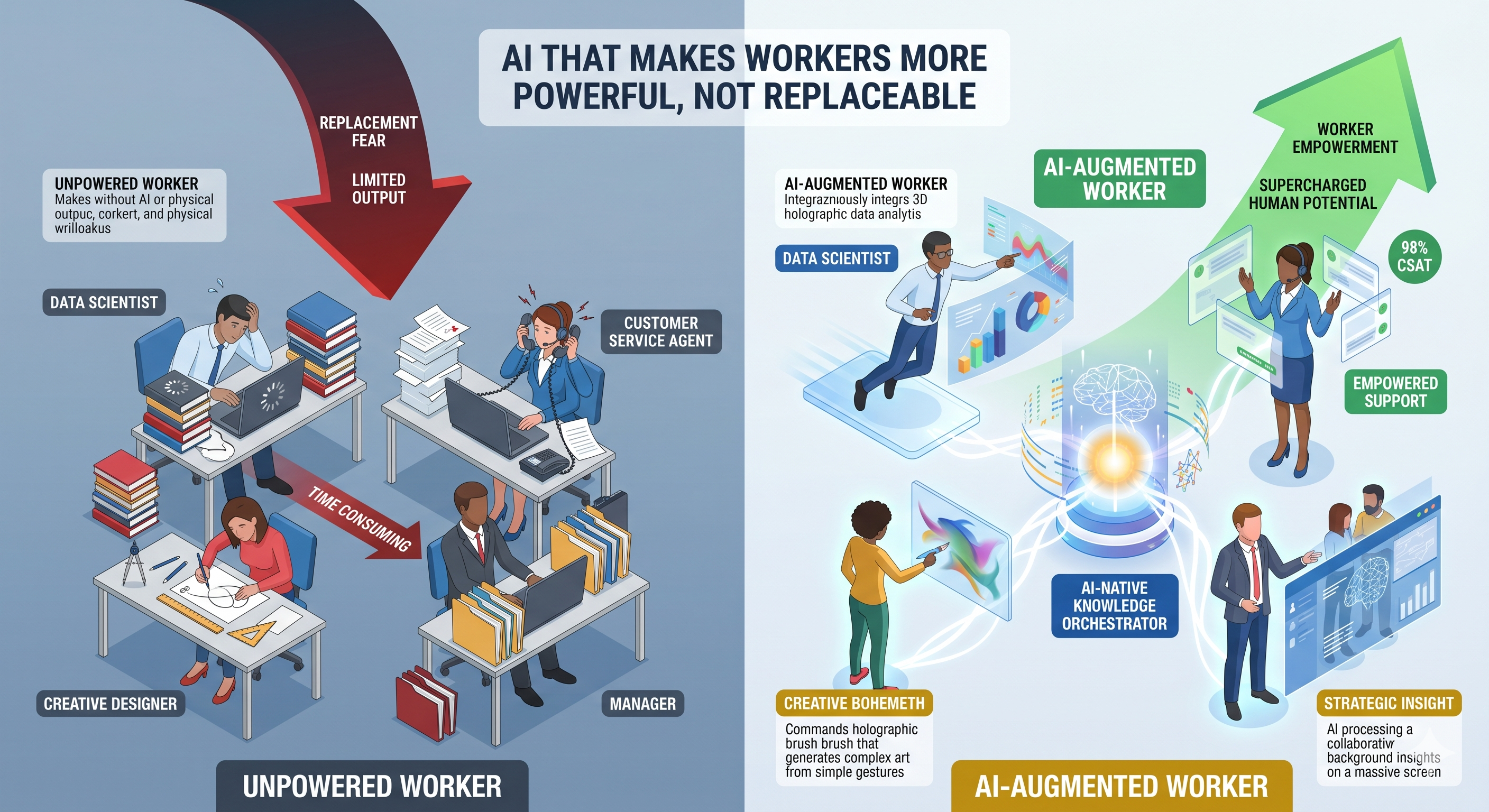
Side-by-side illustration contrasting an 'Unpowered Worker' panel — overwhelmed data scientist, customer service agent, creative designer, and manager buried in books and folders — with an 'AI-Augmented Worker' panel where the same roles are supercharged by an AI-Native Knowledge Orchestrator, with a green arrow showing worker empowerment

AI That Makes Workers More Powerful — Not Replaceable

Enterprise AI should 10x worker productivity and drive business growth, not eliminate jobs.
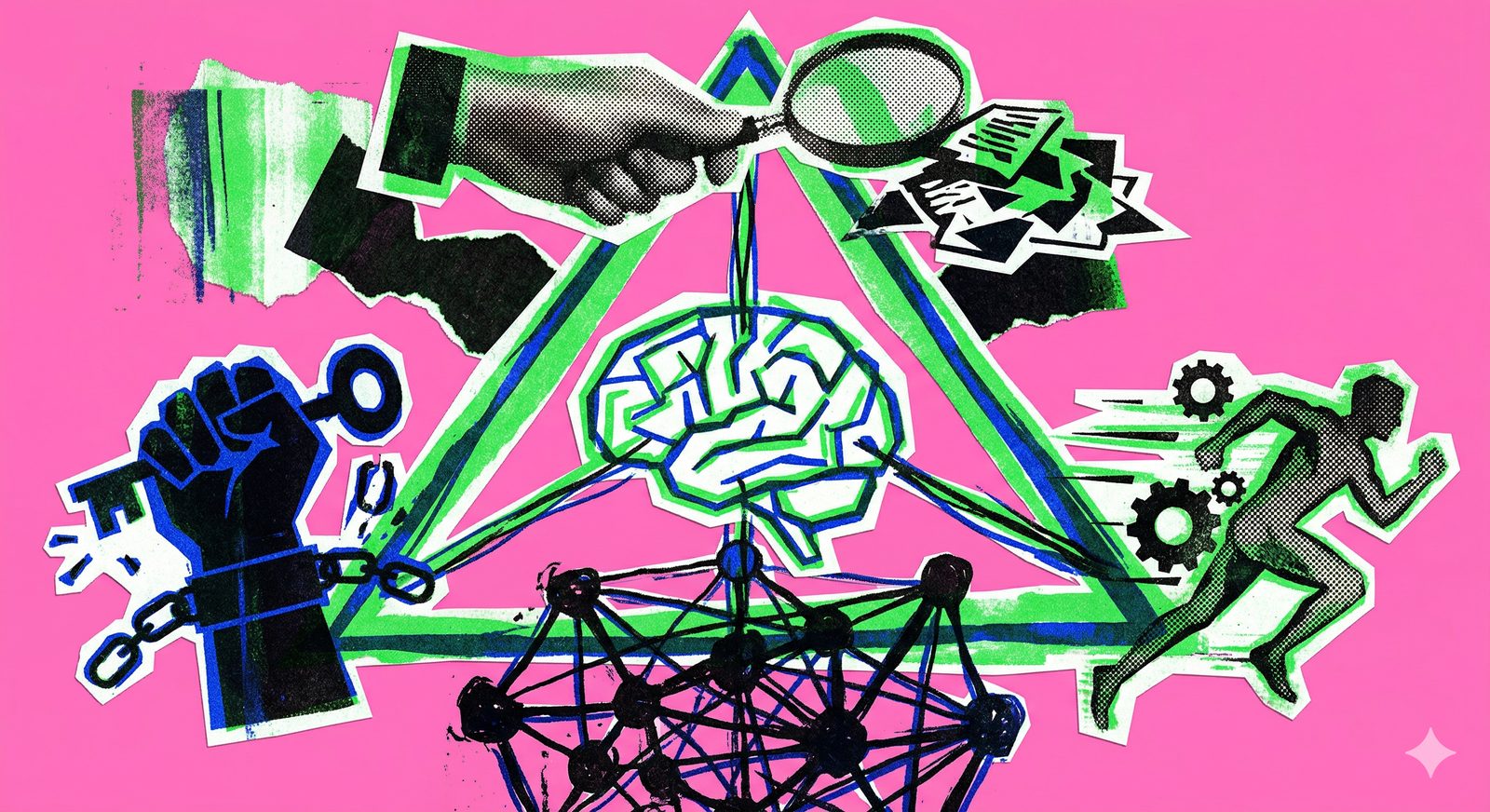
Architectural diagram of an agentic harness development process

Developing Agentic Harnesses

Notes from building three agent architectures for the same product — the tradeoffs between right answers, right security, and right performance, and why the foundational rule is never let the agent lie.

AI as a force multiplier for enterprise workforce potential

AI's Highest-Leverage Use Case: Multiplying Human Potential, Not Replacing It

AI delivers the biggest enterprise returns when it amplifies every worker’s decision quality and execution speed—embedding intelligence directly into the flow of work.