ai
How Hive and Sayya give architects and tech leads a live system of record—not another wiki
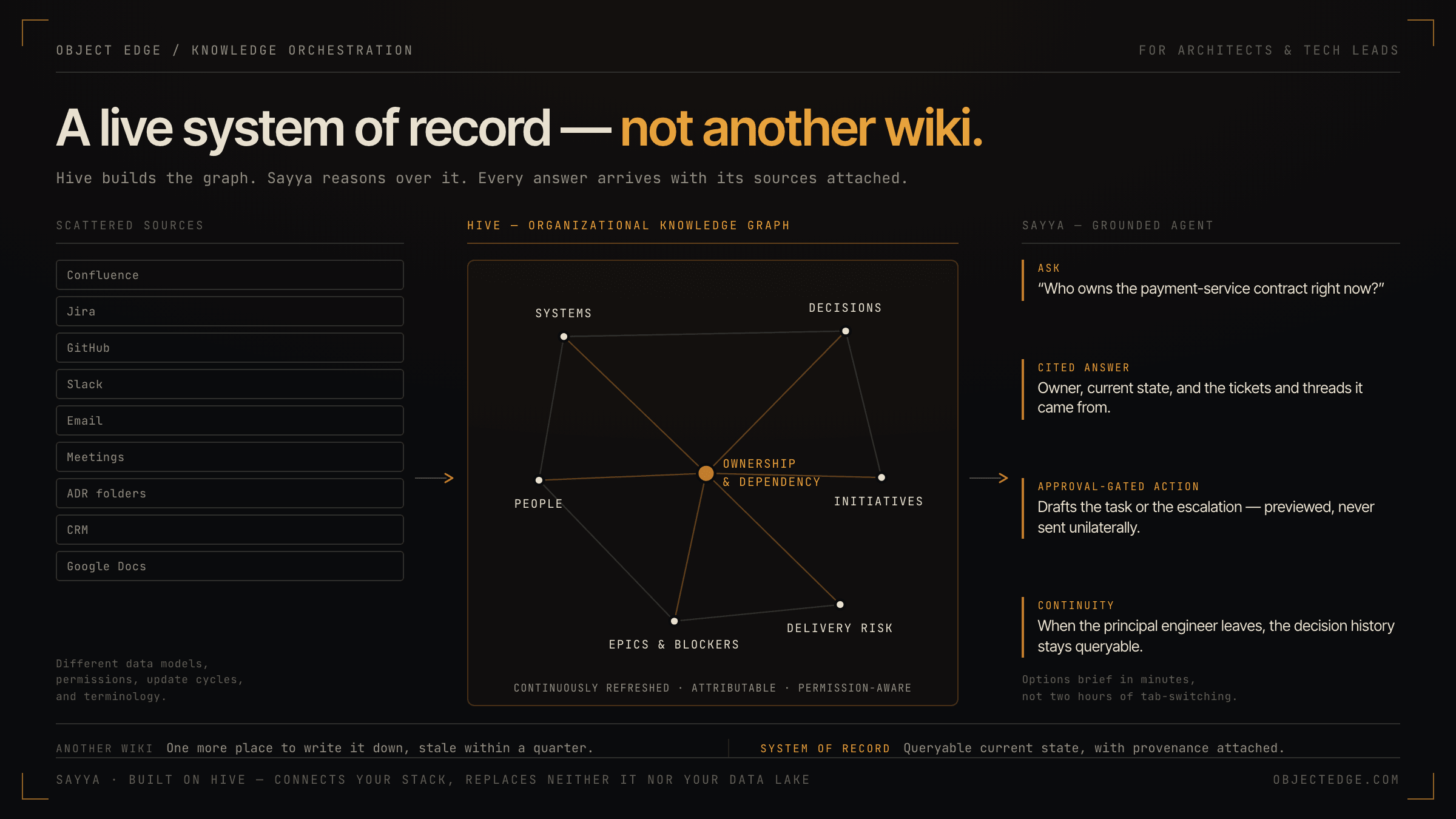
Architects and tech leads own the integrity of the system. Boundaries, dependencies, non-functionals, delivery risk—it all lands on your desk. But the “source of truth” you are supposed to reason from is scattered across Confluence spaces, ADR folders, Jira epics, GitHub projects, Slack threads, and the working memory of three people who left last quarter.
That is not a documentation problem. It is a structural one. And dropping another wiki on top of it does not solve it.
Hive and Sayya were built for this specific seat. Hive is an enterprise knowledge graph and semantic intelligence layer that unifies structured and unstructured work signals—without replacing your data lake or ripping out your toolchain. Sayya is the grounded conversational agent that reasons over that graph, holds context across a session, and moves from question to recommendation to approval-gated action. Together they function as the control plane for technical decisions and system context that architecture and delivery leadership have never actually had.
The real bottleneck is not design tools
Most architecture tooling optimizes drawing and documentation. Lucidchart gives you a diagram. Confluence gives you a page. Neither tells you who actually owns the checkout service today, which open decision is blocking the event-bus migration, or whether the dependency your team just took on is also blocking two other squads.
The bottleneck for senior technical leaders is fragmented context, not a lack of diagrams. Specifically:
- Decision amnesia. ADRs get written once and become PDFs. The options considered, the people who signed off, the follow-through tasks—gone within a quarter.
- Dependency blindness. Cross-team friction surfaces in retros, not sprint planning. By the time you see it, it has already slipped the date.
- Tribal knowledge. When a principal engineer leaves, the mental model of how five systems actually talk to each other walks out with them.
- Ungrounded AI. Generic copilots answer from the internet, not from your systems, your decisions, or your delivery state. That is a liability in architecture review, not an accelerant.
Hive addresses the root cause by building a continuously refreshed knowledge graph of the entities and relationships that matter: systems, platforms, projects, epics, people, decisions, initiatives. It ingests from email, chat, meetings, Confluence, Google Docs, Jira, GitHub, CRM, and other systems of record—and surfaces attributable, cited signal rather than averaging it away. It does not replace your analytical data lake. It is the business-semantic and agent layer that sits above it.
What changes when you have a live organizational graph
1. A living architecture map with provenance
Instead of a stale diagram that reflects the system as it was designed eighteen months ago, you can query ownership, dependencies, and current delivery state from a single interface—with citations back to the tasks, docs, and conversations that support each answer. “Who owns the payment-service API contract right now?” is a one-second query, not a thirty-minute Slack thread.
2. Decisions that stay operational
In Hive, decisions are first-class entities linked to the systems, people, and work items they govern. A pending architectural decision shows up as pending—with its options, its owner, and the downstream work waiting on it. ADRs stop being PDF graveyards and become active nodes in the graph.
3. Design-review prep in minutes, not hours
Sayya can assemble a one-page options brief by pulling the relevant ADRs, the current system inventory, open delivery risks, and prior client or stakeholder signals—in a single multi-hop query. What previously took two hours of cross-system tab-switching takes minutes and arrives with sources attached.
4. Early delivery and dependency risk visibility
Stuck work, overdue epics, and cross-team friction patterns are visible before they become escalations. Sayya can draft a risk summary or an escalation message—but it presents it for human review and approval before anything is sent. No unsupervised action on your delivery state.
5. Grounded AI that complements SDLC automation
Roughly 70% of software delivery is not coding—it is requirements clarity, ownership alignment, decision context, and coordination. SDLC automation tools are increasingly capable of the coding layer. What they need to be useful—and safe—is grounded organizational context: which requirements are still open, who owns which component, what decisions have already been made and why. Hive provides that shared semantic context. Sayya surfaces it on demand. This is not vibe-coded architecture; it is AI with a documented reasoning chain.
6. Onboarding and continuity without heroics
When a senior engineer leaves, their decision history and active work links stay in the graph. A new tech lead can query what decisions were made on a given system, who was involved, and what work is currently live against it—without needing a three-week knowledge transfer from someone who may no longer be available.
7. Actions with control—not autonomous chaos
Sayya can stage external actions: drafting an email, creating a Jira task, updating a calendar item, logging a CRM note. Every action is previewed and requires explicit human approval before execution. The agent does not act unilaterally on your systems.
A day in the life
Tech lead, morning standup prep. “What is currently blocking the checkout epic, who owns the blockers, and have we been here before?” Sayya returns a cited summary—Jira ticket links, the Slack thread where the blocker was first raised, and the prior sprint where a related issue was resolved and how.
Solution architect, midday. “Draft a one-page options brief for the event-bus migration: relevant ADRs, current integration inventory, and top delivery risks.” Sayya assembles the brief in minutes from graph nodes across Confluence, GitHub, and Jira. The architect edits; the document is grounded.
Before an executive design board. “Summarize open technical decisions, active delivery risks, and any recent client signals relevant to the platform modernization initiative.” Sayya produces a structured briefing with provenance. Time to prep drops from two hours to twenty minutes.
End of day. “Create follow-up tasks for the three open items from today’s design review and draft the meeting notes.” Sayya stages both—preview only, pending approval—so the architect reviews before anything is written to Jira or sent.
Fit with your existing stack
| Layer | What you have today | How Hive and Sayya fit |
|---|---|---|
| Work tracking | Jira, GitHub, Linear | Graph-linked tasks, epics, blockers, owners |
| Documentation | Confluence, Google Docs, markdown ADRs | Decision and context nodes with live linkage |
| Communication | Slack, email, meeting transcripts | Attributable signal surfaced by entity, not keyword |
| Client and portfolio | CRM, portfolio tools | Initiative and constraint context for architecture decisions |
| Analytics | Data warehouse, data lake | Unchanged—Hive is the business-semantic and agent layer above it |
Hive does not rip and replace. It connects.
Outcomes that matter to architecture and delivery leadership
| Outcome | Before | With Hive + Sayya |
|---|---|---|
| Time to decision brief | 1–3 hours of cross-system research | Minutes, with citations |
| Late dependency surprises | Surfaced in retros and post-mortems | Visible in graph before they slip dates |
| Decision continuity | Walks out with senior engineers | Persists in graph; queryable by anyone with access |
| AI adoption safety | Generic answers, no grounding, liability | Answers cited to org data; actions approval-gated |
| Status theater | Recurring sync meetings to reconstruct state | Replaced by on-demand graph queries |
Getting started
- Connect your systems. Jira, Confluence, Slack, email, GitHub, CRM—whichever represent your highest-friction knowledge sources.
- Build a core knowledge pack. Hive constructs entity dossiers and relationship graphs from the connected sources.
- Pilot with architects and tech leads. Start with the questions that currently require the most cross-system reconstruction—ownership queries, open decision summaries, dependency risk reviews.
- Measure. Track time-to-brief, decision cycle time, and escaped dependency incidents against your pre-pilot baseline.
- Expand. Add packs for additional initiatives, teams, or domains. Layer in approval-gated automations as trust in the graph matures.
Hive externalizes organizational memory. Sayya makes it usable—ask a question, get a cited answer, move to a recommendation, take an approved action. For architects and tech leads carrying the weight of system integrity across fragmented sources and rotating teams, that is not a productivity feature. It is the control plane that should have existed years ago.
If your architecture practice is running on reconstructed reality, it is worth a conversation. Explore knowledge orchestration at Object Edge →
Related articles
-
ai
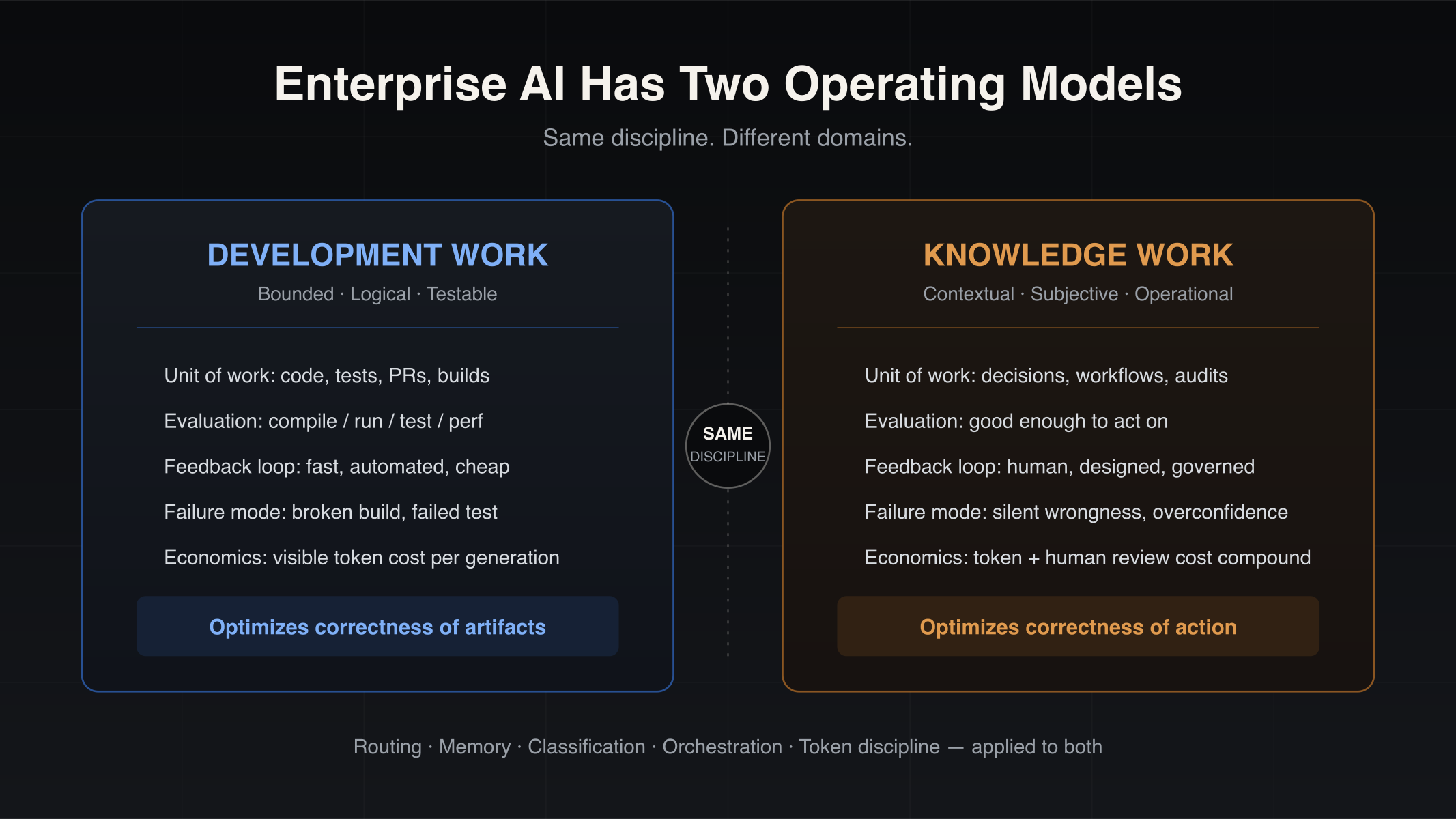
Enterprise AI Has Two Operating Models: Development Work and Knowledge Work
Enterprise AI is splitting into two operating models — development work and knowledge work. Why coding-copilot playbooks stall on operational workflows, and which engineering disciplines transfer.
-
ai
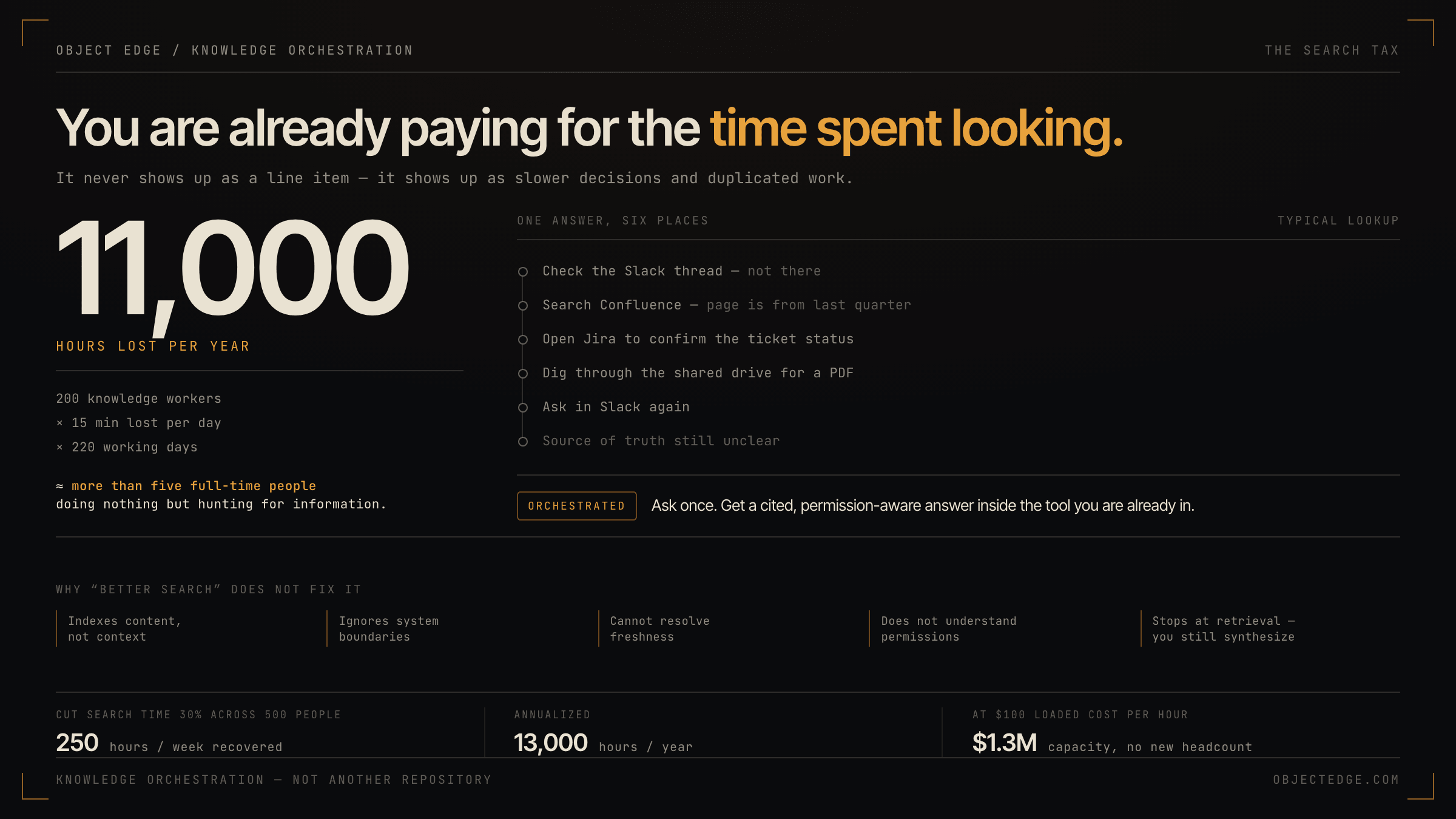
Stop Losing Hours to Search: How Knowledge Orchestration Cuts Time Wasted Across Systems
Why teams burn hours hunting for answers across tools, and how knowledge orchestration reduces that friction for engineering and operations leaders.
-
ai
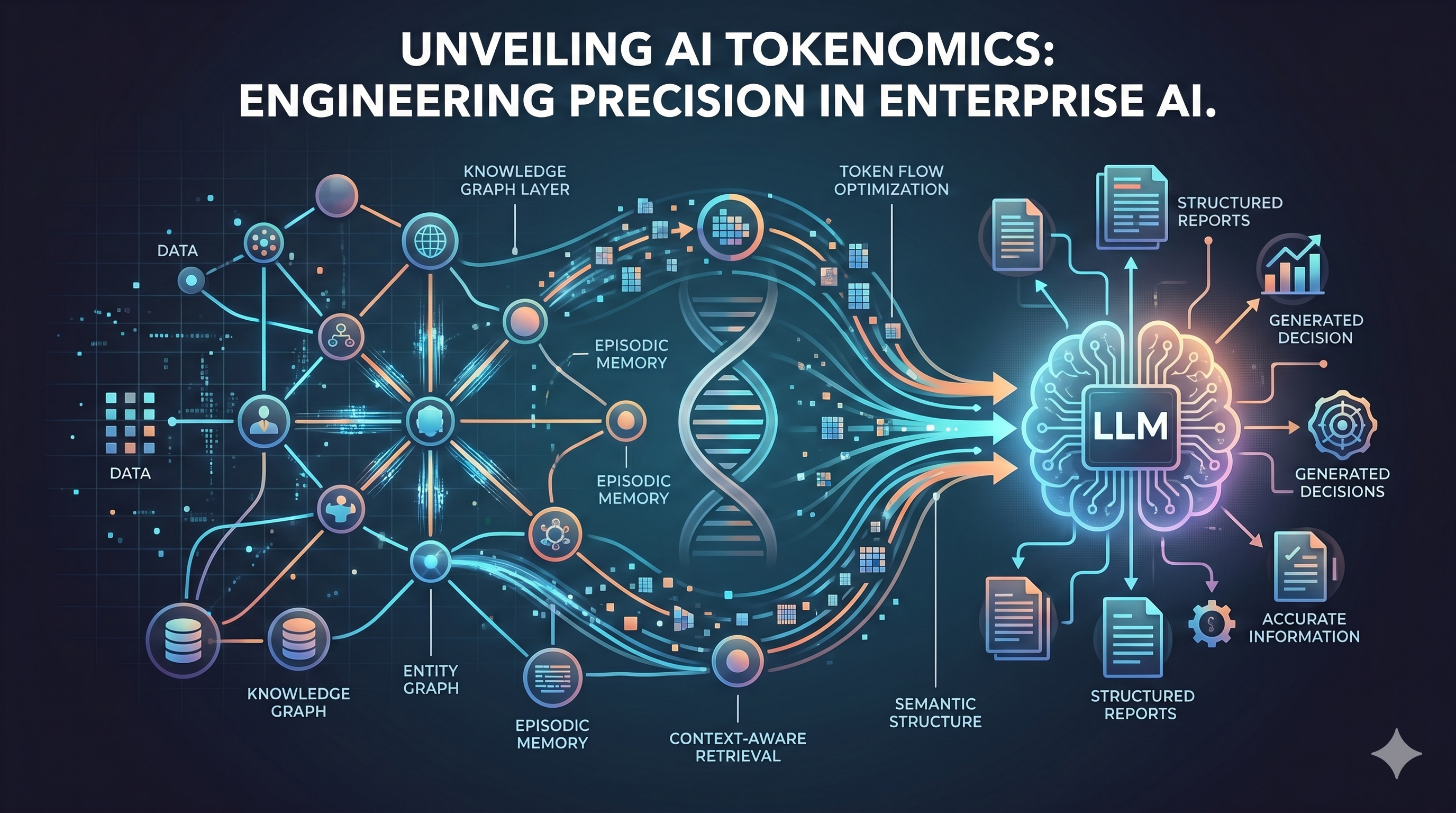
Tokenomics Is the New AI Efficiency Frontier — and Here's How We're Winning It
AI tokenomics is the discipline of managing token consumption at enterprise scale. Learn how semantic infrastructure, context-aware retrieval, and agent budgeting cut AI costs without sacrificing quality.