ai
OpenClaw, Grok Bot, and the Open-Source Assistant Wave Are Not the Shift — the Company Brain Underneath Is
I run Claude, ChatGPT, Grok, OpenClaw, and Grok Bot extensively. All on private keys, so my data stays secure. And here is what I have learned after months of daily use across five different agentic platforms: the assistant is not the thing. The assistant is the wallpaper. The thing — the durable, compounding asset — is the layer underneath that remembers everything every assistant has ever done.
OpenClaw 2.0 launched to a wave of well-deserved excitement. Grok Bot made waves for different reasons. Both are impressive pieces of engineering. Both are also, on their own, a trap.
The trap is subtle because the assistants are genuinely useful. They write code, summarize documents, draft communications, analyze data. You start with one, it works, you feed it more context, it works better, and then — without noticing — you have built your workflow inside that assistant’s context window. Your project history lives in Claude’s artifacts. Your meeting notes live in ChatGPT’s memory. Your code review decisions live in Grok’s thread. Your automated tasks live in OpenClaw’s configurations. You have, in effect, distributed your company’s institutional knowledge across five different silos, each one accessible only through its own interface, each one invisible to the others.
That is not a brain. That is a collection of clever interns, each with their own notebook, none of whom have ever met.
The real unlock is Hive sitting underneath every agentic harness. Hive is the layer that gives every agent — whether it is Claude, ChatGPT, Grok, OpenClaw, Grok Bot, or whatever launches next month — access to the same context. The same project history. The same company integrations. The same memory of every decision, every document, every conversation that has ever happened across every other agent.
Here is what that looks like in practice. You ask Claude to draft a product requirements document. Hive is there, underneath, feeding Claude the context of the last three design discussions, the customer feedback from last week’s support tickets, and the engineering constraints from the previous sprint retrospective. Then you switch to Grok to analyze the competitive landscape. Grok does not start from a blank page — it already knows about the PRD you just drafted, the features you are evaluating, the timeline you are working against. Then you fire up OpenClaw to automate a workflow. OpenClaw knows about the PRD and the competitive analysis because Hive is the common substrate. You switch agents without switching context, because every agent has the context of every other agent plus company integrations.
That last part matters more than it sounds. Company integrations. Not just chat history — actual, live connections to your CRM, your project management tool, your code repository, your customer support platform, your internal documentation. Hive is not merely a shared memory bank; it is the connective tissue between your agents and your actual business systems.
The difference is visible the first week, but compounding every week after. Without Hive, every agent switch is a context reset. You re-explain the project. You re-paste the requirements. You re-establish the constraints. You lose the trail. With Hive, the trail is the system. The context persists across agents, across sessions, across weeks. The knowledge compounds instead of evaporating.
Builders should build their own layer on top of open agents. The open-source assistant wave is a gift — it means you are not locked into any single vendor’s assistant. But that gift is wasted if you simply hop from assistant to assistant, carrying your context in your head and your clipboard. The real move is to treat open agents as interchangeable front-ends and build your own durable layer underneath them. Your own Hive. Your own company brain.
Because here is the hard truth: if switching agents means losing the trail, you do not have a brain. You have a clever intern with no notebook. Smart, capable, helpful — and completely amnesiac every time you walk away.
Founders and engineering leaders evaluating AI assistants need to stop asking “Which assistant is best?” and start asking “Which layer makes my assistants cumulative instead of disposable?” The assistant landscape will keep shifting. OpenClaw 2.0 will be replaced by OpenClaw 3.0. Grok Bot will evolve. New players will enter. The companies that win will not be the ones who picked the best assistant in any given quarter. They will be the ones who built an assistant-agnostic layer that captures every interaction, connects every integration, and turns every agent — regardless of vendor — into a front-end for the same shared intelligence.
That layer is the company brain. That layer is the paradigm shift. The assistants are just the interface.
The open-source wave did not change the fundamental problem — it made the problem more visible. When assistants were proprietary and scarce, the silo problem was hidden. Now that assistants are open and abundant, the silo problem is impossible to ignore. You can switch between five different assistants in a single afternoon. But unless you have something underneath them, you are switching between five different amnesiacs.
Build the layer. Keep the trail. Turn your assistants into a brain.
(Hive is a platform we build, so weigh my enthusiasm accordingly.)
Related articles
-
ai
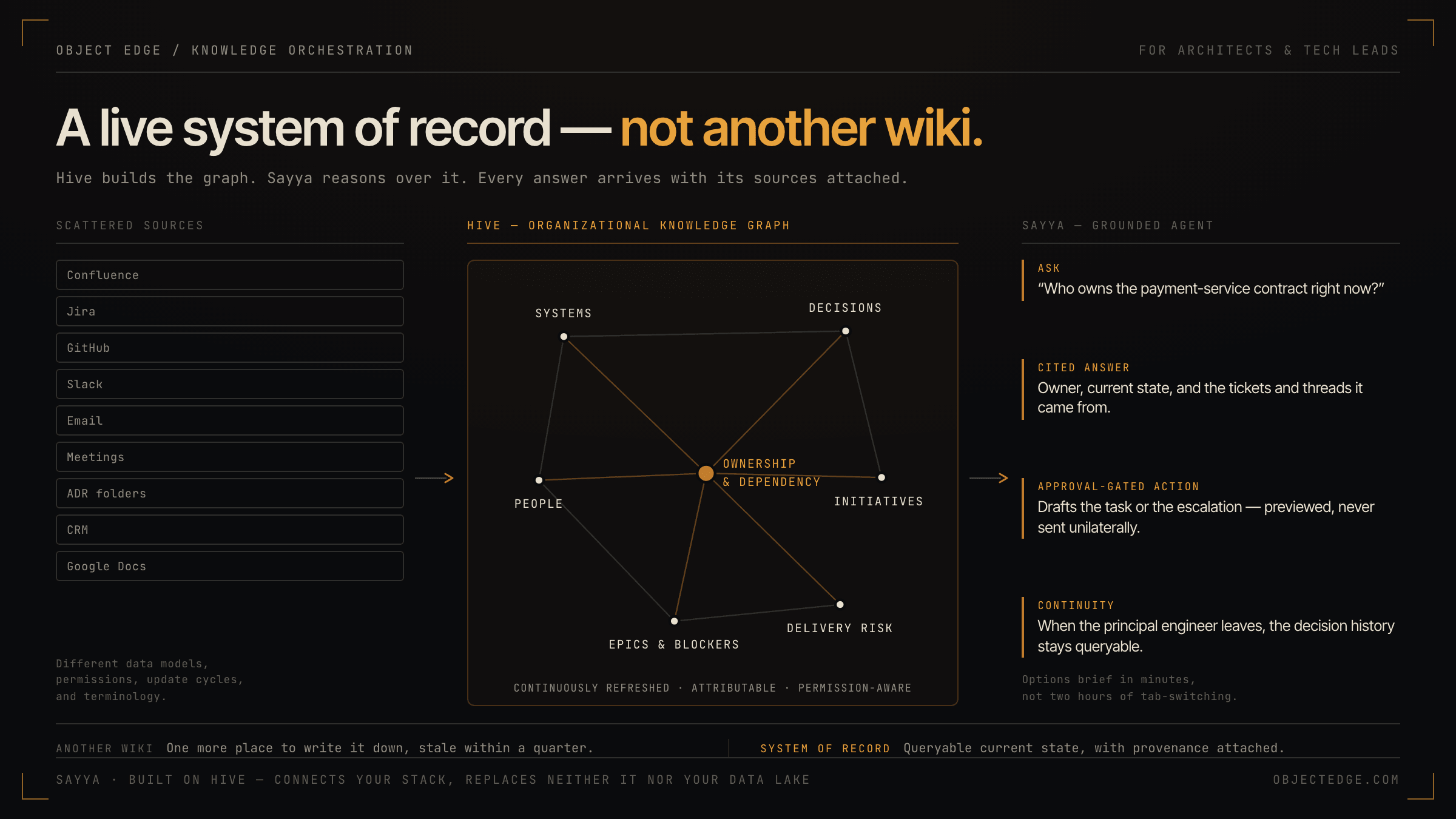
How Hive and Sayya give architects and tech leads a live system of record—not another wiki
Hive builds a continuously refreshed organizational knowledge graph; Sayya is the grounded agent that queries it. Together they give solution architects and tech leads the decision context, dependency visibility, and controlled AI actions that scattered docs and tribal knowledge never could.
-
ai
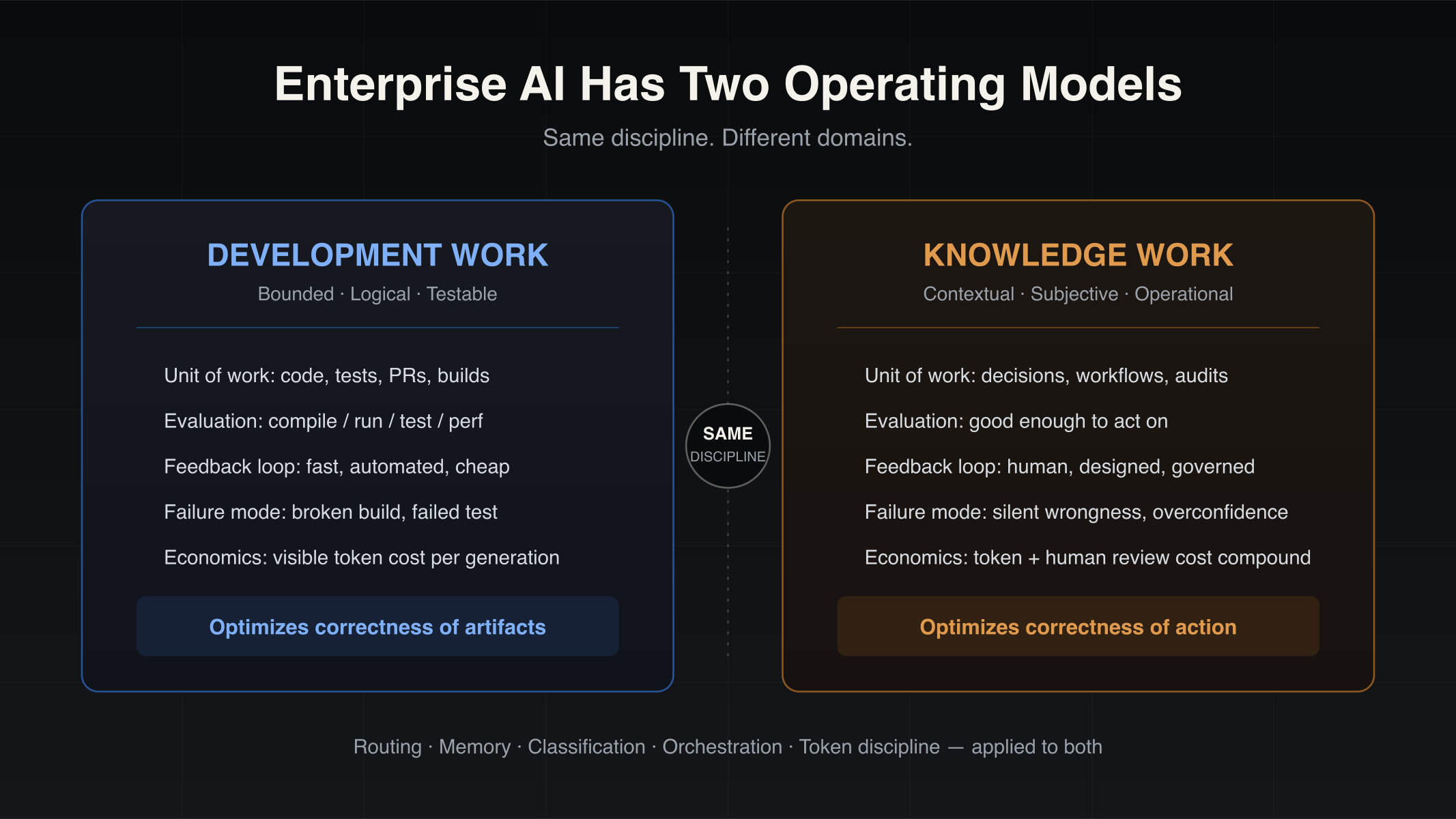
Enterprise AI Has Two Operating Models: Development Work and Knowledge Work
Enterprise AI is splitting into two operating models — development work and knowledge work. Why coding-copilot playbooks stall on operational workflows, and which engineering disciplines transfer.
-
ai
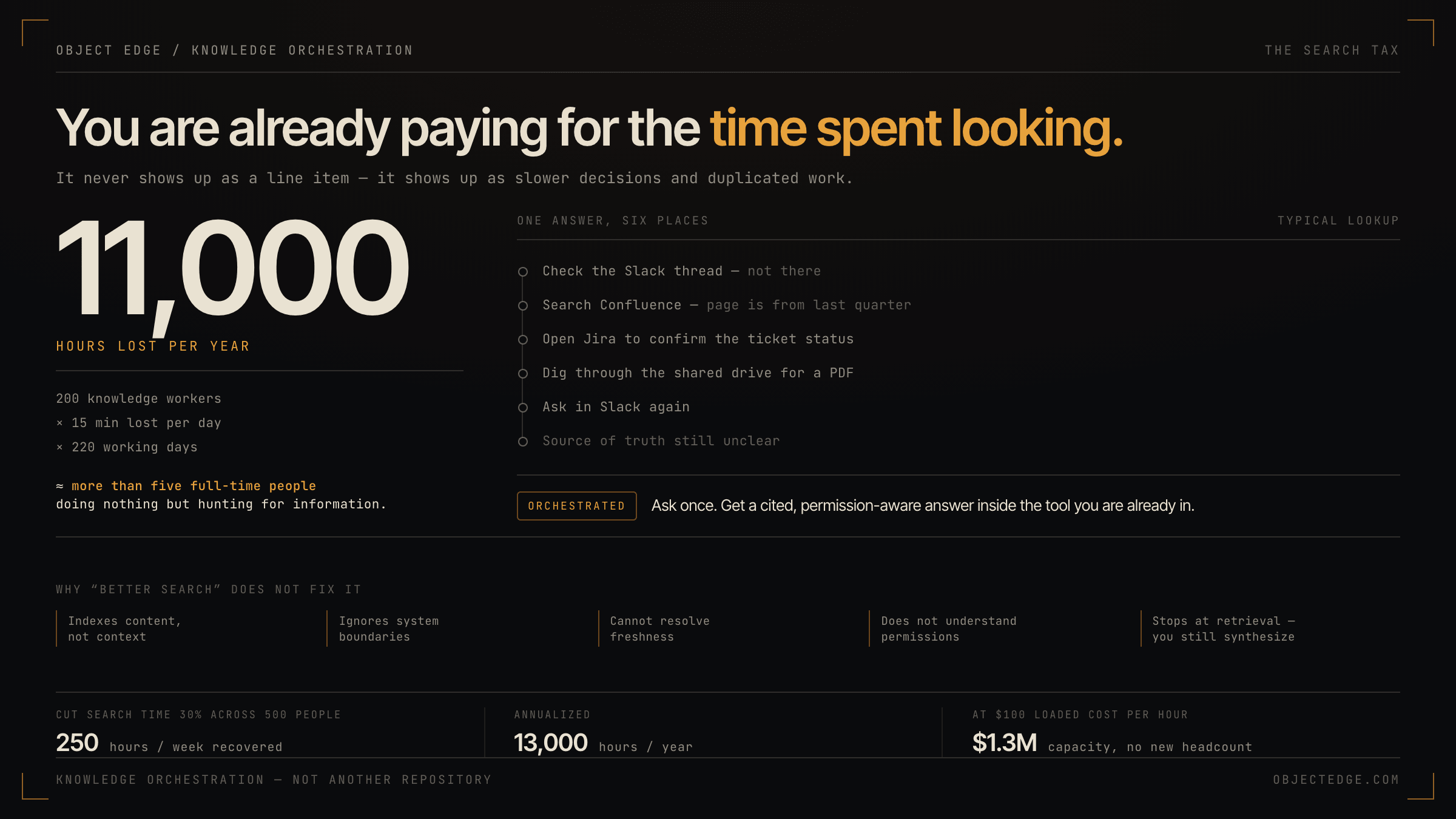
Stop Losing Hours to Search: How Knowledge Orchestration Cuts Time Wasted Across Systems
Why teams burn hours hunting for answers across tools, and how knowledge orchestration reduces that friction for engineering and operations leaders.