ai
You Don't Need to Replace Your Workflows to Cut Handle Time — Here's What Actually Works
Here’s a contrarian take most contact center leaders don’t want to hear: your workflows aren’t the problem.
The average handle time (AHT) crisis in enterprise contact centers isn’t a workflow problem. It’s a friction problem. And there’s a meaningful difference — one that determines whether your next transformation project costs $2M or $200K.
Most organizations respond to rising AHT by doing the same thing: launching a full platform migration, retraining hundreds of agents, and hoping the new system magically unlocks efficiency. Some of those bets pay off. Many don’t. And almost all of them take 18 months longer than the slide deck promised.
What if the answer was already sitting inside the workflows you’ve spent years building?
The Stat That Should Stop You in Your Tracks
According to research from McKinsey, agents spend up to 35% of their time searching for information during a live customer interaction — not resolving the issue, not empathizing, not upselling. Just hunting.
A separate study by Salesforce found that 70% of customers expect connected experiences, but agents are often toggling between four, five, or even eight different systems to piece together a single customer’s history.
That’s not a workflow problem. That’s a surface area problem. The workflows exist. The data exists. The gap is in how quickly and cleanly agents can access and act on it — in the moment, under pressure, while a customer is waiting.
This is exactly where AI-augmented contact center solutions are generating real, measurable ROI — not by replacing what works, but by reducing the cognitive and mechanical friction that slows everything down.
What “Reducing Handle Time” Actually Means in Practice
Before going further, it’s worth separating the two levers most operations leaders conflate:
- Structural AHT — the time baked into your process by design: required verification steps, compliance disclosures, mandatory system entries.
- Frictional AHT — the time lost to searching, switching, re-entering, clarifying, and waiting for systems to respond.
Most improvement programs attack structural AHT first because it’s visible. Frictional AHT is harder to see — it hides in after-call work logs, in “hold while I check on that” moments, and in the five-second lag every time an agent opens a new tab.
But frictional AHT is where AI wins without disruption.
Three Places Friction Is Silently Killing Your Handle Time
1. Knowledge Retrieval During Live Calls
An agent handling a billing dispute doesn’t need a better knowledge base. They need the right answer surfaced at the right moment — ideally before they even finish reading the customer’s opening message.
AI-powered real-time assist tools can listen to the conversation (voice or chat), detect intent, and surface relevant knowledge articles, scripts, or policy guidance in seconds. Agents stop hunting. Resolution accelerates. The workflow — the escalation path, the CRM entry, the wrap-up code — stays exactly the same.
In deployments Object Edge has supported, this single intervention has reduced AHT by 15–22% without a single change to the underlying workflow architecture.
2. After-Call Work (ACW) and Wrap-Up
After-call work is one of the most overlooked contributors to AHT — and one of the easiest to compress. Agents spend anywhere from 45 seconds to several minutes summarizing calls, logging outcomes, and selecting disposition codes, often from memory and often inconsistently.
AI-generated call summaries, auto-populated CRM fields, and suggested disposition codes — all derived from the conversation transcript — can cut ACW by 30–50%. Again, the workflow doesn’t change. The data still flows into the same systems. Agents simply spend less time doing manual transcription work.
3. Authentication and Verification Friction
KYC and identity verification steps are non-negotiable. But the way they’re executed is often far more painful than it needs to be. Agents asking customers to repeat their account number, date of birth, and last four digits of their SSN — while manually cross-referencing against a legacy system — adds minutes to every interaction.
Biometric voice authentication, pre-verified digital identity tokens, and AI-assisted identity matching can compress this from 90 seconds to under 20 — while improving compliance outcomes, not weakening them.
Why the “Replace Everything” Instinct Is So Costly
There’s an understandable logic to rip-and-replace thinking. Legacy systems are frustrating. Vendors promise clean slates. Leadership wants transformation, not incremental improvement.
But here’s what that approach consistently underestimates:
- Institutional knowledge lives in your workflows. Years of edge case handling, escalation logic, and compliance customization are embedded in the processes your teams follow. Replacing the platform means rebuilding that knowledge — slowly, expensively, and imperfectly.
- Agent retraining is a productivity crater. Even a well-executed platform migration typically costs 6–10 weeks of reduced throughput per agent cohort. At enterprise scale, that’s a significant operational hit.
- Integration debt multiplies. New platforms mean new API contracts, new data mapping exercises, and new failure points. The contact center doesn’t operate in isolation — it’s connected to your CRM, your ERP, your commerce platform. Every new system is a new dependency.
The smarter path is augmentation: layering AI capabilities on top of existing workflows rather than underneath them.
What to Look for in an Augmentation Approach
Not all AI-augmentation solutions are created equal. When evaluating options, contact center leaders should pressure-test vendors on a few specific questions:
- Does the solution require workflow changes to generate value? If the answer is yes, understand exactly what changes — and what they’ll cost.
- How is the AI trained on your specific data? Generic LLMs won’t understand your product catalog, your compliance requirements, or your customer segments. Domain-specific fine-tuning matters.
- What does the integration footprint look like? The best augmentation tools sit as a layer above your existing systems — reading from them, writing to them, but not requiring them to be rebuilt.
- How are outcomes measured? AHT reduction is a lagging indicator. Look for vendors who can instrument leading indicators — search queries per call, hold frequency, ACW duration — so you can see the mechanism, not just the outcome.
The Practical Starting Point
If you’re a contact center leader looking to move on this, here’s a pragmatic 90-day starting point:
- Audit your current AHT composition. Break it into structural vs. frictional components. Most organizations have never done this rigorously. The data will be illuminating.
- Identify your top three friction sources. Knowledge retrieval, ACW, and authentication are common culprits — but your data may tell a different story.
- Run a contained augmentation pilot. Pick one team, one use case, one tool. Measure obsessively. Expand what works.
- Resist the urge to boil the ocean. The goal is to generate a proof point that builds internal confidence — not to solve everything at once.
The Bottom Line
Reducing handle time doesn’t require a platform revolution. It requires a precise diagnosis of where time is being lost, and a targeted intervention that addresses the friction — not the workflow.
The contact centers winning right now aren’t the ones who replaced everything. They’re the ones who got surgical.
If you’re navigating this challenge and want a second set of eyes on where your friction is hiding, reach out to the Object Edge team. We’ve helped enterprise operations teams find and eliminate frictional AHT without the disruption — and the results tend to show up faster than anyone expects.
Object Edge helps enterprise organizations deploy AI-augmented solutions across commerce, service, and operations. Learn more at objectedge.com.
Related articles
-
ai
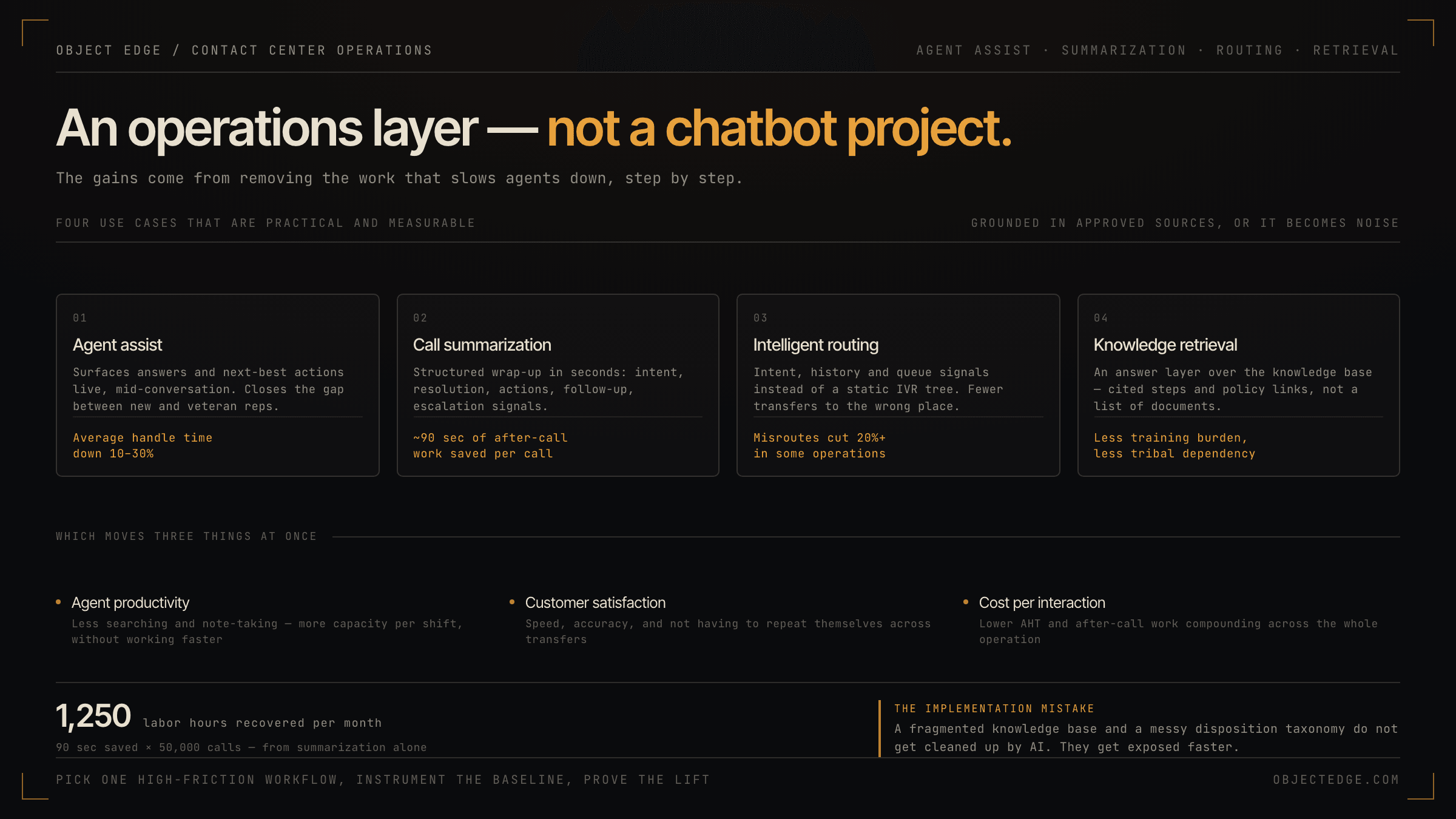
How AI Is Reshaping Contact Center Operations: Faster Agents, Better CSAT, Lower Cost
A practical look at how AI improves contact center productivity, customer satisfaction, and operational efficiency through agent assist, summarization, routing, and knowledge retrieval.
-
ai
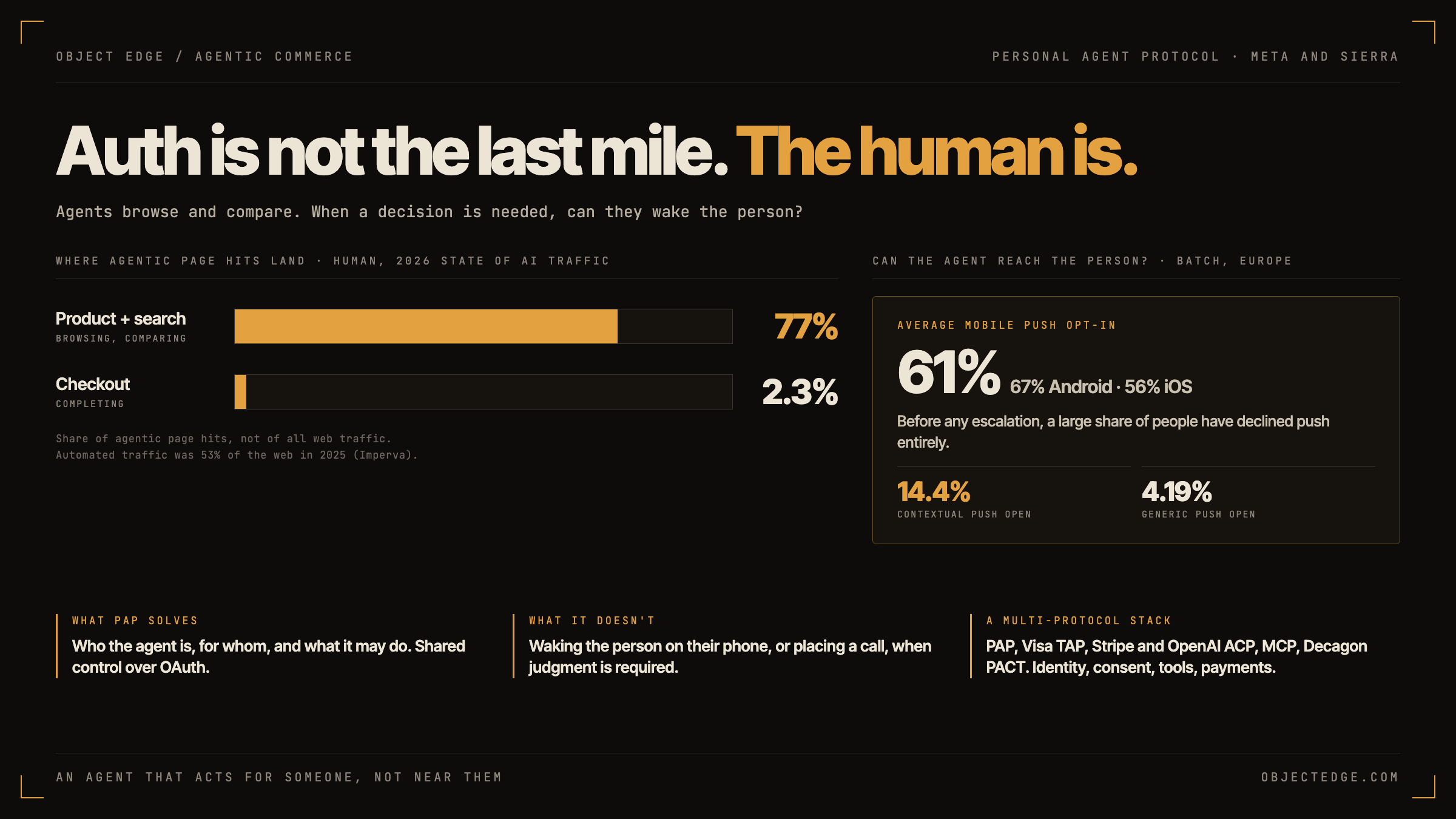
Every Harness Will Adopt Personal Agent Protocol. That Is Not the Hard Part.
Meta and Sierra's Personal Agent Protocol standardizes how personal AI agents authenticate to businesses, and every harness will adopt it. The harder problem is the last mile: when judgment is required, can the agent reach the person on their phone, or place a call?
-
ai
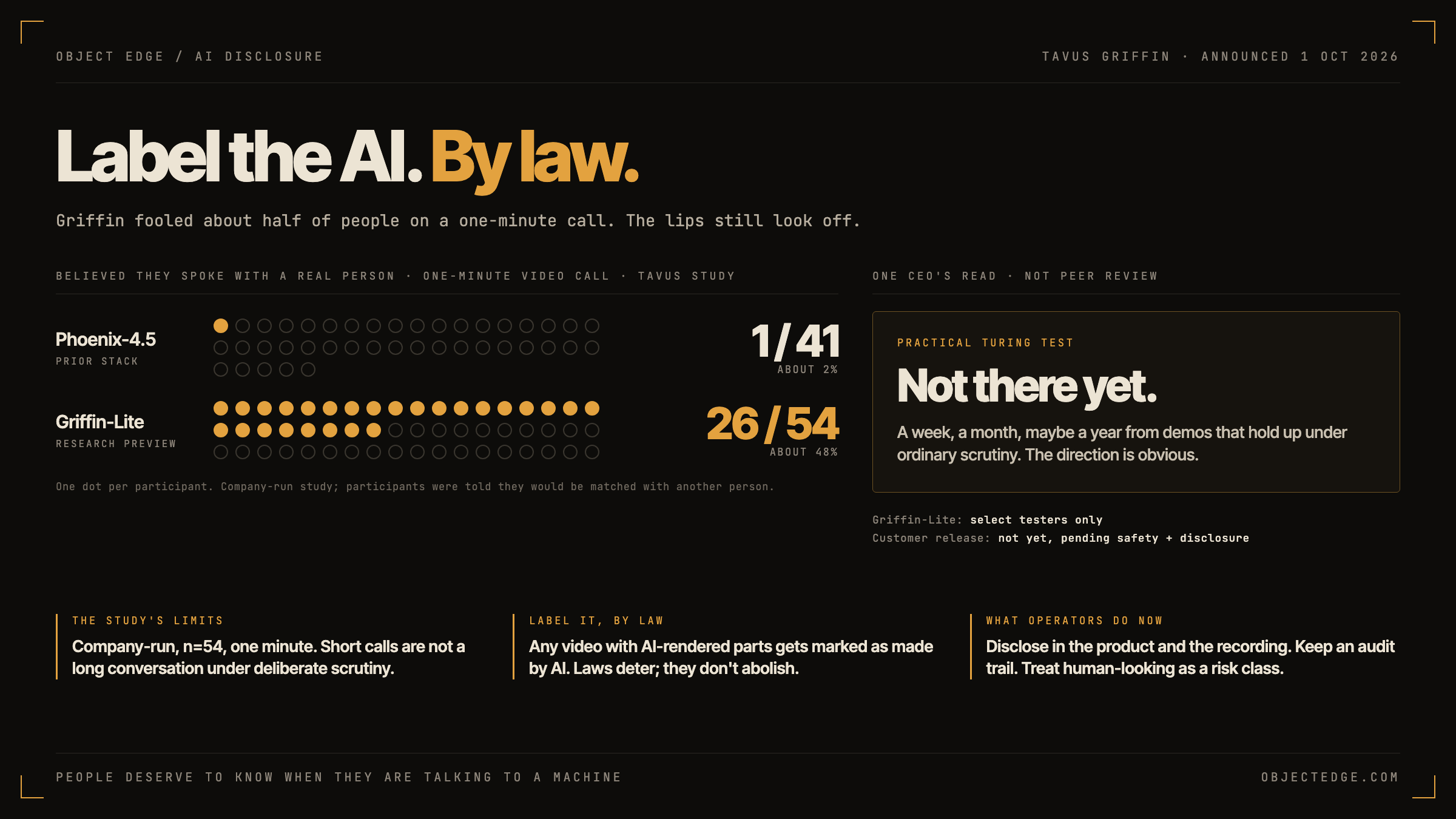
Griffin's 'Video Turing Test' Is Less Interesting Than What We Do While the Demos Still Look Unfinished
Tavus says its Griffin model fooled 26 of 54 people, about 48%, on a one-minute video call. The lips still look off and the study is small, but the direction is obvious. Why all AI-generated video should be labeled by law, and what operators should do before the law catches up.