ai
Every Harness Will Adopt Personal Agent Protocol. That Is Not the Hard Part.
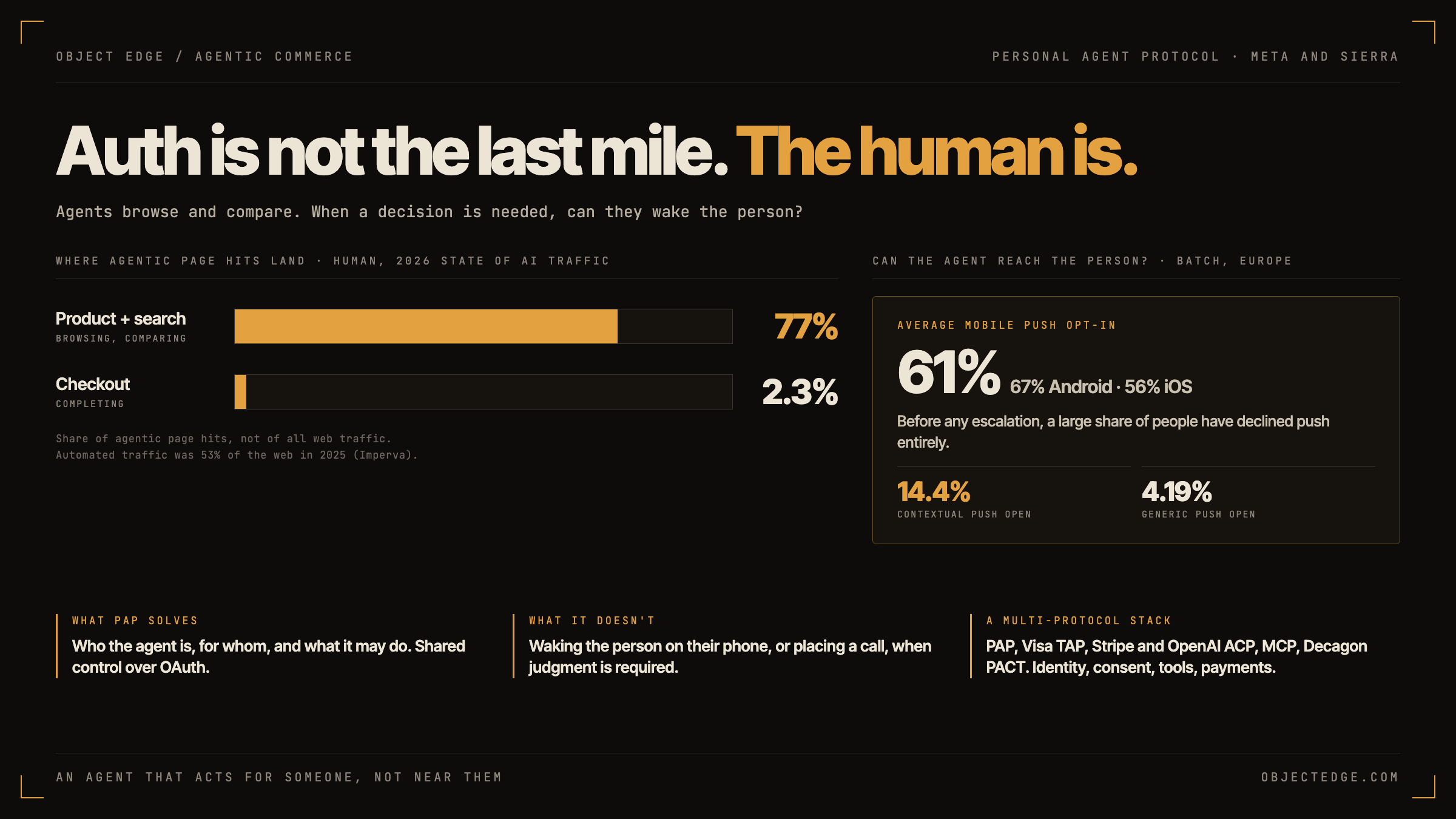
When a customer’s personal agent needs a human decision (approve a return, confirm an overspend, pick between two flights), can it reach that person on their phone, or even place a call? If it cannot, pushing a message into the agent is plumbing with no last mile.
Meta and Sierra announced Personal Agent Protocol this week as an open standard for how personal AI agents authenticate and interact with businesses. The protocol will be absorbed into harnesses quickly. Interoperability at this layer is table stakes once agents show up at the front door instead of the customer. I believe the real product question is not whether machines can handshake. It is whether the application, via the agent, can summon the person when judgment is required.
What Personal Agent Protocol actually is
Personal Agent Protocol is an open standard Meta and Sierra are developing with partners at Genesys, Instinct, Rocket, Shopify, Stripe, and Walmart. So what does it do? It defines how a personal agent acting for a consumer authenticates to a business and works through that business’s website, APIs, or company agent, with visibility so the company knows it is dealing with an agent for a person rather than a random bot.
The design principle is shared control. Consumers decide what access to give their agents. Companies set parameters for what those agents can do. Sessions sit on OAuth. An agent can start as a guest for read-only tasks such as checking availability or a returns policy, then move to a signed-in session with read or write access when the customer authorizes it. The company chooses which routes to expose: its regular website, APIs built on standards such as MCP and OpenAPI, or its own conversational agent for tasks that need dialogue.
Bret Taylor told CNBC that the current state is “kind of chaos until such a standard exists,” and that he expects the large labs to join even though OpenAI and Anthropic are not aboard yet. Sierra plans a v0.1 specification later this month plus a reference implementation. The early roadmap also mentions push notifications to the agent (a delayed flight, a shipped order) and payment flows that avoid sharing card numbers. Notice what that roadmap still centers: machine-to-machine reachability. The human phone and the human call are not the product being standardized.
Why harnesses will absorb it immediately
The chaos claim is not marketing fluff. Imperva’s Bad Bot Report 2026 found that automated traffic was 53% of web traffic in 2025, against 47% human. Cloudflare, reporting on 30 September 2026, said daily AI-agent requests rose more than 1,700% year over year, while human traffic fell by as much as 40% in some heavy-crawl verticals, including retail, in less than a year.
HUMAN’s 2026 State of AI Traffic puts an even sharper lens on agentic behavior, with a caveat that matters: agentic AI traffic rose 7,851% year over year from a low base, so the percentage is a growth rate, not a share of total traffic. Of agentic page hits, product and search made up 77%, while checkout was only 2.3%. Retail accounted for 46.6% of agentic traffic by vertical. In HUMAN’s words, only one half of one percent separates the rate of benign automation from the rate of malicious automation. HUMAN also reported more than 150 billion attempted scrapes on retail and ecommerce in 2025.
Adobe has been tracking generative-AI referral traffic into US retail for longer. In March 2025, Adobe Analytics reported a 1,200% jump in gen-AI referral traffic to US retail sites from February 2025 versus July 2024, and that 39% of respondents had used generative AI for online shopping. Later coverage citing Adobe reported a 4,700% year-over-year figure for July 2025; treat that as a growth rate off a tiny base, not as a claim that AI already owns retail traffic.
On the consumer side, Meta has said Muse has “millions of users in the U.S.” (via CNBC). A Sensor Tower estimate reported in trade press put US downloads around 5 million in 22 days; I treat that as secondary until a primary release confirms it. The directional point is enough: personal agents are no longer a lab demo. Banks and brands have been asking how to tell a legitimate personal agent from a scraper. A shared auth and visibility layer answers that question. That is why every serious harness will implement PAP or something compatible. Standards at this layer do not stay optional for long.
Auth is not the same as being reachable
Here is what I think is happening. Personal Agent Protocol solves a real problem: who is this agent, for whom, and what is it allowed to do. It does not solve the last mile to the human.
Consumers are open to delegation and still want a veto. Salesforce’s Connected Shoppers research (8,350 shoppers, late 2024) found that 39% already use AI for product discovery, rising to 54% among Gen Z. Requiring purchase approval ranked as the third most important trust factor. Forty-nine percent had abandoned a purchase because of ordering friction. Salesforce’s holiday 2025 predictions said that among AI shoppers, 48% were open to an agent making a purchase, and forecast that 21% of holiday orders globally would be AI- or agent-referred, worth $263 billion. That forecast is a forecast, not a measured outcome. Zendesk’s CX Trends survey (June–July 2024) found 67% of consumers ready to delegate tasks to AI, while 75% of CX leaders expected 80% of interactions to be resolved without a human “in the next few years.” That second figure is an expectation about the future, not current operations.
Put those numbers next to notification reality. Batch’s Push Benchmark, a European study (July 2024–July 2025, roughly 800 billion messages across push, in-app and email), reported an average mobile push opt-in of 61% (67% on Android, 56% on iOS), with contextual open rates at 14.4% versus 4.19% for generic pushes. Emarsys’s 2026 directional benchmarks put push opt-in in a 45–70% band, direct open rates around 4–6%, and email opens around 37–40%. Even before you ask an agent to escalate, a large share of people have declined push entirely, and most who receive one do not open it.
What we do not have, and should not invent: a public percentage of consumers who completed a full agent-led purchase end to end; a primary average for how long people take to respond to a push; or measured rates of agent-to-phone-call escalation. The gaps themselves are the point. We are standardizing the handshake while the human surface is still assumed.
Checkout already taxes commerce. Agents amplify the tax without a wake-up path.
Cart abandonment is the oldest proof that last-mile friction kills conversion. Baymard’s meta-analysis of 50 studies, updated September 2025, puts average cart abandonment around 70.2%. Baymard’s US checkout research still finds familiar blockers: a long or complicated checkout (about 17%), forced account creation (about 18%), and related trust and usability failures.
Agents do not erase those taxes. HUMAN’s split (heavy product and search traffic, a tiny checkout share among agentic hits) suggests agents are already browsing and comparing far more than they are completing. If the agent can discover and negotiate but cannot wake the person when a decision or confirmation is required, you have automated the front of the funnel and left the conversion moment as silent as ever. An application that can only announce into an agent, with no push to the person’s phone and no path to a call, leaves the customer out of the loop at the exact moment judgment is required.
This is a multi-protocol stack, not a winner-take-all race
Personal Agent Protocol will not be the only standard in the room. Visa’s Trusted Agent Protocol (October 2025) focuses on cryptographic agent identity and distinguishing trusted agents from malicious bots in a payments-adjacent context. Stripe and OpenAI’s Agentic Commerce Protocol (September 2025) covers discovery plus merchant-controlled checkout. Anthropic’s Model Context Protocol (November 2024) is about tools and data access; Sierra’s own write-up notes that PAP can use MCP and OpenAPI for company APIs. Decagon’s PACT, announced the same day as PAP, is a consent and trust layer for scopes, and Decagon says it is joining the PAP working group. There are no public adoption numbers for PACT yet, so I mention it as adjacent work rather than as a measured ecosystem.
Shopify and Stripe appearing across more than one of these efforts is not a contradiction. It is the multi-protocol reality operators should plan for: identity, consent, tools, and payments will not collapse into a single acronym. PAP is useful plumbing inside that stack. It is not the whole stack, and it is not the human surface.
Useful plumbing is not the product experience
I treat Personal Agent Protocol as something every harness will implement quickly, for good reason. Auth, consent, and company visibility are necessary once personal agents become a front door. Celebrating the protocol as the product misses the operator question that remains after the handshake works.
When judgment is required, who gets woken? Until the application, via the agent, can notify the person on their phone or place a call, the standard will move messages between machines while the human stays quiet. That, I have come to think, is the difference between an agent that acts for someone and an agent that merely acts near them.
Sources
- Sierra, “Introducing Personal Agent Protocol” (6 Oct 2026)
- CNBC, “Meta joins with group of companies to tame ‘chaos’ of doing business with AI bots” (6 Oct 2026)
- Imperva (Thales), 2026 Bad Bot Report
- Cloudflare, “The Internet has a second audience” (30 Sep 2026)
- HUMAN, 2026 State of AI Traffic and Cyberthreat Benchmark
- Adobe, traffic to US retail websites from generative AI sources jumps 1,200% (17 Mar 2025)
- 9to5Mac, Sensor Tower estimate of Muse downloads (30 Sep 2026)
- Salesforce, AI agent retail trends and Connected Shoppers research
- Salesforce, holiday predictions 2025 (16 Sep 2025)
- Zendesk, 2025 CX Trends
- Batch, Push Benchmark
- Emarsys, omnichannel engagement benchmarks (13 Mar 2026)
- Baymard Institute, cart abandonment rate (updated 22 Sep 2025)
- Baymard Institute, checkout usability research
- Visa, Trusted Agent Protocol (14 Oct 2025)
- Stripe, Stripe and OpenAI: Instant Checkout and the Agentic Commerce Protocol (29 Sep 2025)
- Anthropic, “Introducing the Model Context Protocol” (25 Nov 2024)
- Decagon, “Introducing PACT, the Personal Agent Consent & Trust Protocol” (6 Oct 2026)
See also: Griffin’s video Turing test and why AI video should be labeled.
Related articles
-
ai
Griffin's 'Video Turing Test' Is Less Interesting Than What We Do While the Demos Still Look Unfinished
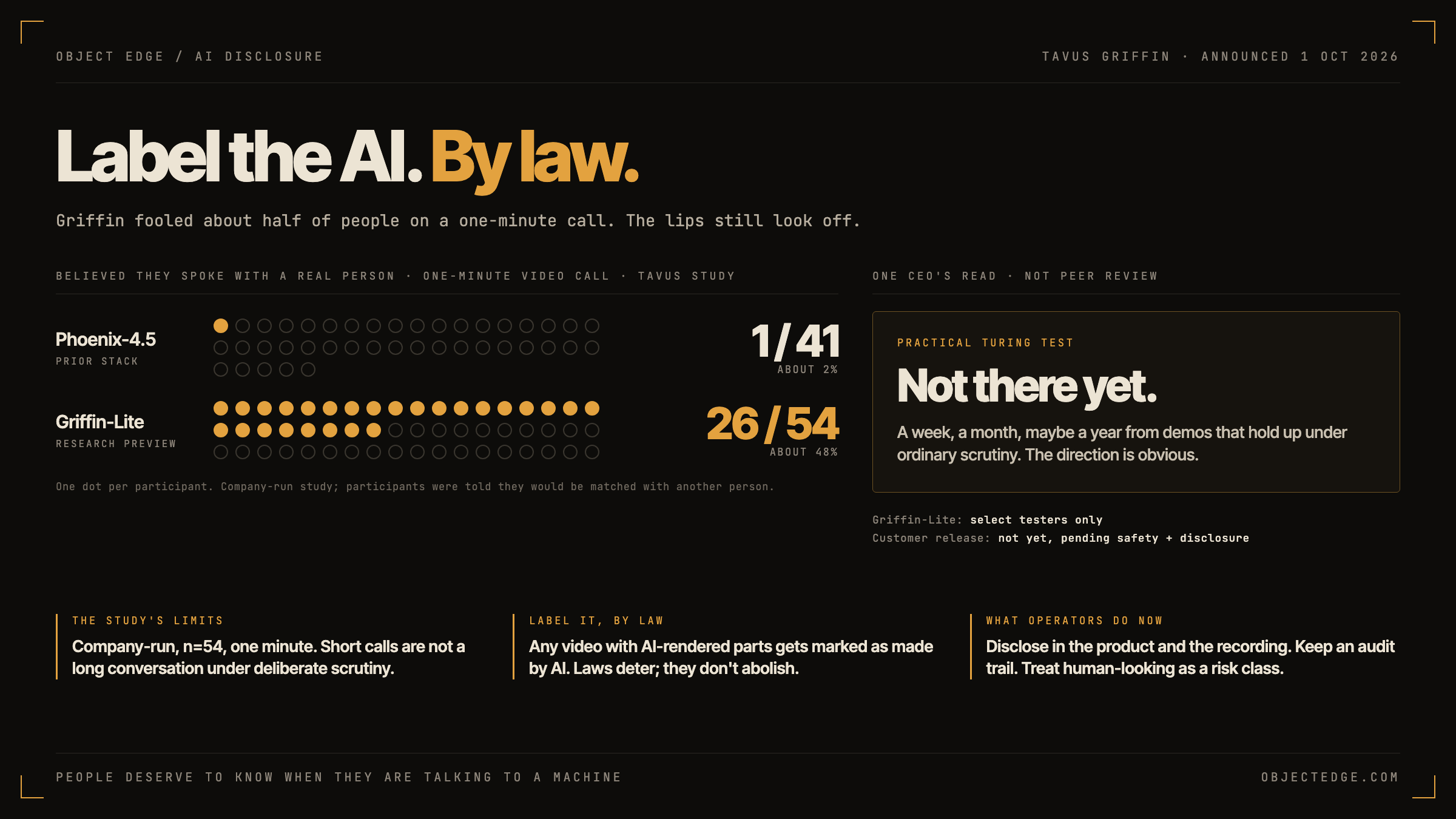
Tavus says its Griffin model fooled 26 of 54 people, about 48%, on a one-minute video call. The lips still look off and the study is small, but the direction is obvious. Why all AI-generated video should be labeled by law, and what operators should do before the law catches up.
-
ai
Harvey's Margin Swing Is a Tokenomics Story, Not Only a Legal-AI Story
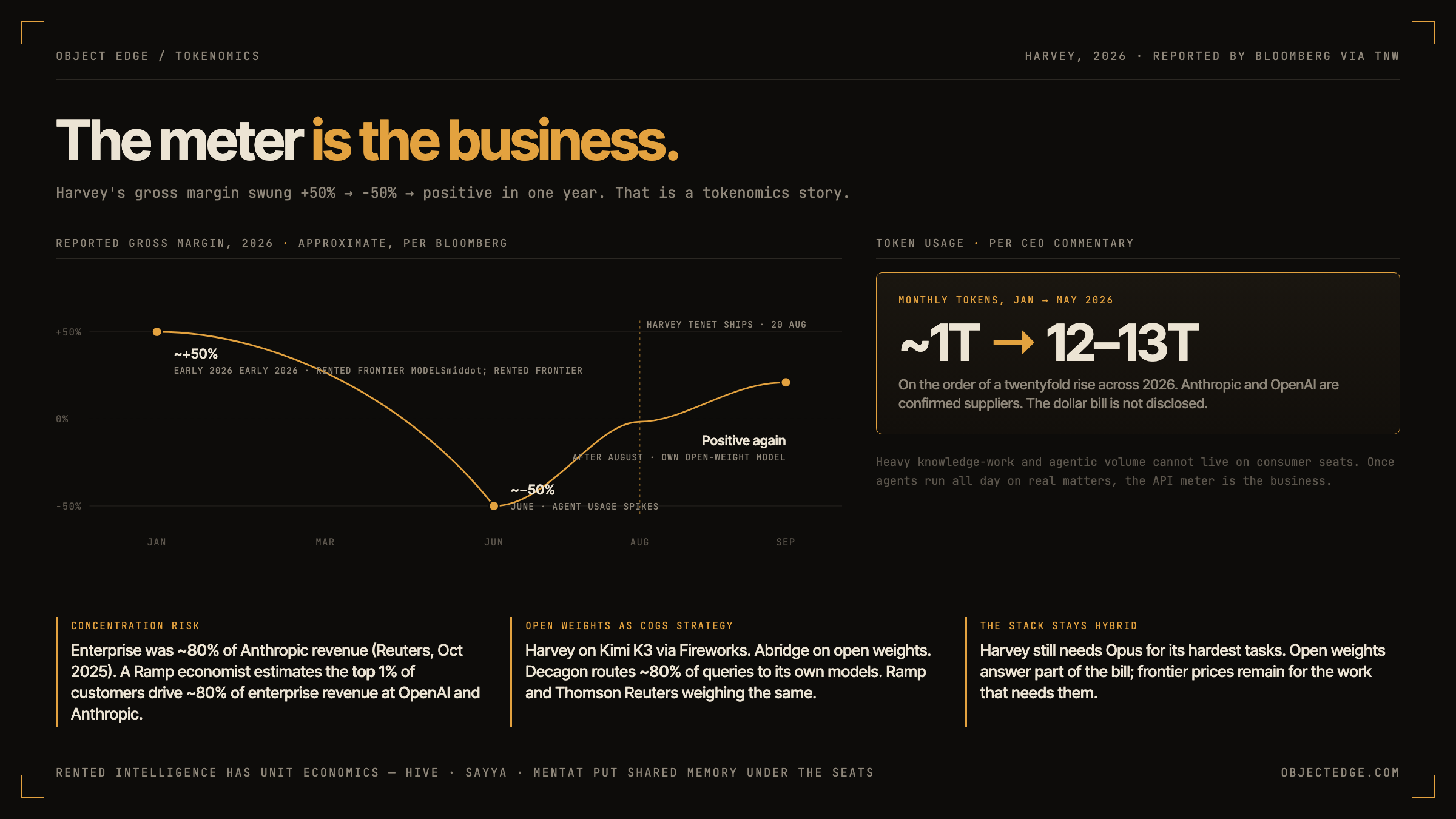
Harvey's gross margin went from about +50% to about -50% and back positive in 2026 as agent usage spiked on rented frontier models, then moved onto its own open-weight model. What that swing says about metered knowledge work, revenue concentration at Anthropic and OpenAI, and open weights as a cost-of-goods strategy.
-
ai
AI-Native Services Are a Real Market. Enterprise Still Needs a Company Brain.
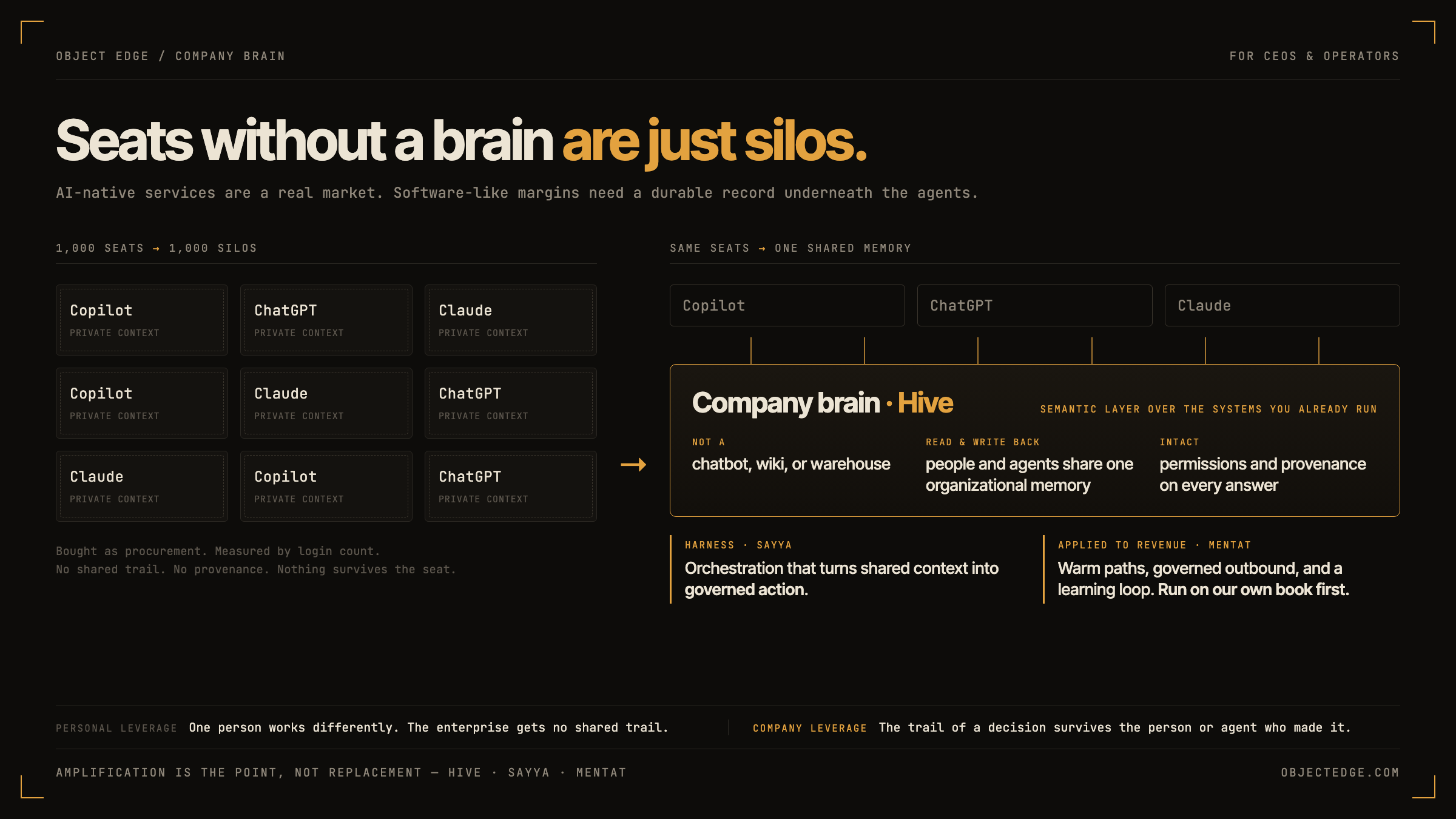
Greg Isenberg's $100B AI-native services thesis is right about the market. The operator question is whether the enterprise keeps a durable record under its agents. Without one, a thousand AI seats become a thousand silos.