ai
How AI Is Reshaping Contact Center Operations: Faster Agents, Better CSAT, Lower Cost
How AI Is Reshaping Contact Center Operations: Faster Agents, Better CSAT, Lower Cost
Contact centers are under pressure from all sides: rising ticket volumes, higher customer expectations, and a labor model that gets more expensive every year. The old answer was to add headcount, add training, and tighten scripts. That does not scale.
AI changes the operating model. Not by replacing the contact center, but by removing the work that slows agents down. In the best deployments, AI reduces after-call work, shortens handle times, improves first-contact resolution, and gives frontline teams faster access to the right information. The result is measurable: higher agent productivity, better customer satisfaction, and lower cost per interaction.
The companies getting value from AI are not treating it as a chatbot project. They are using it as an operations layer across the contact center stack.
The contact center problem is operational, not just conversational
Most contact center inefficiency comes from friction in the workflow:
- Agents spend too much time searching for answers.
- Supervisors spend too much time reviewing calls manually.
- Customers repeat themselves across transfers and channels.
- Routing logic sends contacts to the wrong queue.
- Every interaction creates more wrap-up work than it should.
If an average agent spends 30 to 60 seconds searching knowledge articles during a call, or 1 to 3 minutes writing notes after each interaction, the math gets ugly fast. At 100,000 monthly interactions, even small inefficiencies add up to thousands of labor hours.
AI targets those repeatable losses.
Where AI creates the most value
The highest-ROI use cases are not experimental. They are practical and easy to measure.
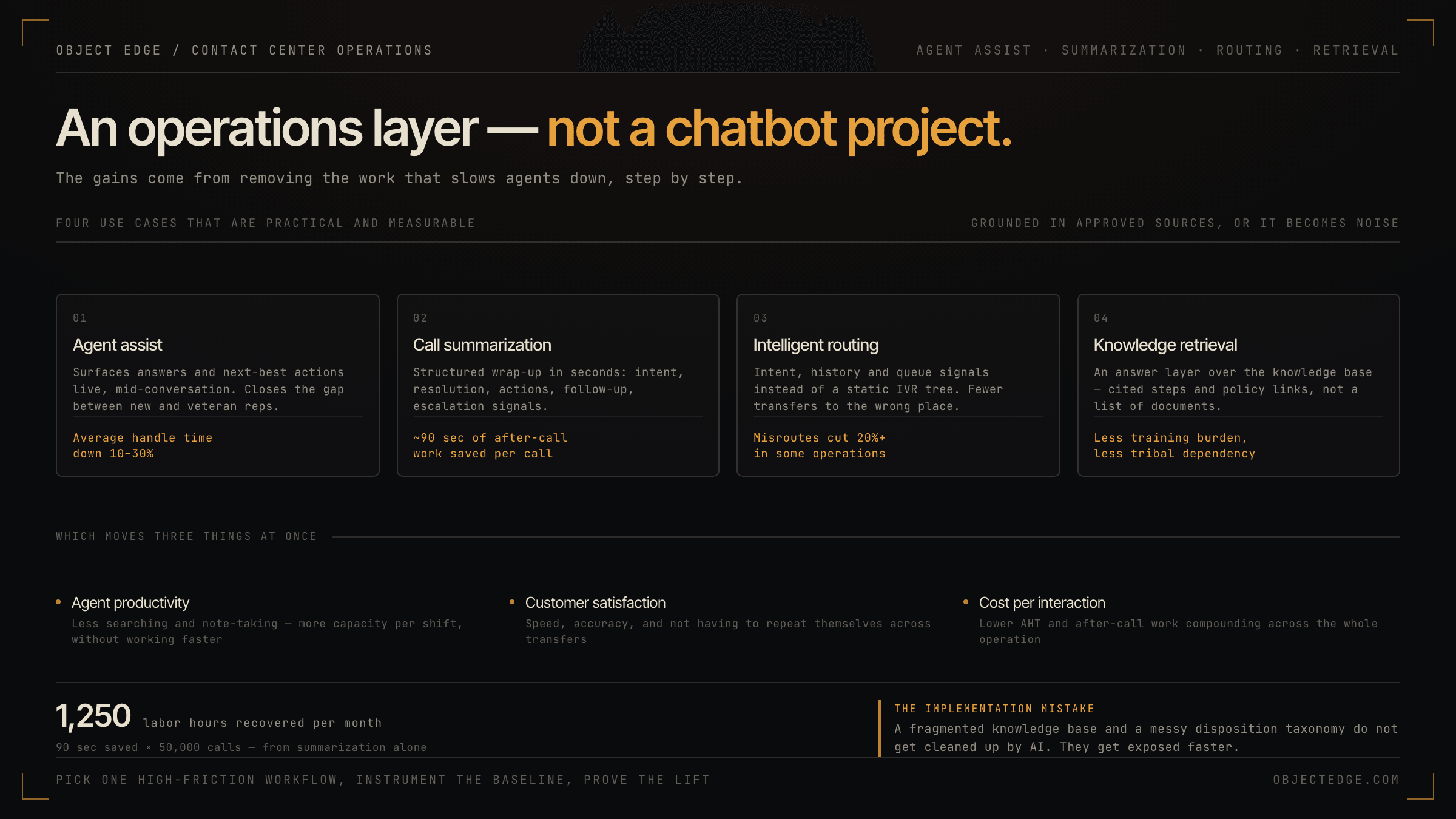
1. Agent assist
Agent assist gives representatives live support during the conversation. It can surface relevant answers, suggest next-best actions, identify policy exceptions, and even recommend a response based on the customer issue.
The value is simple: fewer moments of silence, fewer escalations, and less time hunting for information.
In a well-designed deployment, agent assist can reduce average handle time by 10% to 30%, depending on the complexity of the queue and the quality of the knowledge base. It also improves consistency. New agents can perform closer to experienced reps because the system helps close the knowledge gap in real time.
That matters most in high-variation environments like:
- Financial services claims and disputes
- Telecom billing and plan changes
- Healthcare member support
- Retail order exceptions and returns
- SaaS support with complex product workflows
The technology only works if it is grounded in current, trusted sources. If knowledge is stale, agent assist becomes noise. The best implementations connect to approved content, ticketing history, CRM data, and policy documents with guardrails around what can be recommended.
2. Call summarization
After-call work is one of the most obvious productivity drains in the contact center. Agents end a call, then spend time typing notes, tagging issues, and updating systems. That work is necessary, but it should not require manual transcription from scratch.
AI call summarization can produce a structured summary in seconds:
- customer intent
- issue resolution
- actions taken
- follow-up required
- sentiment or escalation signals
This is one of the easiest use cases to quantify. If a summary saves even 90 seconds per call, a team handling 50,000 calls per month saves more than 1,200 labor hours monthly. That is real capacity.
Summarization also improves data quality. Manual notes are inconsistent. AI-generated summaries can standardize disposition codes, capture key entities, and make downstream reporting more reliable. That helps operations, QA, compliance, and analytics teams all at once.
3. Intelligent routing
Routing is where customer experience often breaks. A customer starts with one issue and gets transferred twice before reaching the right queue. Every transfer adds time, frustration, and cost.
AI-based routing uses intent detection, historical interaction patterns, customer profile data, and queue performance signals to direct contacts more accurately. Instead of relying only on static menus or basic IVR paths, routing can adapt based on what the customer is actually trying to do.
The impact is usually visible in:
- lower transfer rates
- faster time to resolution
- higher first-contact resolution
- lower abandonment
In some organizations, routing improvements alone can cut misroutes by 20% or more. That is not just an efficiency gain. It is a customer satisfaction gain, because the shortest path to resolution is usually the best one.
4. Knowledge retrieval
Knowledge is the backbone of support operations, but most knowledge systems are hard to use under pressure. Articles are long, search is imprecise, and frontline teams end up relying on memory or asking a colleague.
AI retrieval changes that by turning knowledge into an answer layer. Instead of searching for a document, the agent can ask a question and get a grounded response with source citations, recommended steps, and links to the underlying policy or procedure.
This is especially important for:
- regulated industries
- product-heavy support environments
- rapidly changing policies
- distributed teams with variable experience
When knowledge retrieval is done right, it reduces training burden and improves consistency. It also prevents “tribal knowledge” from becoming a hidden dependency. That matters when veteran agents leave and the operation needs to maintain performance.
What improves first: productivity, CSAT, or cost?
The answer is usually all three, but not in the same way.
Agent productivity
Productivity improvements show up fast. AI reduces search time, note-taking time, and repetitive explanation work. That gives each agent more capacity per shift without forcing the team to work faster in a brittle way.
Customer satisfaction
Customers care about speed, accuracy, and not having to repeat themselves. AI helps on all three. Faster answers and better routing reduce friction. Better summaries and connected context reduce repetition. More consistent responses reduce recontacts.
Operational efficiency
This is where the financial case gets real. Contact centers run on thin margins. If AI can reduce AHT, lower after-call work, and improve first-contact resolution even modestly, the cost impact compounds across the entire operation.
For many teams, the value is not one giant breakthrough. It is a series of 5% to 15% improvements across multiple steps in the workflow.
The implementation mistake most teams make
The common failure mode is trying to “add AI” before fixing the operating foundation.
If your knowledge base is fragmented, your CRM data is inconsistent, and your call disposition taxonomy is messy, AI will not magically clean it up. It will expose the problems faster.
Successful teams do four things first:
-
Pick one workflow with measurable pain
Start with agent assist, summarization, or routing. Do not launch five use cases at once. -
Define the operational metric
Use AHT, CSAT, FCR, transfer rate, or after-call work. If you cannot measure it, you cannot manage it. -
Connect AI to trusted systems
Ground responses in approved knowledge, ticket history, and customer context. -
Build human override and review loops
Agents and supervisors need to see when AI is uncertain, and they need a path to correct it.
The goal is not automation for its own sake. The goal is better operational control.
What technical buyers should look for
CTOs and operations leaders should evaluate AI in the contact center the same way they evaluate any enterprise system: integration, governance, latency, security, and measurable business impact.
Look for:
- support for existing CCaaS, CRM, and knowledge platforms
- retrieval grounded in approved data sources
- auditability for prompts, outputs, and agent actions
- role-based access controls and PII handling
- configurable workflows, not black-box automation
- reporting tied to operational KPIs
If the platform cannot show where an answer came from, who approved it, and how it affected performance, it is not ready for enterprise use.
The bottom line
AI is not changing contact centers by removing humans from the loop. It is changing them by making human work faster, more consistent, and less expensive.
Agent assist helps agents resolve issues in real time. Call summarization cuts after-call work. Intelligent routing reduces transfers and abandonment. Knowledge retrieval turns static content into usable answers. Together, these capabilities improve productivity, customer satisfaction, and operational efficiency in ways that are measurable and repeatable.
The winners will not be the teams that buy the most AI. They will be the teams that apply it to the highest-friction parts of the workflow and tie it to operational outcomes.
If you are modernizing your contact center, start with one high-volume use case, instrument the baseline, and prove the lift. That is how AI earns a permanent place in the operating model.
Ready to apply AI to contact center operations?
Object Edge helps enterprise teams design and deliver AI workflows that improve productivity, customer experience, and operational performance. If you are evaluating agent assist, summarization, routing, or knowledge ret
Related articles
-
ai
Harvey's Margin Swing Is a Tokenomics Story, Not Only a Legal-AI Story
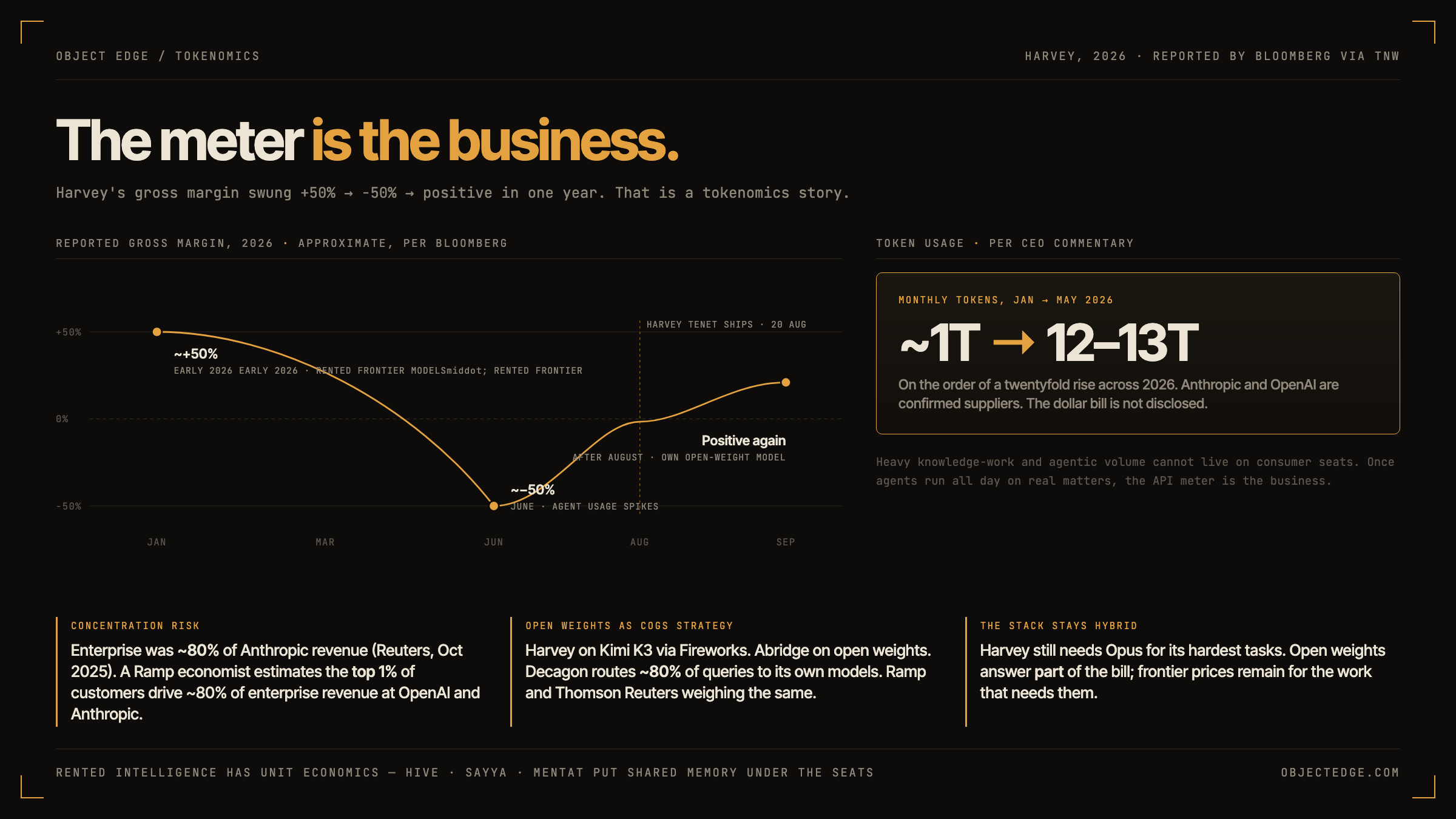
Harvey's gross margin went from about +50% to about -50% and back positive in 2026 as agent usage spiked on rented frontier models, then moved onto its own open-weight model. What that swing says about metered knowledge work, revenue concentration at Anthropic and OpenAI, and open weights as a cost-of-goods strategy.
-
ai
AI-Native Services Are a Real Market. Enterprise Still Needs a Company Brain.
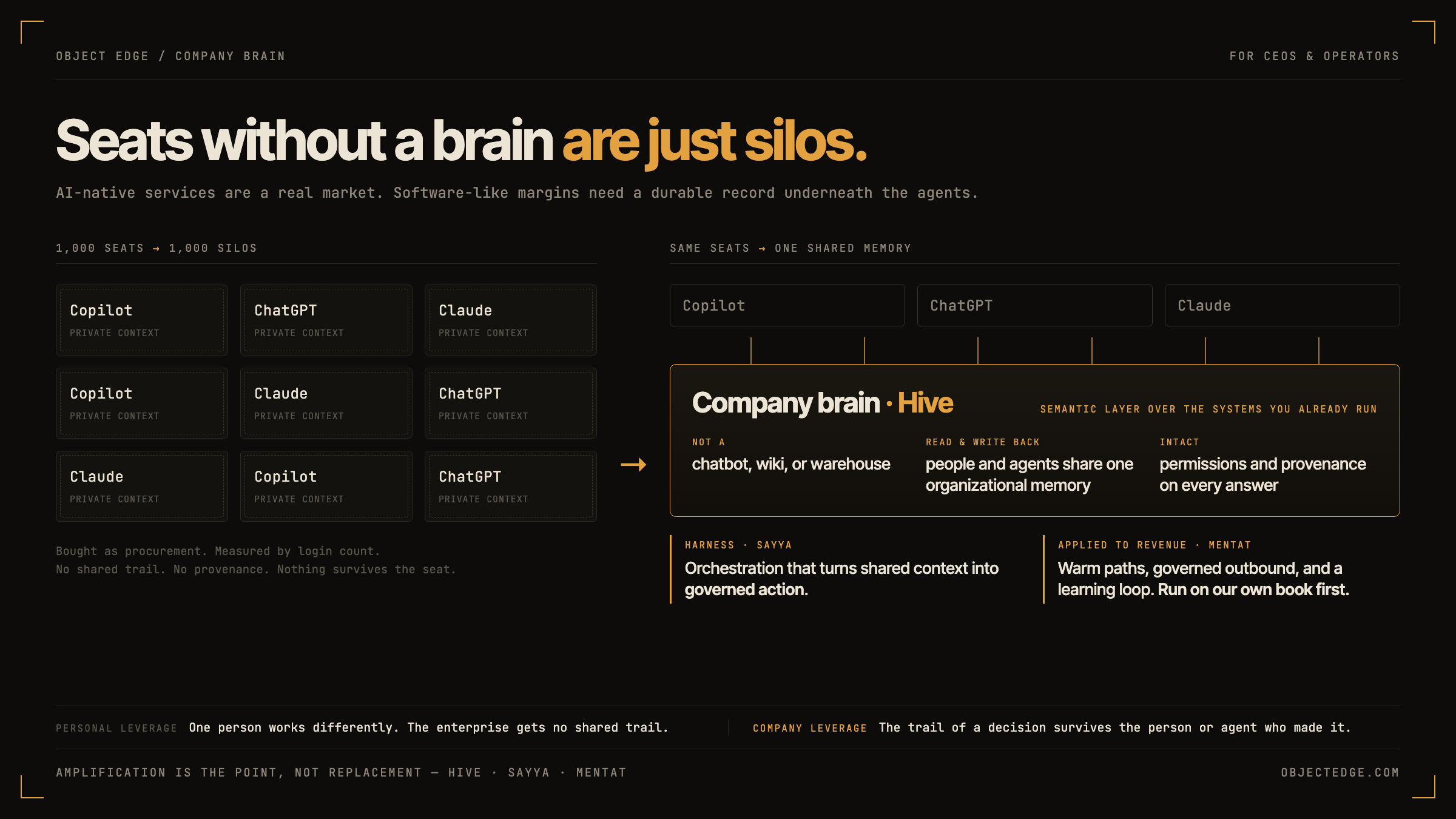
Greg Isenberg's $100B AI-native services thesis is right about the market. The operator question is whether the enterprise keeps a durable record under its agents. Without one, a thousand AI seats become a thousand silos.
-
ai
Faster, Cheaper Tokens — Why Your AI Bill Won't Fall Like You Think
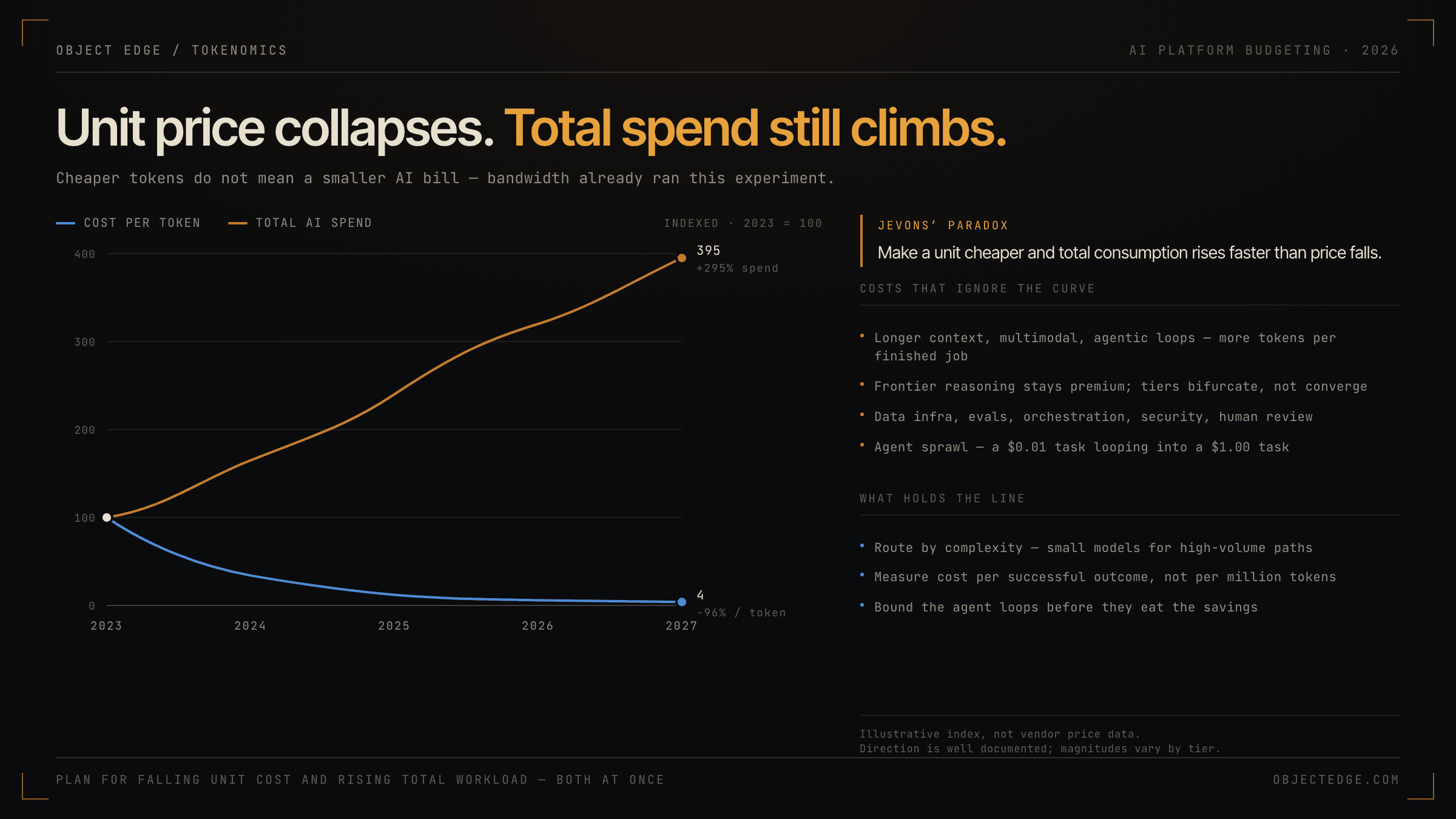
LLM inference costs are collapsing along a curve that mirrors internet bandwidth pricing — but buyers who confuse cheaper tokens with lower total AI spend will get burned.