ai
AI-Native Services Are a Real Market. Enterprise Still Needs a Company Brain.
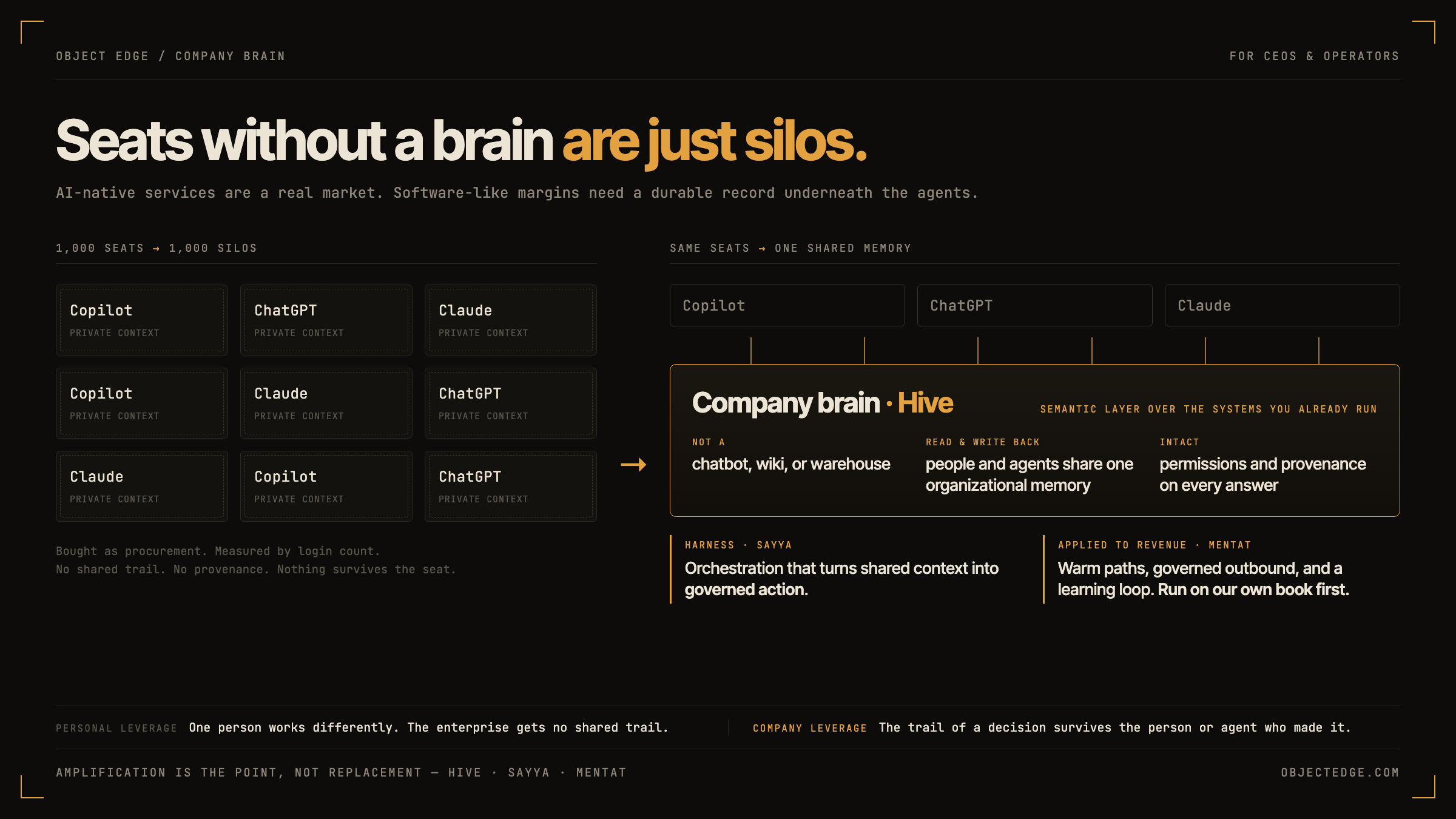
Greg Isenberg has been making the case that AI-native services are roughly a $100B opportunity: agents that deliver finished work at software-like margins, sitting between SaaS wrappers and classic agencies. Amongst my peers the consensus reading is that the next services firm looks like a product company with humans in the loop. I understand that reading. I run Object Edge, a bootstrapped firm that still sells both services and product, so I feel every change in unit economics in the calendar.
I have come to think the interesting question is not whether agents can ship finished work. It is whether an enterprise can keep a durable record underneath those agents. Without that record, you do not get software-like margins. You get a thousand seats and a thousand silos.
Seats without a brain are just silos
For a long time the market treated cloud AI as a procurement problem. Buy seats for Copilot, ChatGPT, or Claude. Roll them out to a thousand people. Measure adoption by login count. It isn’t a procurement problem. It is a context problem.
So what is a company brain? It is a durable semantic layer over the systems you already run, not a chatbot, not a wiki, and not a warehouse, so people and agents can read from and write back to the same organizational memory. At Object Edge that layer is Hive. Sayya is the harness on top of Hive: orchestration that turns shared context into governed action. Mentat is the brain applied to revenue, what we call a company brain for revenue: warm paths, governed outbound, and a learning loop. We run Mentat on our own book first, because I do not trust a product we will not use on ourselves.
Amplification is the point, not replacement
The seats themselves are not the mistake. The mistake is leaving each seat as its own private context. Amplification of those seats requires something underneath them that remembers what the company already knows, with permissions and provenance intact. Personal agent leverage is not company leverage. A thirty-day experiment with a personal harness can change how one person works. It does not give the enterprise a shared trail.
WeGrow as a living example
WeGrow is a live partnership where we are deploying this idea in public enough terms to say plainly. The pattern we keep seeing is “1,000 seats, 1,000 silos.” Companies buy cloud AI seats; each seat becomes its own context island. With WeGrow we are putting Headless Hive underneath the tools people already use, with OAuth and sensitivity guards, so buyers can meet the work in Claude or ChatGPT while Hive remains the trust and permissions plane. Signal-by-category prompts sit on that shared graph rather than in a thousand private chats.
The partnership hypothesis is to co-sell Hive and forward-deployed engineering alongside WeGrow’s change-management and industry problem data, and to prove the motion on a handful of joint pursuits before we talk structure or fundraising. We also have a WeGrow community path: three months of Hive and Sayya at no charge for customers and friends of that community, so the trial runs against real systems rather than a sandbox. I will not invent win rates or revenue for that work. It is early. It is concrete. That is enough for now.
The services P&L is still an open question
There is a second thread I want to leave open on purpose. Amplifying cloud seats and building a company brain for revenue both change how a services firm gets paid. We are preparing for onshore and nearshore unit economics to look different. Humans still run companies, and I believe a combination of human and agent support lasts for years. People will still pay premiums for scarce skills: people who can intelligently lead and apply technology, build relationships, tell a narrative, and establish trust.
How AI-native delivery rewrites a services P&L is not a slide I am ready to publish as settled. We are instrumenting the question. We are not pretending we have solved it. Greg’s $100B frame is useful as a market signal. The operator work is still duller: connect the systems once, keep a shared memory, put a harness on top that can act with evidence, and be honest about what that does to the firm that delivers it.
People do careful work when the trail of a decision survives the person, or the agent, who made it. They get noisy when every seat is a private room with no shared notebook. Finished work at software-like margins will arrive for enterprises that keep the notebook. The rest will keep buying seats.
Sources: Greg Isenberg on X; Object Edge product pages for Hive and Sayya; the WeGrow community trial.
Related articles
-
ai
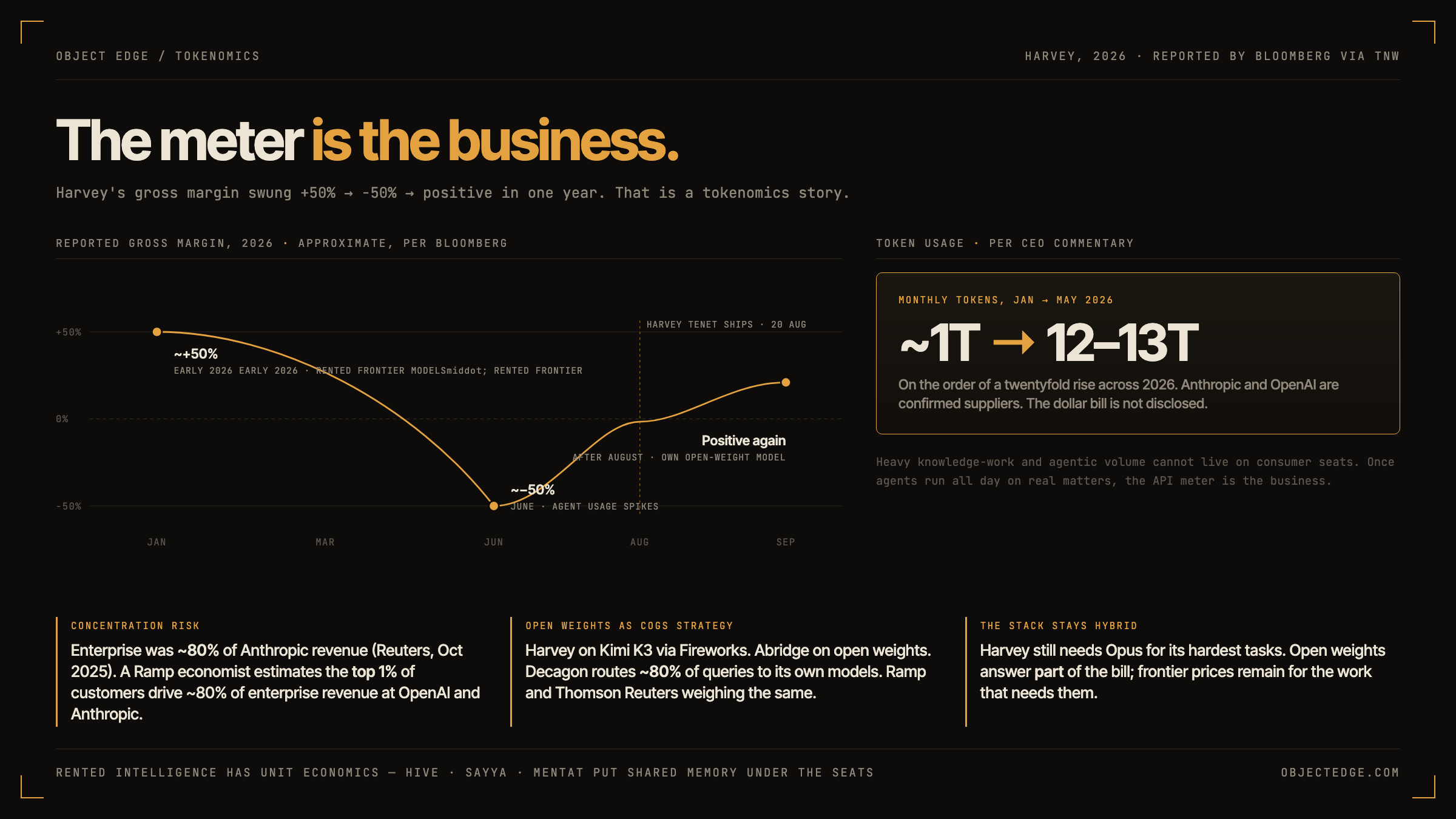
Harvey's Margin Swing Is a Tokenomics Story, Not Only a Legal-AI Story
Harvey's gross margin went from about +50% to about -50% and back positive in 2026 as agent usage spiked on rented frontier models, then moved onto its own open-weight model. What that swing says about metered knowledge work, revenue concentration at Anthropic and OpenAI, and open weights as a cost-of-goods strategy.
-
ai
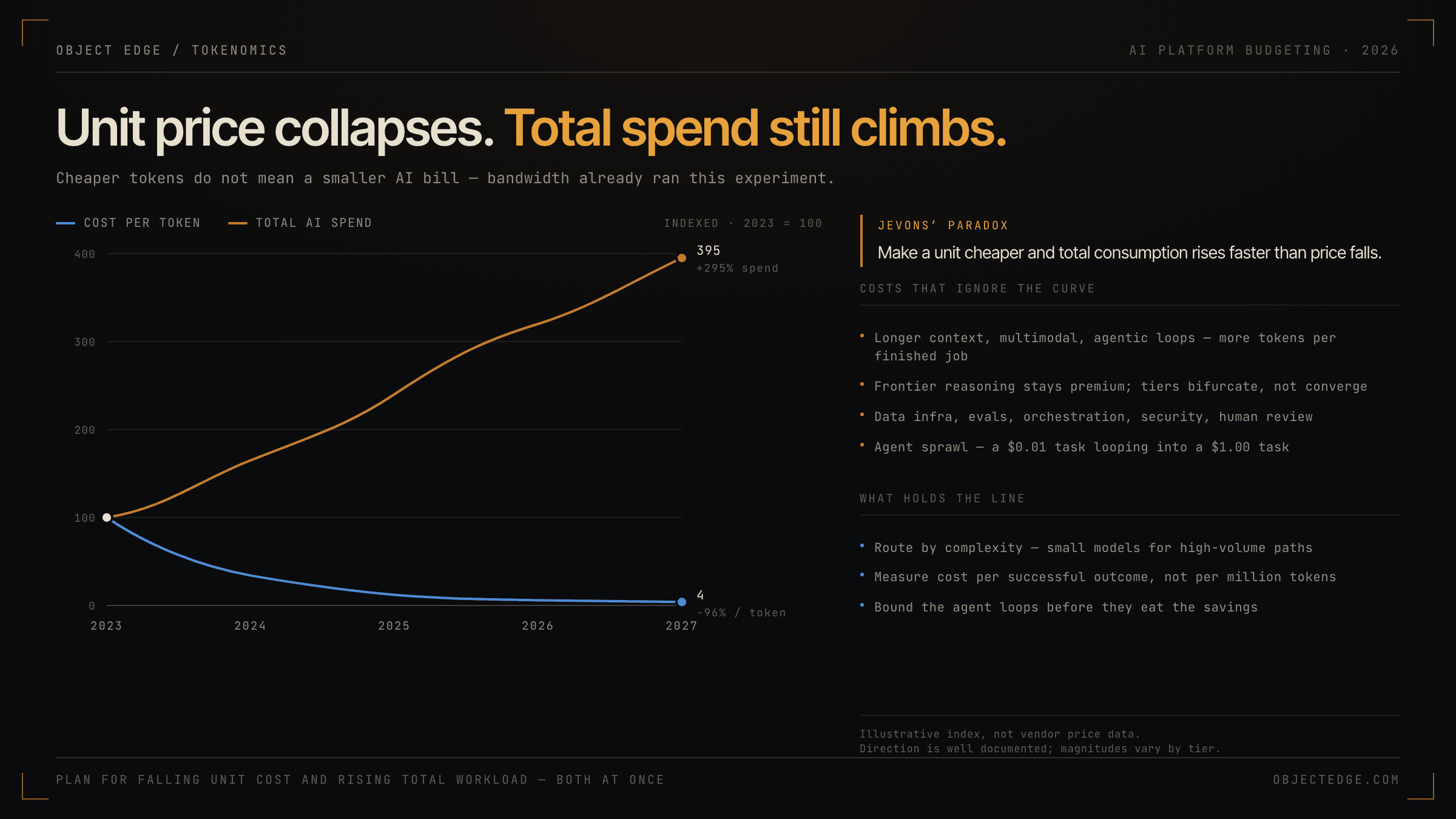
Faster, Cheaper Tokens — Why Your AI Bill Won't Fall Like You Think
LLM inference costs are collapsing along a curve that mirrors internet bandwidth pricing — but buyers who confuse cheaper tokens with lower total AI spend will get burned.
-
ai
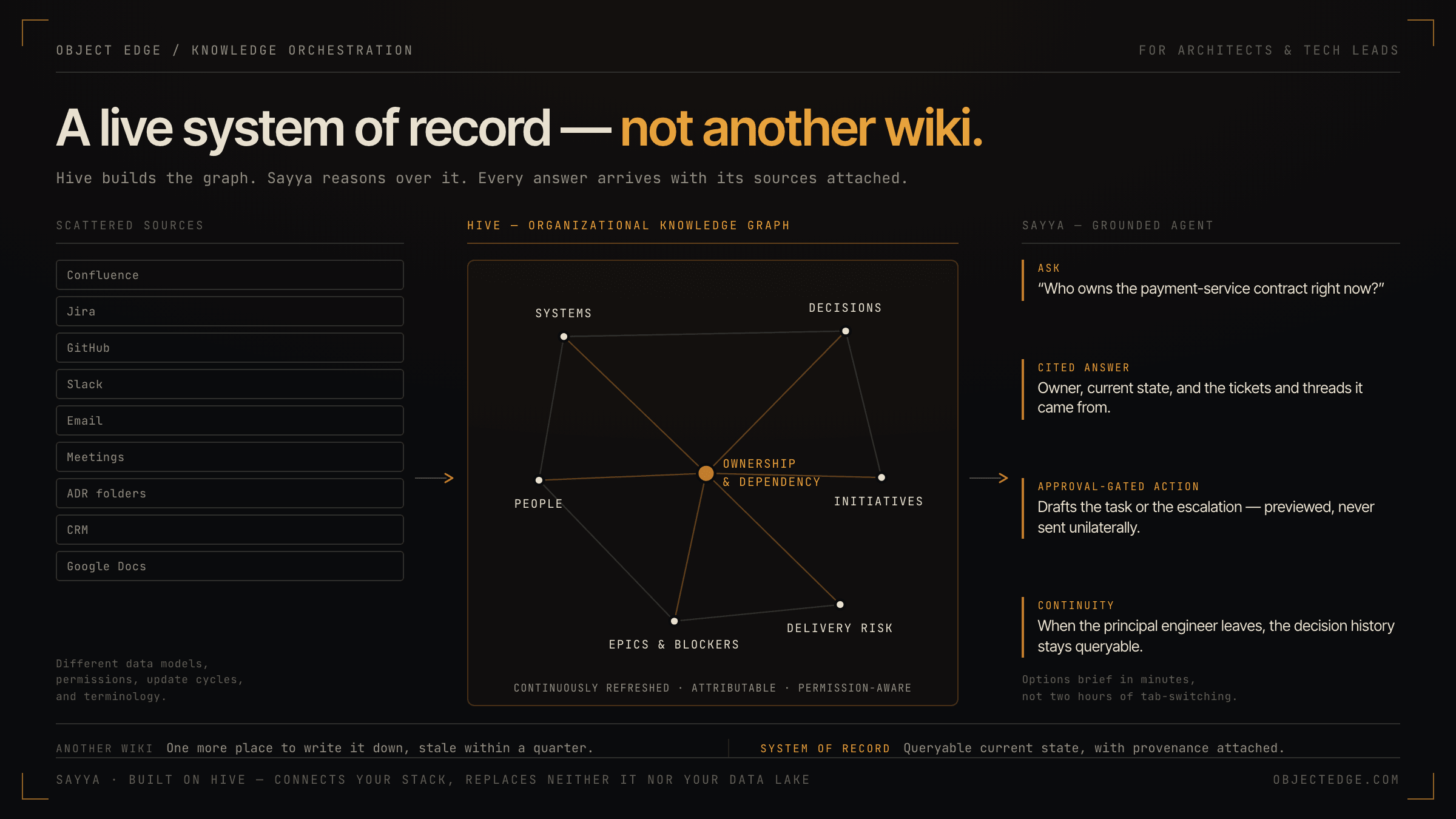
How Hive and Sayya give architects and tech leads a live system of record—not another wiki
Hive builds a continuously refreshed organizational knowledge graph; Sayya is the grounded agent that queries it. Together they give solution architects and tech leads the decision context, dependency visibility, and controlled AI actions that scattered docs and tribal knowledge never could.