Object Edge // Hive for Teams
You deployed five thousand AI seats. Not one of them knows your business.
The seats work. The rollout worked. What is missing is underneath them — there is nowhere for your company’s context to live, so every seat starts from nothing, stays there, and takes whatever it learned with it when the person leaves.
What It Costs You
Four problems, and every one of them scales with headcount.
Every seat starts blank.
Nobody seeded it with company context, so five thousand people are each teaching an assistant what your business is, from scratch, forever.
Everyone works alone.
Five thousand people solve the same problem five thousand times, and the good work can’t travel. The prompt someone perfected last quarter leaves when they do.
Every rollout is per-person, permanently.
Every connection, every skill file, every automation — connected individually, by each person, every time. Multiply that by your headcount, then by every change you will ever want to make.
You can’t switch models.
Move to a better model and the context stays behind. You aren’t locked into a vendor — you’re locked into everything your people already taught it.
The Company Brain
The same four, answered in the same order.
Hive doesn’t add a sixth tool. It adds the layer the other five were missing — one company brain, sitting underneath every seat you already pay for.
Day one, every seat knows the business.
The company brain is already built. A new hire’s first question lands on the same context as everyone else’s thousandth.
What anyone learns, everyone can use.
Work done in one corner of the company becomes available across it — under role-based permissions enforced at the query, not by keeping people in separate islands.
One skill file. One automation. Everybody.
Publish a capability centrally and it applies to the whole organization at once. Change management stops scaling with headcount.
Switch whenever the market moves.
Route some queries to one provider and some to another, and swap either without rebuilding anything underneath. The context is the asset, not the model in front of it.
What It Costs
$25 a seat either way. The difference is who supplies the models.
Hive is not a replacement for the AI licences you have already bought. It goes underneath them. If you would rather consolidate onto our models instead, that path exists too.
Keep the enterprise licence you already signed.
Sayya routes through your existing Microsoft, OpenAI, or Anthropic enterprise agreement. Your negotiated rate, your committed tokens, and your own data-retention terms — all unchanged. Nothing gets ripped out and nothing goes back to procurement.
That is the whole bill. You are already paying for the models.
Nothing to negotiate.
Our keys across multiple providers, or hosted models running where you need them to run. One line item, one vendor, no second model contract to put through procurement.
$1 per million input tokens · $5 per million output tokens
below frontier-model list pricing, because tiered routing keeps routine work off the expensive tier and grounded retrieval keeps raw records out of the context window.
Also available on AWS Marketplace — buy through your AWS account and draw down committed spend.
The Shared Brain, On Film
One question. Six systems. Four minutes.
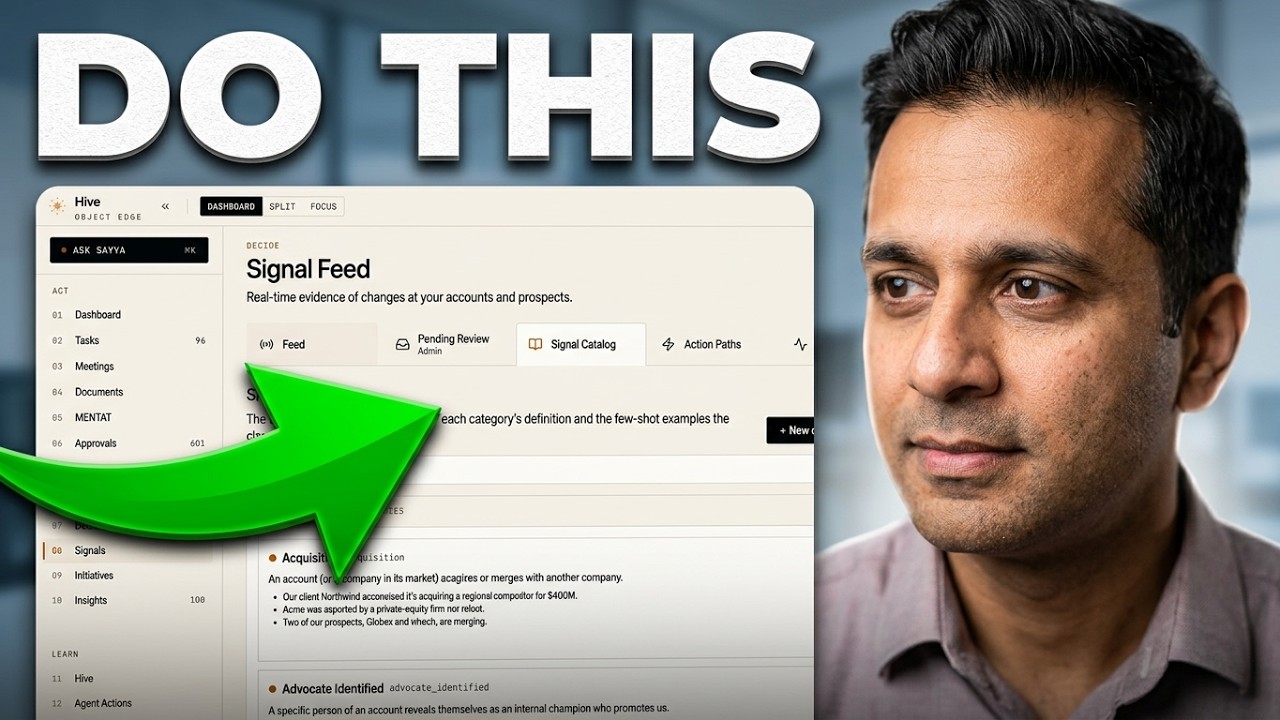
Product data sits in the PIM, pricing in the ERP, content in the CMS. Ask whether you can run a promo and somebody spends three days assembling the answer — then the next person asks and assembles it again. Watch what happens when all of it answers from one company brain instead, with the source attached to every claim.
The same pattern in other operations
The Question We Get Most
“We just bought five thousand Copilot seats.”
Then keep them. You are not replacing that investment — you are making it worth what you paid for it.
The seats were never the problem. A capable assistant with no company context is exactly as good as a capable assistant with no company context, whichever logo is on it. Hive goes underneath the licences you already hold, through the contract you already signed, on the retention terms you already negotiated.
And if you decide later that you would rather consolidate onto one vendor, the replacement path is there. That’s a decision you get to make afterwards, on evidence, instead of upfront on a slide.
Why does Hive answer faster?
Connectors hand the model raw records. Ask a question and it enumerates each system from scratch, then tries to infer how they relate while you wait. It does that again on the next question.
Hive resolves the entities and relationships before the question is ever asked. A query lands on a structure that already exists, so the expensive work of understanding the business happens once instead of on every prompt.
Why does one context matter more than one tool?
Ecosystem assistants are genuinely fast inside their own walls. Ask one to reach a CRM or a ticketing system natively and you are into additional tooling, and from there into copy, paste, and a thread of context that quietly drops on the way across.
Workspace, CRM, ticketing, shared drives, and custom APIs resolve into the same company brain. There is no seam to carry the answer across, because there is no second surface to move it to.
Why does the economics gap widen with adoption?
Re-reading raw records on every question burns tokens, and the bill scales with use. As enterprise agreements move toward usage-based pricing, that pattern gets more expensive at exactly the moment the tool starts working.
Targeted retrieval against resolved context means far less raw material per answer, and tiered models keep routine work off frontier pricing. Cost per answer stays predictable as adoption grows rather than rising with it.
What happens when the best model changes?
Choosing an ecosystem assistant means choosing that vendor’s models, release cadence, and roadmap. The knowledge your people build up inside it is not portable to the next one.
Hive is model-agnostic. Plug in whichever model suits the task and swap it as the market moves, without rebuilding the layer underneath. The context is the asset, not the model in front of it.
Does it get better at your business over time?
A stateless assistant learns nothing durable about your enterprise. Every session starts from zero, and the correction someone made last week is gone.
Corrections, preferences, vocabulary, and successful tool paths persist as durable, inspectable guidance — and they persist for the organization, not just for the person who taught them.
You are connected to your slice. Hive is connected to the organization.
This is the difference that does not close with a better model or a faster connector, which is why we treat it separately from everything above.
Each person connects their own CRM, their own inbox, their own tracker. The assistant sees one employee’s slice of the company. What a colleague knows sits behind their own separate connection, and no prompt can reach across to it. There is nowhere in that design for shared context to live.
Hive holds one company brain underneath a governed access layer. A question can span what several people, teams, and systems know at once, with role-based permissions, provenance, and audit intact. The security boundary is enforced at the query, not by keeping the data in separate islands.
Common Questions
What procurement asks next.
Does Hive replace our Copilot, ChatGPT, or Claude licences?
No. Hive sits underneath the seats you have already deployed and gives them shared company context. You keep the licences and the contract. If you would rather consolidate later, Hive can route through its own hosted models instead, but that is a decision you make afterwards on evidence.
What does $25 per user per month include?
Access to the company brain for that user: shared organizational context, centrally deployed skill files and automations, and model routing through Sayya. If you bring your own enterprise model licence, $25 per seat is the whole bill. If you use our models instead, it is $25 per seat plus usage at $1 per million input tokens and $5 per million output tokens — roughly 70% below frontier-model list pricing.
Can we keep our existing enterprise model contract?
Yes, and most organizations do. Sayya routes through your existing Microsoft, OpenAI, or Anthropic agreement, so your negotiated rate, committed tokens, and data-retention terms all stay exactly as they are. Nothing goes back to procurement.
How does shared context work without breaking permissions?
Access is role-based and enforced at the query rather than by keeping people in separate data islands. A question spans what several people and systems know, but each person only ever sees what they are cleared to see, and every answer carries provenance.
What happens to our accumulated context if we switch models?
Nothing. The context lives in Hive, not in the model. Swap providers, or route different queries to different providers, and the corrections, preferences, vocabulary, and successful tool paths your people built up stay where they are.
How long does a pilot take?
Two weeks with one team. That is long enough for the silo problem to prove itself or not, without a procurement cycle around it.
Start Small
Connect one team for two weeks.
Pick the team that complains most about context. Two weeks is enough for the silo problem to prove itself — or not.
Connect one team for two weeks
Tell us how many seats you’ve deployed, which assistant, and which team feels the context gap most.