Object Edge // Hive Architecture
Underneath the company brain.
The company brain is the idea. The semantic layer is the architecture. The knowledge graph is the implementation. Everything else on this site is about the first one. This page is about the other two.
The Semantic Layer
What “company brain” means once you open it.
A company brain is a semantic layer: a model of what your business is made of and how those things relate, kept current against the systems that actually change. Underneath it, that model is a knowledge graph — typed entities, typed relationships, temporal history, and provenance on every edge.
The distinction matters because it is what separates this from search. Search returns documents that mention a thing. A graph returns the thing, what it is connected to, who owns it, what changed last week, and where every claim came from.
People, organizations, projects, risks, products, and decisions become first-class objects.
Hive resolves duplicates across channels so the person in Slack, the meeting notes, and the CRM are treated as one identity, not three fragments.
The graph stores how the business actually fits together.
Who owns what. What depends on what. Which decision changed which initiative. Which customer issue maps to which account risk.
What changed matters as much as what exists.
Hive tracks the movement of decisions, assignments, and risks over time so teams can ask what shifted this week, not just what is true right now.
The model adapts to your domain instead of forcing a generic schema.
Cruise operations think in decks and ports. Contact centers think in queues and escalations. Revenue teams think in territories and renewals. Hive supports that directly.
Sayya and the Model Layer
Hive is the constant. The model in front of it is the variable.
Sayya is the agentic harness — the surface people work in, and the thing that decides which tools to reach for and which model should do the reasoning. It is deliberately not welded to a provider. Four routing paths are supported, and organizations commonly use more than one at once.
Sayya routes through the agreement you already signed.
Microsoft, OpenAI, or Anthropic enterprise keys. Your negotiated rate, your committed tokens, and — the part procurement actually asks about — your own data-retention terms, unchanged.
Multiple providers, nothing to negotiate.
Object Edge keys across Anthropic, OpenAI, and Fireworks. One line item, no second model contract to put through procurement.
Models running where you require them to run.
Self-hosted or dedicated inference for environments where model traffic cannot cross a controlled boundary.
Bring your own frontend, with a trade-off.
Hive can be queried directly by an external assistant instead of through Sayya. It works — and you give up the orchestration, the persistent memory, and the action paths the harness provides.
Technical Foundation
Built for enterprise reality, not demo environments.
Structured and unstructured ingestion without a warehouse detour.
Pre-built connectors for Google Workspace, CRM, collaboration tools, shared files, and custom APIs mean new system connections land in days, not quarters.
PostgreSQL + pgvector with typed relationships and provenance.
Hive combines structured queries, embeddings, and temporal history so the graph supports both exact answers and semantic retrieval grounded in source material.
One intelligence substrate for every downstream use case.
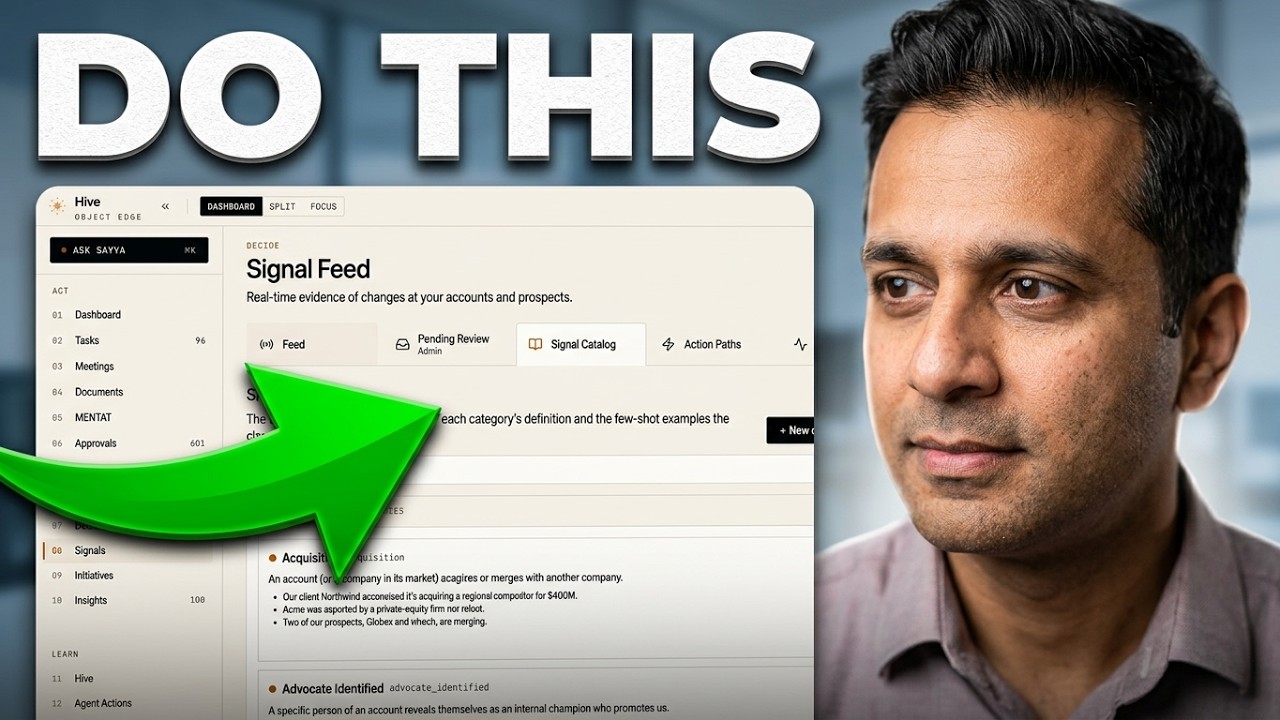
Commerce agents, contact center augmentation, daily planning, QA workflows, and domain copilots all read from the same underlying enterprise context.
Enterprise controls on the query path, not bolted on after.
Role-based access enforced at the query, audit logging, reversible actions, provenance on every answer, and deployment on your own infrastructure. SOC 2 compliant, and reviewed to the standard regulated buyers apply before anything touches production.
How Hive Differs
We get asked about alternatives. The honest answer is that each one solves a different slice of the problem.
Strong at large-scale integration and analytics.
They usually require heavier engineering effort, take longer to operationalize, and stop at read-only analysis instead of decision tracking and action execution.
Strong at task coordination inside a defined workflow.
They do not build a semantic layer across systems, communications, and business context, so the why behind the work still stays fragmented.
Strong at locating documents and references quickly.
Search returns artifacts. Hive returns connected understanding, typed relationships, and a structure agents can act on.
Strong at ad hoc language generation.
Stateless assistants lack org context, persistent memory, system boundaries, and reliable paths to take accountable action inside the enterprise.
The Idea, In 69 Seconds
The architecture exists to make one sentence true.
Every company runs on two kinds of information — the systems, and the human side that never reaches them. A company brain holds both and maps how they connect: this customer, to that contract, to the meeting where it was decided. That map is the ontology, and everything on this page is how it gets built.
What the map produces once it exists
Back to the Problem
The architecture only matters because of what it makes possible.
Three markets, three problems, one layer underneath all of them.