ai
AI's Highest-Leverage Use Case: Multiplying Human Potential, Not Replacing It

The real enterprise problem isn’t “management”—it’s amplification
For most of the modern enterprise era, we’ve treated one question as a management problem: how do we unlock the full potential of a workforce?
We hired managers. We built org charts. We created planning processes, performance reviews, operating rhythms, and layers of oversight meant to help people do their best work. And to be fair, a lot of enterprise value has come from getting management right.
But I think the fundamental challenge of the 21st century is bigger than management. It’s how to unlock the potential of an enterprise workforce at scale, not just through supervision, but through amplification. That’s where AI becomes profoundly interesting.
A lot of the current conversation around AI is framed in terms of replacement. Which jobs will disappear? Which functions will shrink? How much labor can be automated away? That framing is understandable, but I think it misses the more important opportunity.
The real power of artificial intelligence is not in its ability to be a force replacement. It’s in its ability to be a force multiplier.
That distinction matters.
A force replacement mindset asks: how do I remove people from the system?
A force multiplier mindset asks: how do I make every person in the system dramatically more capable?
Those are very different futures.
In the first future, AI is mostly a cost story. In the second, it is a capability story. And history suggests that capability stories are where the largest outcomes get created.
Managers Were the Original Multipliers
If you zoom out, the reason organizations rely so heavily on managers is simple: managers are supposed to multiply human effectiveness.
A great manager clarifies priorities, removes friction, coaches judgment, allocates attention, and creates accountability. They help a team do more together than individuals could do alone.
In other words, management has always been a scaling technology for human potential.
But management has limits.
Even exceptional managers only have so much time, energy, context, and pattern-recognition bandwidth. As organizations grow, those limits show up everywhere: decisions slow down, knowledge gets trapped in silos, execution quality becomes uneven, great ideas die in translation, and talented people spend too much time navigating the system instead of creating value.
This is exactly why AI matters.
AI can extend many of the multiplier functions that have historically depended on scarce human management capacity. It can help people think more clearly, communicate more precisely, access context faster, make better decisions, and execute with less friction.
Not someday. Now.
The Under-Researched Opportunity Inside the Enterprise
In my view, one of the most under-researched questions in business today is this: what happens when every person in an organization gets access to intelligence leverage?
Not just the executive team. Not just the analysts. Not just engineering. Everybody.
What if every salesperson had sharper preparation, better account memory, and faster synthesis? What if every delivery lead had an always-on operating partner that could surface risks, summarize status, and tighten follow-through? What if every manager could scale coaching, planning, and communication quality? What if every individual contributor could spend less time assembling context and more time applying judgment?
That is not a headcount reduction thesis.
It is an organizational potential thesis.
And it changes the unit of analysis.
Instead of asking, “What roles can AI replace?” we should also be asking, “What output, quality, judgment, and speed can AI unlock per person?”
That second question is much more interesting.
Because if AI increases the effectiveness of every node in an enterprise system, the effect is not linear. It compounds.
Better thinking improves better decisions. Better decisions improve better execution. Better execution improves customer outcomes. Better customer outcomes create more learning, more trust, and more opportunity.
That is what a real multiplier looks like.
AI Should Sit Inside the Flow of Work
The enterprise often makes a predictable mistake with new technology: we treat it like a destination instead of an embedded layer. We create separate systems, separate workflows, separate teams, separate experiments, and then we wonder why adoption stalls.
The highest-leverage use of AI is not to ask people to leave their work and go “use AI.” It’s to put intelligence inside the flow of work itself.
Inside meetings. Inside decisions. Inside account planning. Inside delivery management. Inside writing. Inside analysis. Inside follow-up. Inside the thousand small moments where momentum is either created or lost.
When AI is embedded properly, it does not feel like a tool someone has to remember to use. It feels like the organization got sharper.
That is the bar.
The Best Organizations Will Multiply, Not Just Automate
There will absolutely be automation. There should be. Any repetitive, low-judgment, low-value work that can be compressed should be compressed.
But if that is where the strategy stops, leaders will massively under-capture the opportunity.
The best organizations will use automation as a floor, not the ceiling.
Their real advantage will come from building enterprises where people are better informed, decisions are better framed, context moves faster, expertise becomes more accessible, managers become more effective, and teams spend more time creating value and less time fighting entropy.
That is a different ambition.
It says the goal is not merely to do the same work with fewer people. The goal is to build a company where the people you have can operate at a dramatically higher level.
That is the kind of advantage competitors feel.
This Is a Leadership Question, Not Just a Technology Question
AI will not become a multiplier automatically. If deployed poorly, it can create noise, dependency, shallow thinking, and a new layer of digital clutter. We should be honest about that.
But if deployed well, it can become one of the most important leverage layers ever introduced into the enterprise.
That puts the burden on leadership.
Leaders have to decide what game they are playing. Are they trying to squeeze labor out of the system? Or are they trying to elevate the capability of the system?
Those choices shape everything: where AI gets embedded, which workflows get redesigned, how teams are trained, what gets measured, whether trust grows or erodes, and whether AI becomes empowering or threatening.
In other words, the technology does not determine the outcome by itself. The operating philosophy does.
The Bigger Idea
I believe we are still early in understanding what enterprise intelligence augmentation really means.
We have spent decades optimizing workflows, reporting structures, and management practices around a world in which human attention was the hard bottleneck. Now we are entering a world where intelligence itself can become more available, more ambient, and more operationalized.
That should force us to revisit some basic assumptions about how organizations work.
Maybe the most important contribution of AI will not be doing human work for us. Maybe it will be helping humans do better work with greater consistency, confidence, and scale.
Maybe the real transformation is not replacement. Maybe it is amplification.
And if that is true, then the fundamental challenge of this century is no longer just managing people well. It is designing organizations that systematically unlock more of the potential already inside them.
AI, at its best, gives us a chance to do exactly that.
Not by replacing the workforce.
By multiplying it.
Related articles
-
ai
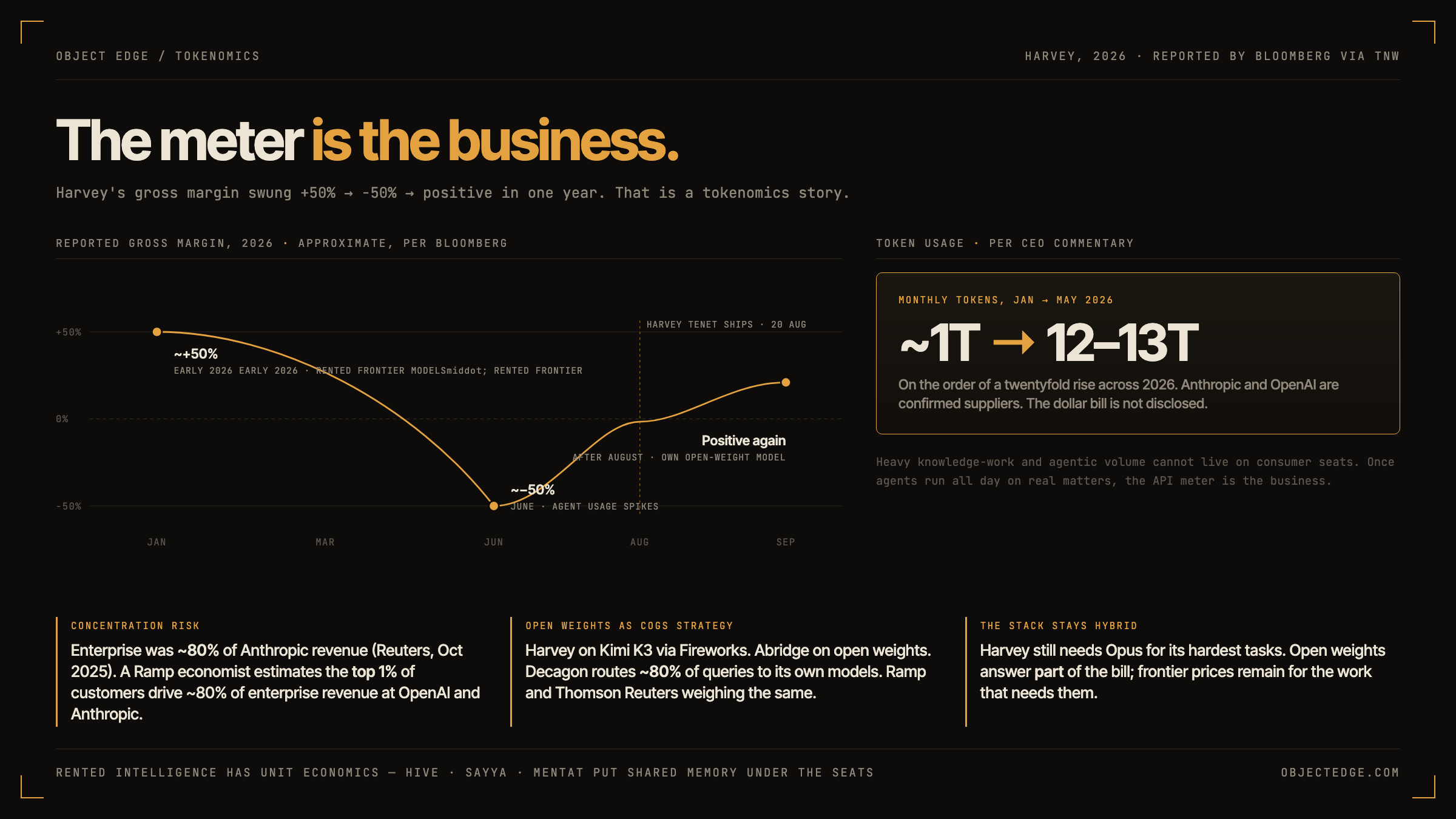
Harvey's Margin Swing Is a Tokenomics Story, Not Only a Legal-AI Story
Harvey's gross margin went from about +50% to about -50% and back positive in 2026 as agent usage spiked on rented frontier models, then moved onto its own open-weight model. What that swing says about metered knowledge work, revenue concentration at Anthropic and OpenAI, and open weights as a cost-of-goods strategy.
-
ai
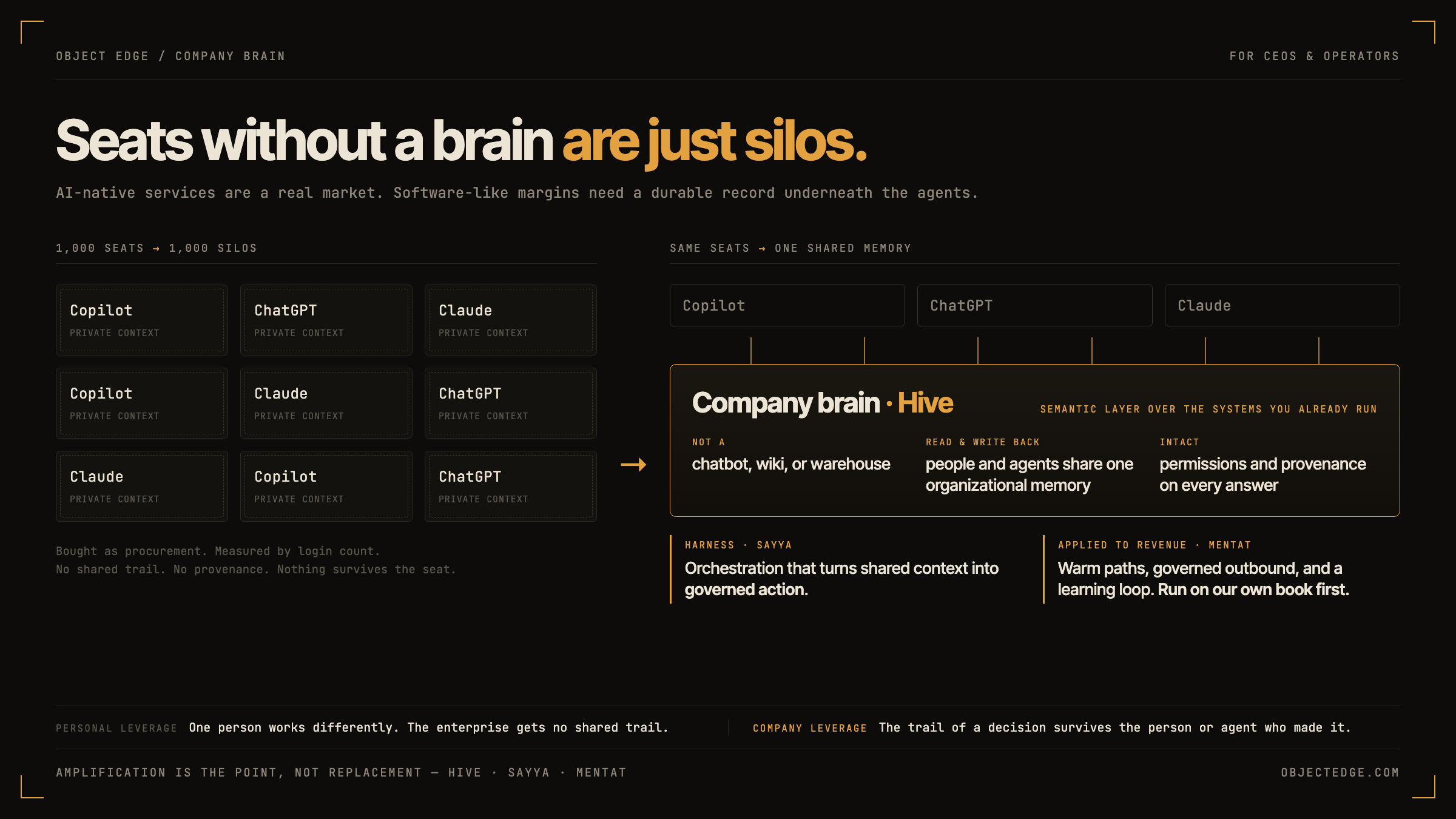
AI-Native Services Are a Real Market. Enterprise Still Needs a Company Brain.
Greg Isenberg's $100B AI-native services thesis is right about the market. The operator question is whether the enterprise keeps a durable record under its agents. Without one, a thousand AI seats become a thousand silos.
-
ai
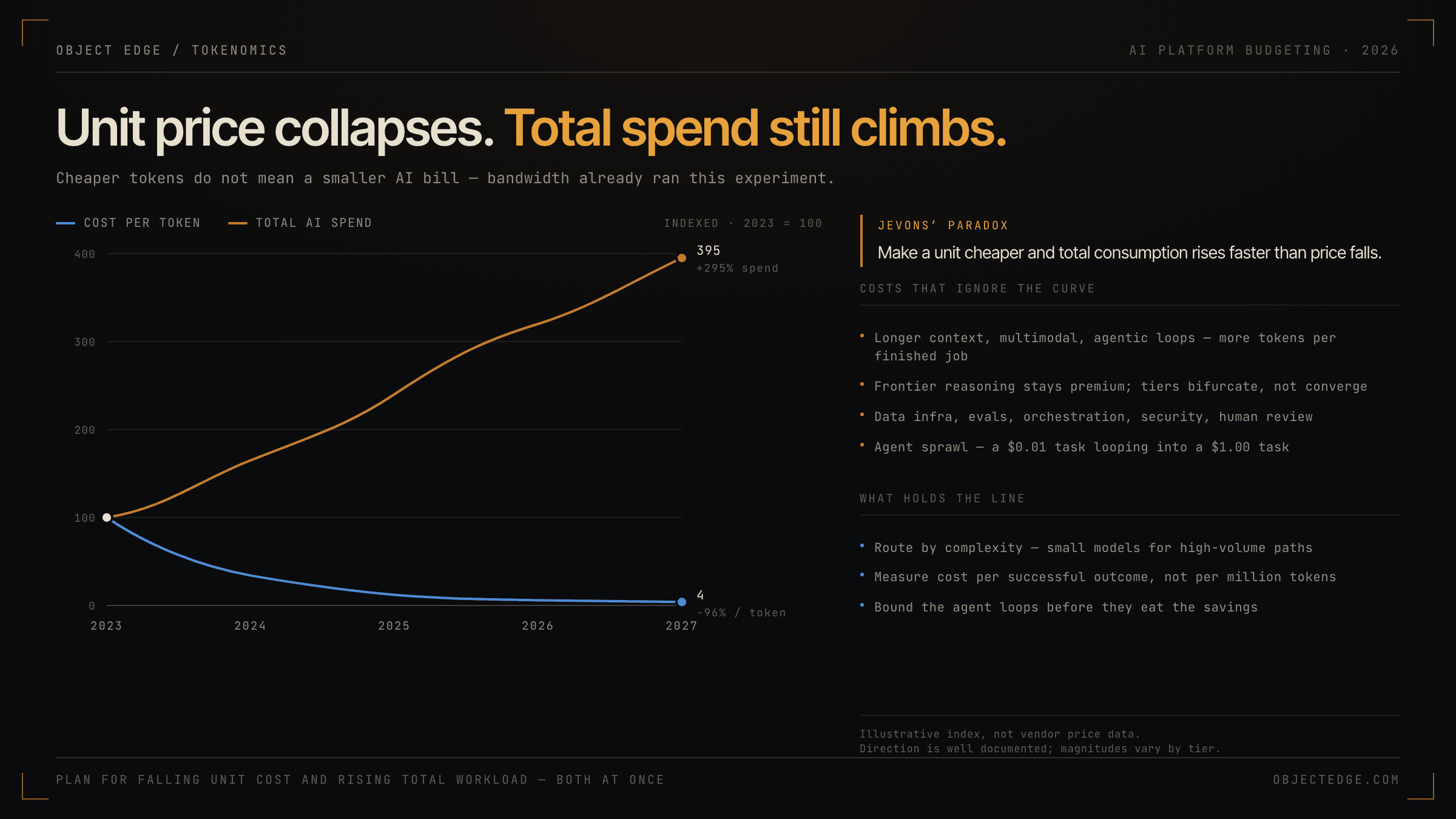
Faster, Cheaper Tokens — Why Your AI Bill Won't Fall Like You Think
LLM inference costs are collapsing along a curve that mirrors internet bandwidth pricing — but buyers who confuse cheaper tokens with lower total AI spend will get burned.