ai
AI That Makes Workers More Powerful — Not Replaceable
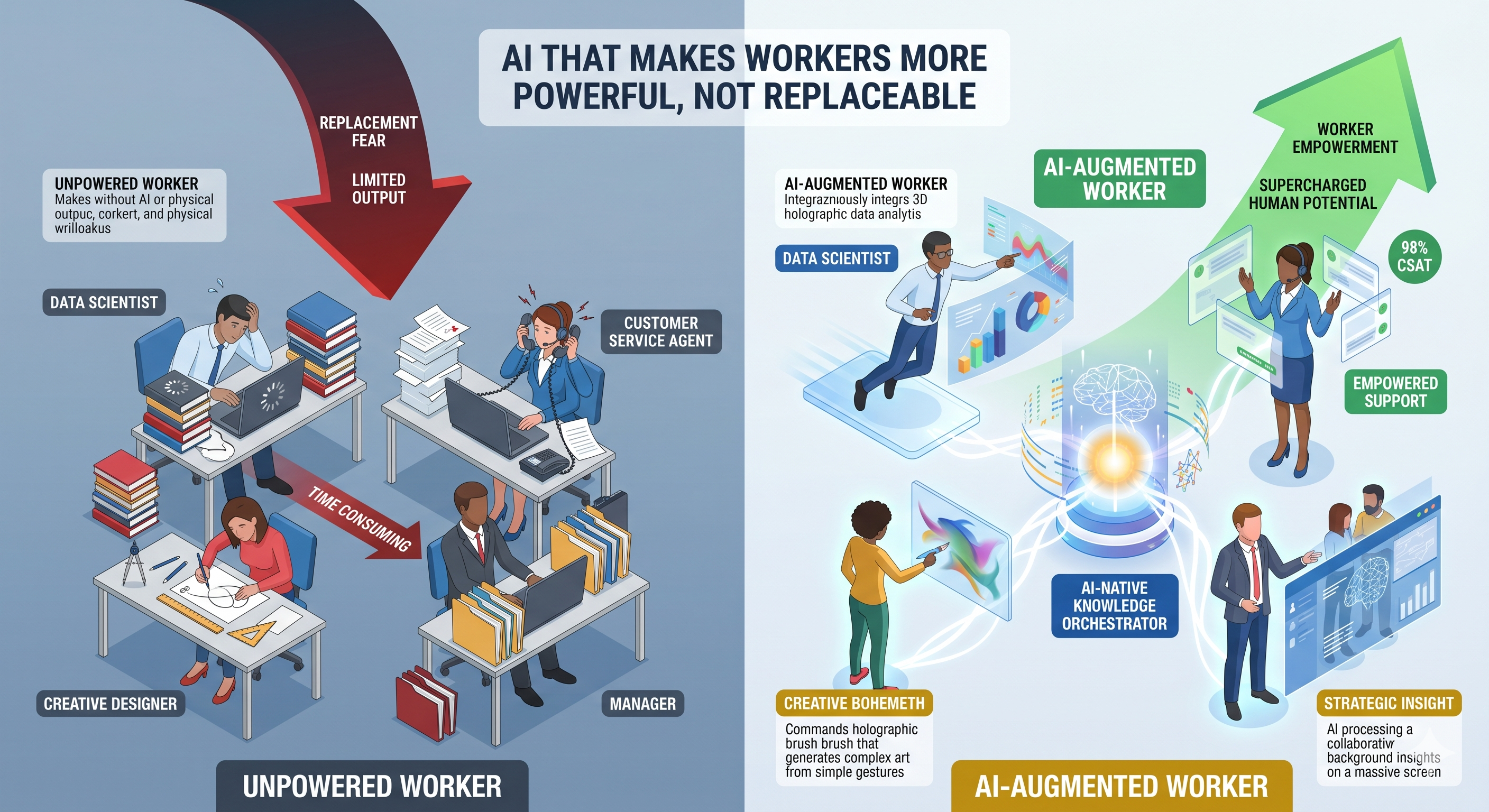
AI That Makes Workers More Powerful - Not less Employed
The most important question in enterprise AI is not whether it can automate work. It’s whether it can make people more powerful.
That has been the core design principle behind Hive and Sayya from the beginning. We are not building systems to sideline workers. We are building tools that give them better visibility, faster execution loops, and more leverage over increasingly complex organizations. The goal is simple: help people do higher-value work, serve clients better, and create the conditions for more growth and more hiring.
Our thesis: AI should expand human capacity
Most AI products are framed around replacement. Fewer people. Less labor. Smaller teams.
We think that framing is too small.
In real companies, the biggest constraint is rarely that people exist. It’s that coordination fails, context is fragmented, priorities drift, decisions get stuck, and leaders lack clear visibility into what is actually happening. The result is missed opportunities, slower client delivery, weaker follow-through, and unnecessary organizational drag.
Hive and Sayya are designed to attack that drag directly.
They help leaders and teams:
- understand what is happening across the business in real time
- track initiatives and decisions across functions
- identify blockers, overdue work, and execution risk
- connect customer, project, and operational context in one place
- turn fragmented information into usable action
That is not a replacement story. It is an amplification story.
An Example What these tools actually do - we are client 0
Hive, here at Object Edge, serves as an organizational intelligence layer. Sayya acts as an executive copilot on top of it. This is just our usage of it.
Together, they can:
- map people, initiatives, tasks, clients, decisions, and relationships across the company
- surface execution risk before it becomes failure
- help leaders see where momentum is real and where work is stuck
- retrieve relevant organizational context instantly
- support better planning, follow-up, and decision-making
- make it easier for teams to move from discussion to action
This matters because knowledge work is often bottlenecked not by intelligence, but by discoverability, alignment, and responsiveness.
When those bottlenecks shrink, workers become dramatically more effective..
These tools have already been used for:
- executive visibility across accounts, initiatives, and priorities
- account orchestration and tracking
- KR and execution monitoring
- surfacing risk and follow-up needs
- scheduling and coordination
- preparing for key internal and external meetings
- turning strategic ideas into concrete tasks and outputs
Even in simple use, the leverage is obvious: less time hunting for context, less managerial guesswork, less dropped follow-through, and faster movement from idea to execution.
For leaders, that means better judgment with less friction.
For operators, that means fewer coordination penalties.
For teams, that means more capacity to actually deliver.
Why this creates value for clients
The real economic case for AI in services businesses is not just labor reduction. It is client value expansion.
Take a company like Object Edge. A project manager there is often sitting at the center of a highly complex delivery environment: client expectations, internal teams, deadlines, dependencies, blockers, status reporting, changing priorities, and commercial pressure.
In a normal environment, a large part of that job is spent chasing updates, reconciling conflicting information, escalating issues late, and manually maintaining alignment.
With tools like Hive and Sayya, that same project manager can operate at a much higher level.
They can:
- get instant visibility into project state
- spot slippage and blockers earlier
- coordinate teams with better context
- prepare client updates faster
- make better escalation decisions
- reduce avoidable delivery surprises
- improve responsiveness and confidence with the client
That means better outcomes for the customer.
And better outcomes for the customer usually create more demand:
- stronger trust
- more retained business
- broader scopes
- better expansion opportunities
- more referrals
- larger accounts over time
This is where the conversation gets important.
If a project manager can successfully handle more complexity, serve clients better, and help the company win more business, the end state is not necessarily fewer workers. It can just as easily be more revenue, more accounts, more projects, and more hiring.
Productivity growth should lead to business growth
Historically, the best productivity tools have not simply eliminated work. They have changed the scale at which businesses can operate.
Spreadsheets did not eliminate finance teams.
CRMs did not eliminate sales orgs.
Cloud software did not eliminate engineering.
Instead, these tools allowed companies to do more, respond faster, and expand what was economically possible.
We believe enterprise AI will follow the same pattern when built correctly.
If AI helps a services company:
- deliver better work
- manage more client complexity
- reduce operational drag
- increase customer satisfaction
- improve margin and responsiveness
then that company can grow.
And when companies grow, they hire.
Not just because there is more work, but because the quality of work shifts upward. More strategy. More client leadership. More creative problem-solving. More specialized execution. More roles that exist because the company can now serve more customers at a higher standard.
The future worker is not replaced — they are upgraded
The best use of AI is not to erase the worker. It is to remove the waste around the worker.
That means:
- less time searching
- less time re-explaining
- less time chasing status
- less time manually stitching together context
- less time operating blind
And more time:
- deciding
- building trust
- solving hard problems
- serving customers
- growing accounts
- creating new value
This is the future we are trying to build with Hive and Sayya.
A future where AI helps people see more, do more, and lead more effectively.
A future where productivity gains do not shrink ambition, but expand it.
A future where the result of better tools is not fewer humans in the system, but more capable humans building more valuable companies.
That is the standard we think AI should meet.
And it is the one we are building toward.
Schedule a conversation about knowledge orchestration that makes your workers more powerful, not more replaceable.
Contact us to see how Hive and Sayya can amplify your team’s capabilities.
Related articles
-
ai
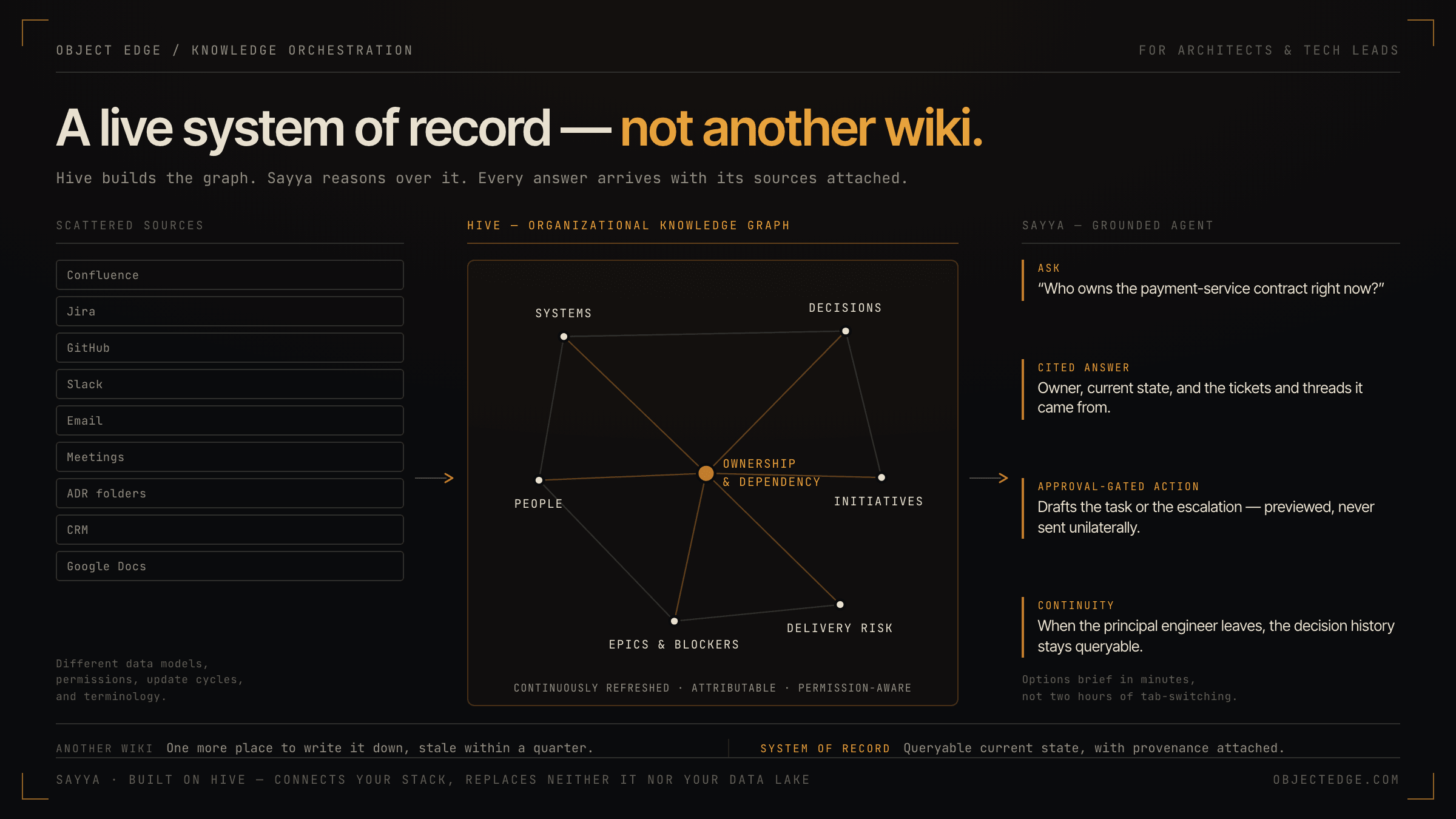
How Hive and Sayya give architects and tech leads a live system of record—not another wiki
Hive builds a continuously refreshed organizational knowledge graph; Sayya is the grounded agent that queries it. Together they give solution architects and tech leads the decision context, dependency visibility, and controlled AI actions that scattered docs and tribal knowledge never could.
-
ai
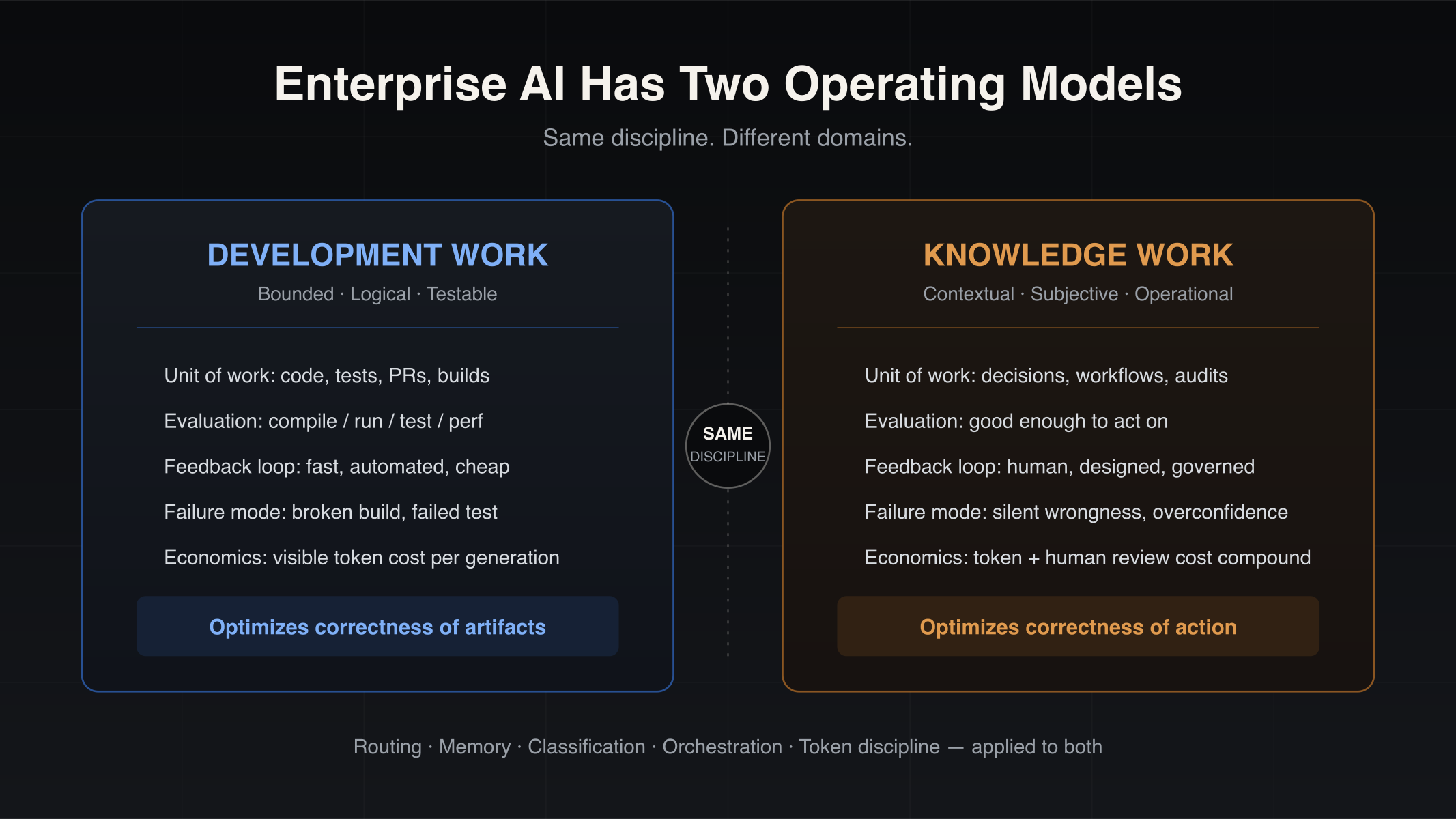
Enterprise AI Has Two Operating Models: Development Work and Knowledge Work
Enterprise AI is splitting into two operating models — development work and knowledge work. Why coding-copilot playbooks stall on operational workflows, and which engineering disciplines transfer.
-
ai
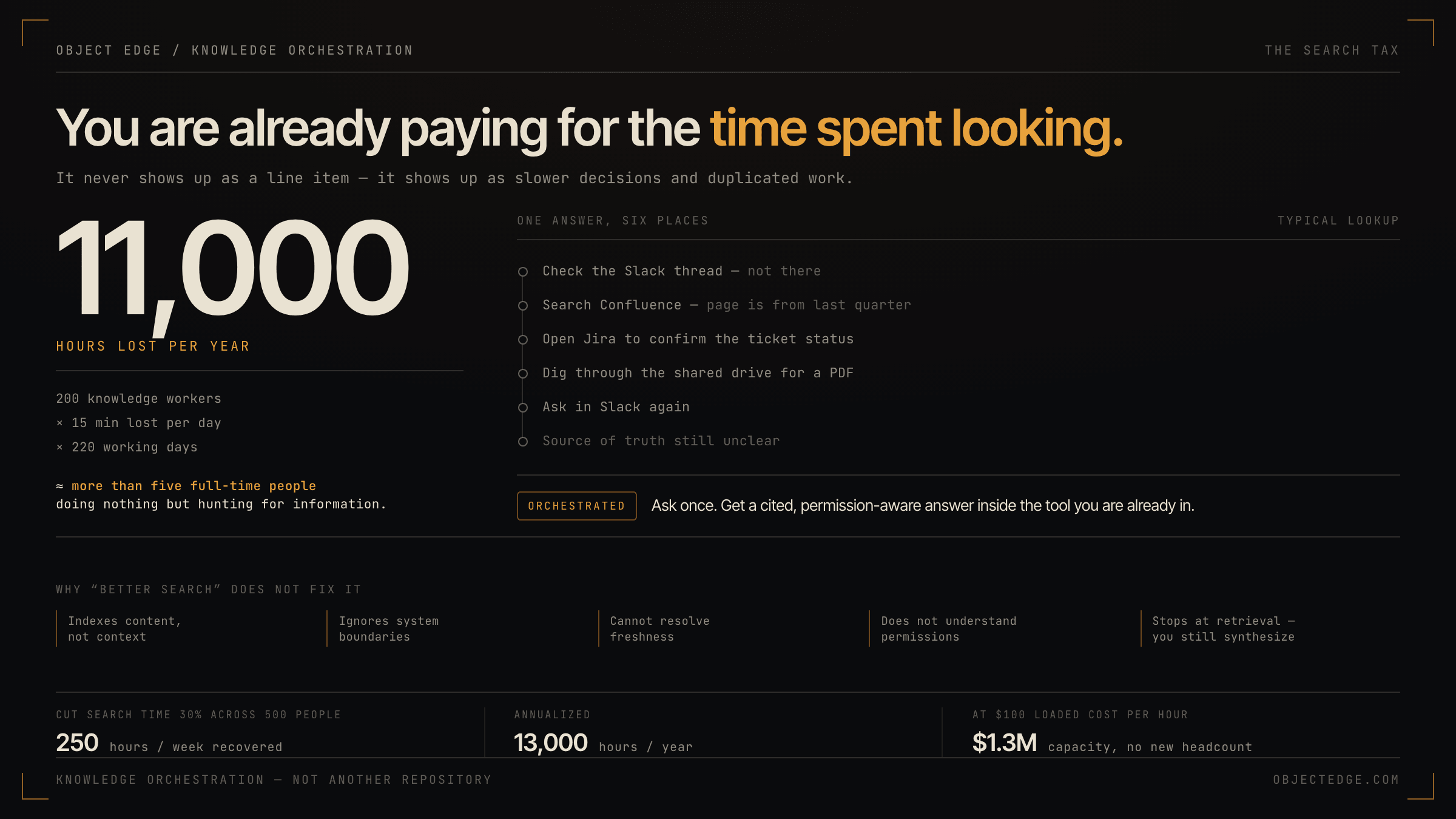
Stop Losing Hours to Search: How Knowledge Orchestration Cuts Time Wasted Across Systems
Why teams burn hours hunting for answers across tools, and how knowledge orchestration reduces that friction for engineering and operations leaders.