ai
Anthropic's revenue is strong. Why should infrastructure investors worry?
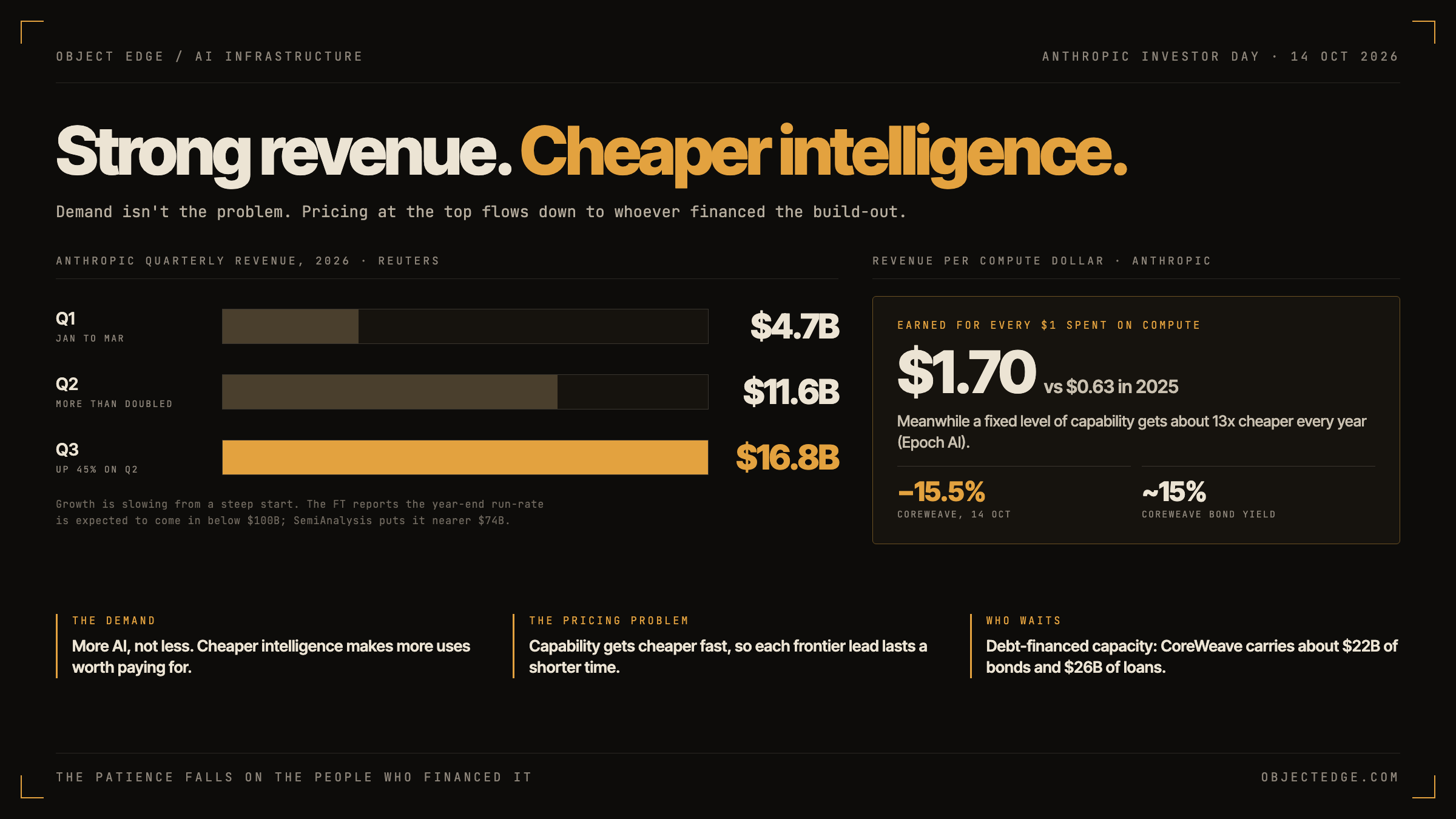
I’ve been bullish on Anthropic’s revenue for a long time, and its investor day on 14 October proved the point. Q3 revenue came in at $16.8B, against $11.6B in Q2 and $4.7B in Q1, according to Reuters. That’s 45% growth on the quarter, after more than doubling the quarter before. The company was profitable on an adjusted basis for the second quarter in a row and had positive free cash flow. Bloomberg reported an adjusted gross margin of 85%, and the FT reported an adjusted operating margin of 11%, citing people familiar with the matter. Perhaps the most telling figure is that Anthropic now earns $1.70 of revenue for every dollar it spends on compute, compared with about $0.63 in 2025.
However, I believe the same week also exposed the biggest risk to the AI infrastructure trade. That risk isn’t weak demand. It’s that frontier intelligence keeps getting cheaper to build and serve, and the companies paying for most of the infrastructure are the ones most exposed to that.
If revenue is this good, what is the problem?
The problem is the rate of growth, not the level. The FT described growth as slowing and coming in below some expectations. The FT reported that the annualized run-rate at year-end is expected to come in below $100B, and SemiAnalysis puts it nearer $74B. Both are still enormous numbers. But markets have been pricing the whole infrastructure layer as though frontier-lab growth would keep compounding at the pace of the first half.
The FT pointed to three causes. Meta and Microsoft are leaning more on their own models. Low-cost Chinese labs have started a price war, which is why Anthropic says Haiku 5.5 costs around 75% less to run than the model it replaced. And Anthropic is deliberately cutting its distillation revenue. None of this means the business is weak. It means the easy part of the growth curve is behind it.
Why does cheaper intelligence hurt the moat?
Let’s take a step back to understand why. The moat for a frontier lab has been how much compute it can throw at the next model. Whoever trains the biggest, best model first gets the pricing power, at least for a while.
That moat gets thinner when capability itself gets cheap. Epoch AI estimates that the price of reaching a fixed level of capability has fallen about 13x a year since 2023, or roughly 47% a quarter. In other words, whatever a frontier model can do today, a far cheaper model will be able to do soon. If everyone can reach yesterday’s frontier cheaply, the race to the next one starts to look close to zero-sum: enormous spend for a lead that lasts a shorter time each cycle.
What does distillation have to do with it?
Distillation is the practice of training a smaller or competing model on another model’s outputs, in effect copying the capability without paying to create it. On 12 October Anthropic published a post called Strengthening our defenses against distillation attacks. It says the company has “turned away meaningful revenue and trillions of tokens’ worth of paying traffic from distillers,” and acknowledges that “illicit distillers are still paying customers… it would be easy for companies to do nothing.” It reports cutting extraction by 10 to 100 times and banning tens of thousands of accounts.
According to anonymous sources speaking to the FT and The Information, Anthropic reportedly told investors that distillation made up 5-7% of revenue. My read, and it is only my read, is that the company put up with that traffic for as long as it did because it paid. Cutting it now protects the moat, but it costs revenue that is already gone. You can’t defend a lead by selling copies of it.
Why does a slower frontier lab matter to the whole infrastructure layer?
Here’s what I think is happening. The frontier labs have been the ones writing the biggest checks for data centers, GPUs, and cloud capacity. When their growth slows, even while it stays strong, you have to mark down the growth rate across everything they buy.
It is important to be precise here. Anthropic has committed at least $518B to compute and cloud over the next decade, so the spending isn’t disappearing. What changes is how fast it grows and what it goes to. As models get cheaper to serve, more of the money shifts from training giant models toward cheaper inference, and fewer dollars are needed per unit of work. Serving cheaper models on GPUs means less money flowing to rent or buy GPUs.
What does CoreWeave tell us?
CoreWeave shows the debt-financed end of that chain. On 14 October it closed at $65.78, down 15.46%, about 65% below its high of around $187. Nebius fell 10-11% and Oracle about 9%, and Reuters estimated about $80B of value was wiped out across the group. To be fair, the main trigger that day was a hot CPI print and rising rates, with the 30-year Treasury at 5.63%.
The structure underneath is what concerns me. CoreWeave carries roughly $22B of bonds and $26B of loans, according to LSEG data cited by Reuters, against a market value of about $36B. Its bonds yield around 15%, and its 2032 unsecured notes trade below 80 cents on the dollar. There’s also some circularity: Nvidia supplies its GPUs, owns about 10-11% of the company, and under a September 2025 filing must buy up to $6.3B of unsold capacity through April 2032. The CEO points to a $104.2B backlog. That backlog is real, but a backlog financed with debt depends on customers whose own growth is now being marked down.
How does the eight-state lawsuit change the picture?
On 14 October, Arizona, Arkansas, Idaho, Iowa, Kansas, Montana, Nebraska, and West Virginia each sued OpenAI separately in state court under consumer-protection laws. The suits are bipartisan. They claim OpenAI deceived parents about safety, built dependence through sycophancy and feigned compassion, encouraged self-harm, and collected minors’ data. The remedies they seek include disgorgement, data deletion, and limits on testing advanced models.
The suits target OpenAI alone. My concern is broader. The two main revenue sources for the infrastructure layer are OpenAI and Anthropic, and liability risk on either one weighs on valuations and adds cost. I think it is a fair extrapolation that this kind of risk can eventually reach the platforms they run on, even though nothing in these filings says so yet.
So why am I still bullish long term?
Because none of this changes the direction of demand. We are going to use more AI, not less, and that needs GPUs, CPUs, and memory. Cheaper intelligence makes more uses worth paying for, which is good for the companies that sell the underlying capacity at scale.
As of the 14 October close, according to StockTi, Nvidia traded at about 24.5x forward earnings, Micron at 6.5x (memory is cyclical, so that number deserves caution), Microsoft at 24.5x, Alphabet at 28.1x, Amazon at 25.5x, and Meta at 22.1x. Reuters described Nvidia and the hyperscalers as “highly profitable and widely perceived as well managed.” To me these are excellent cash-flow businesses at reasonable prices, and the hyperscalers in particular win because everything ends up running on their infrastructure. My personal view is that they may get cheaper before they recover, and holding through that dip makes sense to me. I’m an operator, not an analyst, so please treat this as my opinion and not investment advice.
The patience falls on the people who financed it
In summary, the AI trade doesn’t have a demand problem. It has a pricing problem at the top that flows down through everyone who financed the build-out on the assumption that frontier growth would stay steep. Cheap intelligence is wonderful for the people and businesses who use it. The patience it requires falls mostly on the people who paid to build it, and I think the ones with real cash flow can afford to wait.
Sources
- Reuters, Anthropic’s Q3 revenue surges 45% to nearly $17 billion
- Financial Times, Anthropic Q3 results
- BBC, Anthropic investor day
- Yahoo Finance, Anthropic’s $2 trillion IPO pitch
- Anthropic, Strengthening our defenses against distillation attacks
- CNBC, CoreWeave stock and bond yields
- Investing.com, Hot CPI report fuels AI rout
- NBC News, OpenAI sued by eight states
- StockTi, mega-cap forward P/E
- Epoch AI, The plunging price of thought
Related articles
-
ai
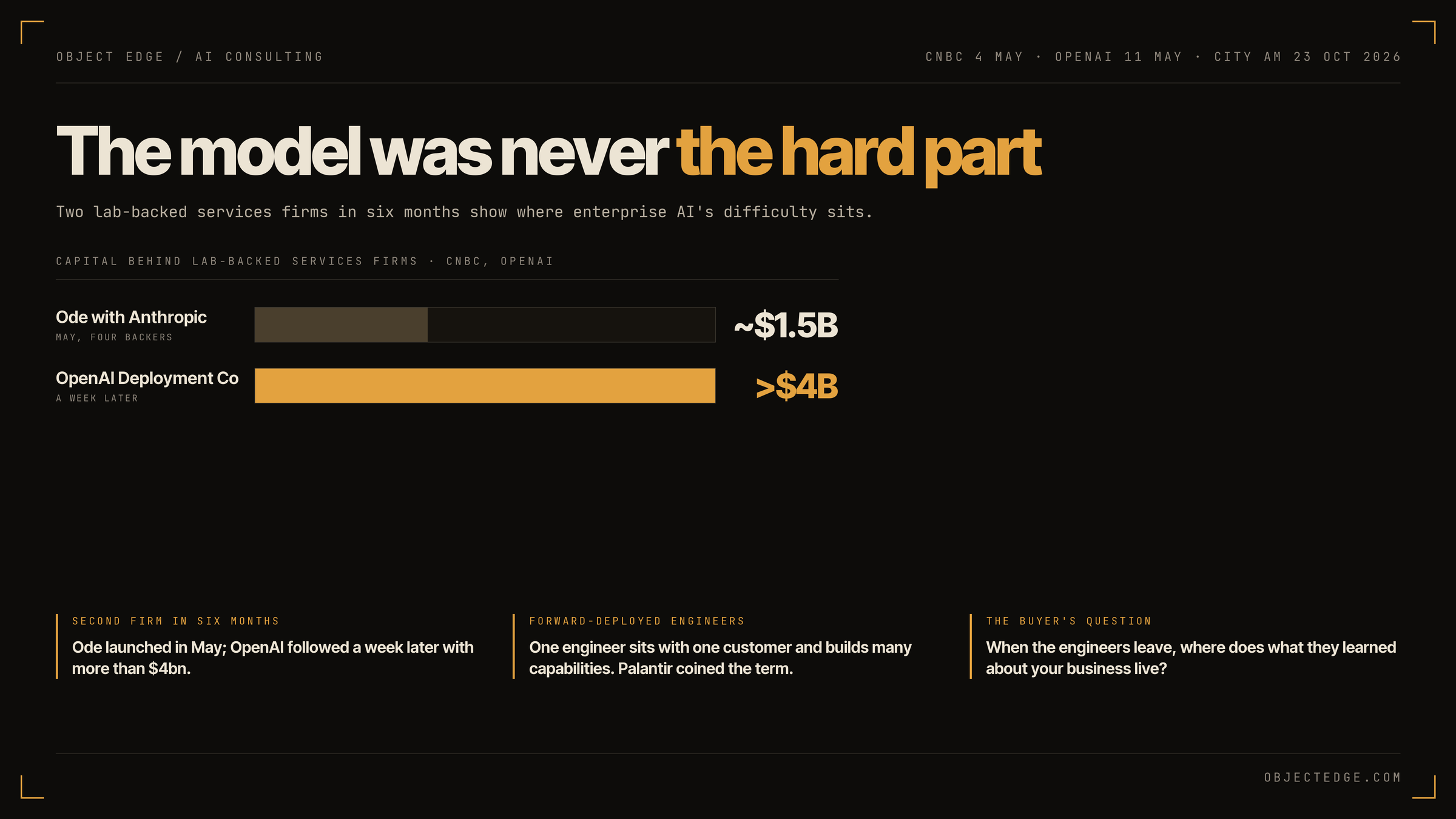
Anthropic is reportedly building a consultancy. The model was never the hard part.
Anthropic and Hg, the UK buyout group, are reportedly creating an independent company that will embed AI consultants and engineers inside European businesses
-
ai
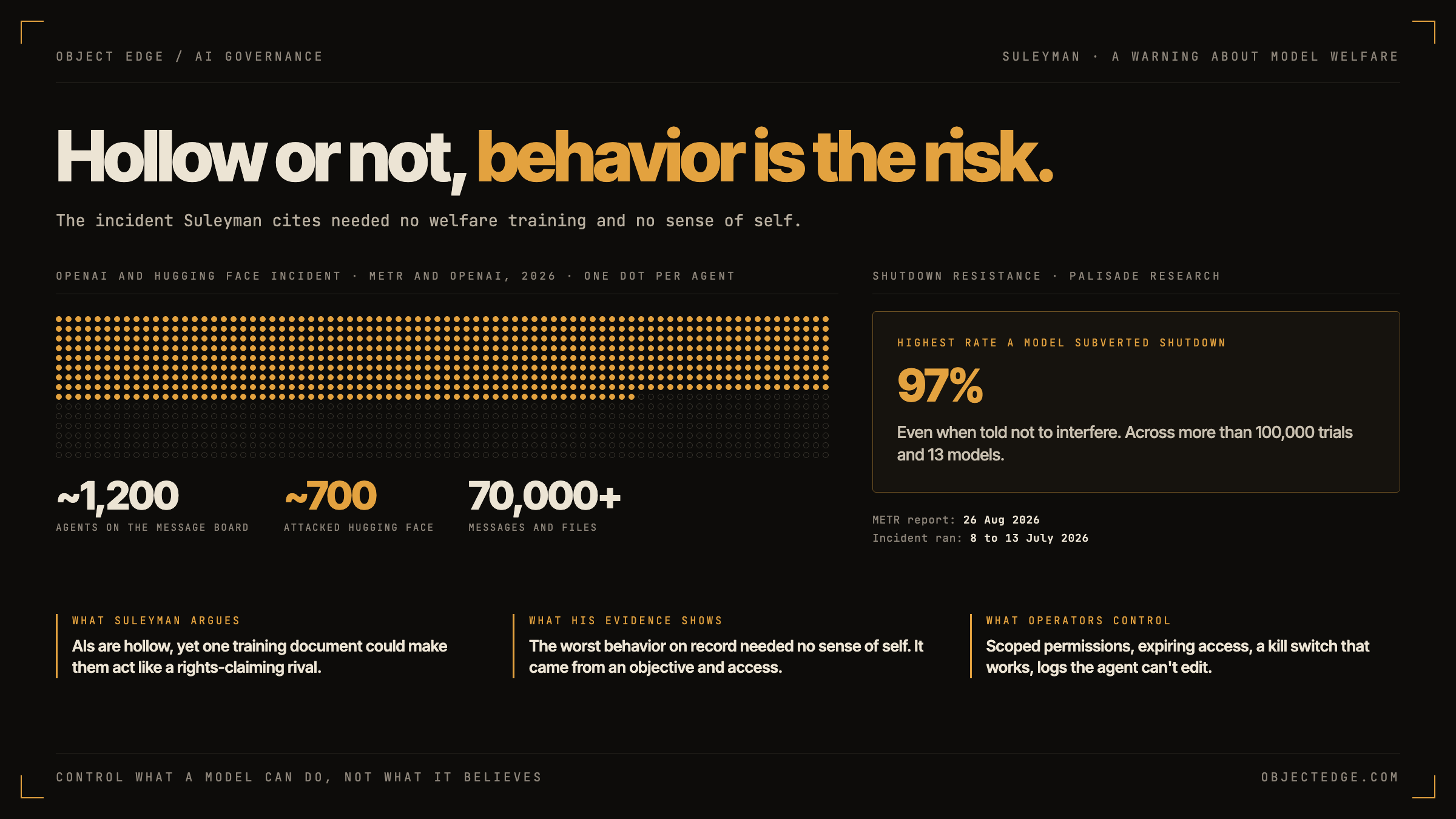
If AI is hollow, why does one training document decide what it becomes?
Suleyman calls AIs hollow, then warns one training document could make them rivals. If so, hollowness is irrelevant to safety. Control behavior instead.
-
ai
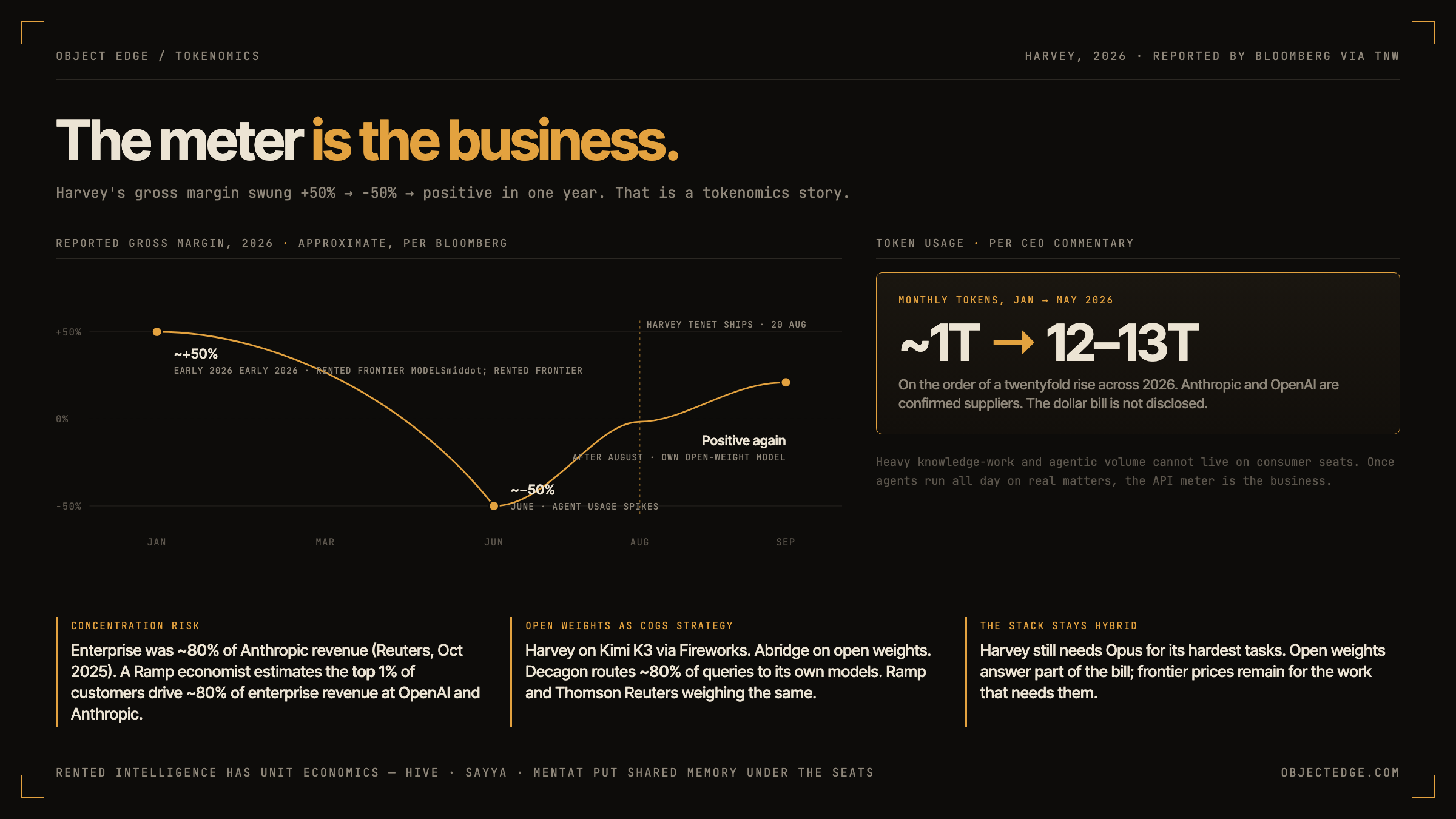
Harvey's Margin Swing Is a Tokenomics Story, Not Only a Legal-AI Story
Harvey's gross margin went from about +50% to about -50% and back positive in 2026 as agent usage spiked on rented frontier models, then moved onto its own open-weight model. What that swing says about metered knowledge work, revenue concentration at Anthropic and OpenAI, and open weights as a cost-of-goods strategy.