ai
Anthropic is reportedly building a consultancy. The model was never the hard part.
Anthropic and Hg, the UK buyout group, are reportedly creating an independent company that will embed AI consultants and engineers inside European businesses, with hubs in London and Berlin and a launch expected by the end of the year.
(Financial Times, Alexandra Heal, 23 Oct. Both companies declined to comment, and the details come from people familiar with the matter.)
It is interesting, and I think it is one of the more honest signals a frontier lab has sent about enterprise AI, even though nobody at Anthropic has said a word about it on record. When the company that builds the model decides it needs its own engineers inside your business to make that model useful, it is telling you where the hard part actually sits.
State of AI put it more sharply than I would: “For years the labs told enterprises the model was the hard part. They’re now spending billions on the evidence that it wasn’t.” (State of AI, 29 Oct)
Is this a one-off or a pattern?
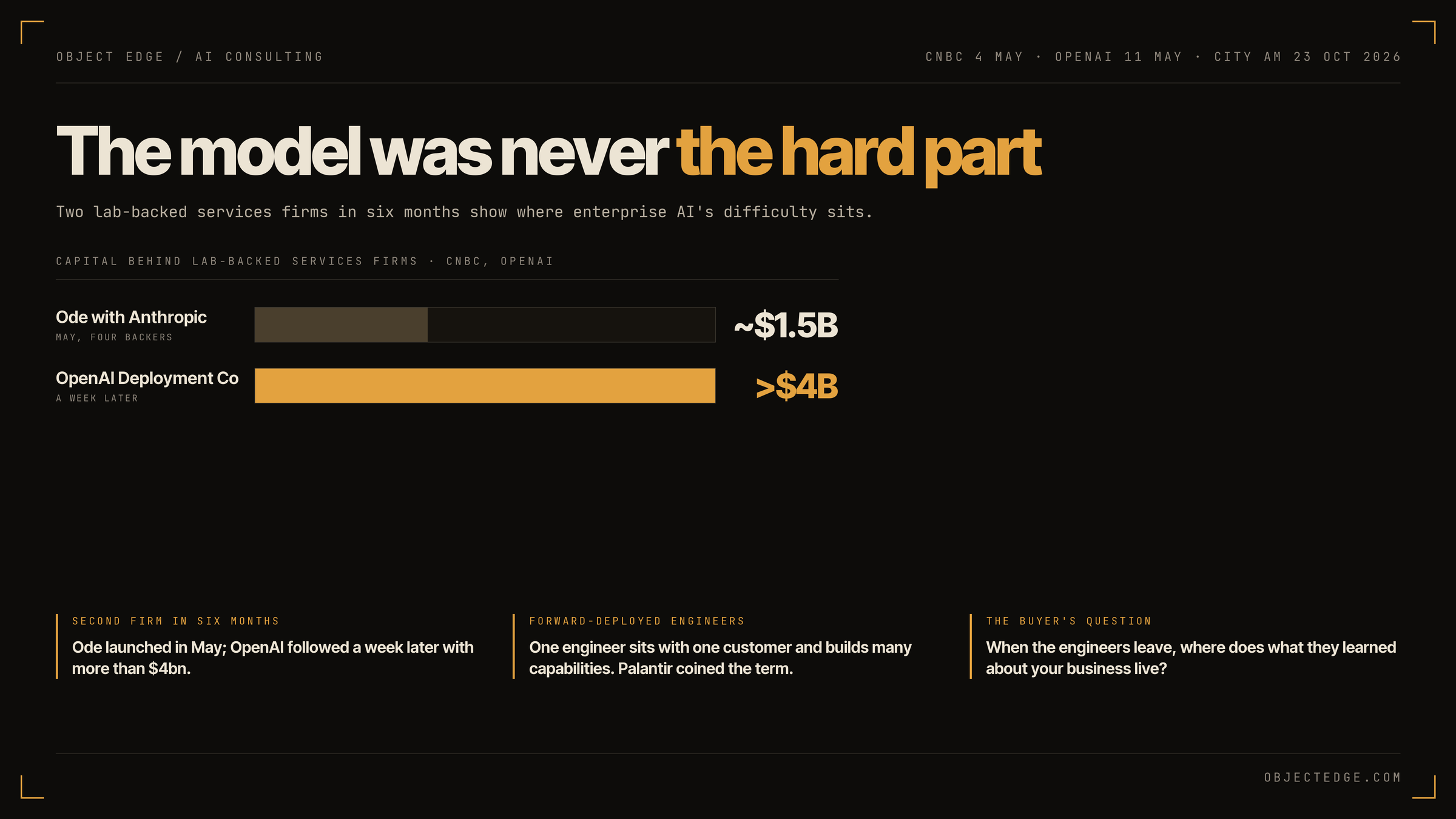
It is a pattern. This is the second lab-backed services firm Anthropic has been part of in six months. In May, Anthropic, Blackstone, Hellman & Friedman and Goldman Sachs launched a firm with about $1.5bn to embed engineers in mid-sized companies, which became Ode with Anthropic in July (CNBC, 4 May; Ode, 15 Jul). A week later OpenAI launched its Deployment Company with more than $4bn and agreed to buy Tomoro, which brings about 150 forward-deployed engineers (OpenAI, 11 May).
So what is a forward-deployed engineer? It’s an engineer who sits with one customer and builds many capabilities for that customer, rather than building one capability for many customers. The term comes from Palantir, which internally calls the role “Delta” as opposed to “Dev” (Palantir engineering blog).
The people funding these firms say the quiet part plainly. Goldman’s Nachmann: “Having the model alone doesn’t change your workflows or how you operate.” (CNBC) OpenAI, in its own launch post: “building powerful AI models is only part of the work.” (OpenAI)
The labs are conceding that the model was never the hard part.
Then what is the hard part?
Here’s what I think is happening. Model access is becoming something every company can buy on a monthly plan, and the frontier models are close enough to each other that access alone rarely decides an outcome. What decides it is whether someone knows how the business actually works: which process to change, which decision an agent can own, where the exceptions live, and what “done” means to the people who will use it.
As I wrote last week, software isn’t dead, and knowing what to build is still the hard part. Production readiness sits upstream of the code. Agents have widened who can describe software, but someone still has to know the scaffolding of a real system and have the experience to get through it.
We saw this building Hive. Six engineers shipped more than 3,500 features in about a year, which we estimate would have taken four to five years without AI coding tools. However, the tools were not what made that year possible. Twenty years of Object Edge domain knowledge, and the ontology and knowledge-graph work underneath it, told us what to build. My honest estimate is that a team with the same tools but without that domain knowledge would need two to three years to reach the same place.
The same is true on the client side. From what I’ve seen, the payoff comes from specific agents in expert hands, wrapped in change management and the process scaffolding that makes people actually work differently. James Ransome of Patrick Morgan said it well: “Developing AI technology and successfully transforming a multinational business are two very different things.” (City AM, 28 Oct)
Does it matter that the consultancy is part-owned by the model vendor?
I believe it does, though maybe not in the way people expect.
A lab-backed consultancy is Claude-first by design. Ode says it can use rival models (TechCrunch, 15 Jul), and I have no reason to doubt that, but every incentive points one way. Fiona Czerniawska of Source Global Research made the sharper point: what consulting firms bring “is not so much independence, but the ability to deploy each of them, depending on what the client wants to see.” (City AM, 28 Oct)
To me, model neutrality is a real selling point for independents, but it is the smaller one. The bigger question is time horizon. Olly Purnell of Q5 put it plainly: “Consultants want a multi-decade relationship with clients, and private equity is all about pushing EBITDA results and having an exit after three to five years.” (City AM, 28 Oct) Domain knowledge compounds over decades of shared work. It is hard to build that on a fund’s clock.
However, I would not dismiss the model either.
Hg already has about 150 AI experts deploying AI across its portfolio, and Anthropic has worked with Hg portfolio companies since 2024 (FT). As Ransome noted, the portfolio gives the new firm an immediate client base and a way to prove results without fighting for every engagement from scratch. That is a real advantage, and it is the same playbook Ode used with its sponsors’ portfolio companies.
Should Accenture and the Big Four be worried?
The market twitched. Accenture fell more than 4% on the Friday the story broke (City AM, 23 Oct), although insider sales and an analyst downgrade were also cited for the drop (Investing.com), and Accenture and Capgemini saw little further movement over the weekend (City AM, 28 Oct).
I don’t think this is a threat to firms that own deep domain knowledge and long client relationships. I think it is a threat to anyone whose value was mainly access: reselling seats, running pilots, or being the people who knew how to use the new tool first. The labs can now supply that access themselves, with their own engineers attached.
What should a buyer ask?
If you are a European company being pitched by one of these firms (or by anyone else), the useful questions are dull ones. Who on this team has actually run the process we are changing? Which decisions will the agents own, and who signs off on the exceptions? If we want a different model next year, what breaks? And when the engineers leave, where does what they learned about our business live?
That last question is the one I care about most. If the knowledge leaves with the engagement, you have rented a capability rather than built one. If it lands in a shared company memory your people and your agents can keep using, the engagement compounds. (We build Hive for exactly that reason, so weigh my view accordingly.)
The part that doesn’t change
Every technology wave arrives faster than the understanding of how to use it. The labs have now looked at that gap and decided to fill it with people, which I think is the right call.
The scarce thing was never the model. It is people who understand how the work actually gets done, who can tell a client a narrative they believe, and who earn enough trust to change how that client operates. That takes years to build, and it does not come in the box.
Sources: Financial Times via Expansión (23 Oct 2026); City AM (23 and 28 Oct 2026); State of AI (29 Oct 2026); CNBC (4 May 2026); Ode press release (15 Jul 2026); TechCrunch (15 Jul 2026); OpenAI, “OpenAI launches the Deployment Company” (11 May 2026); Palantir blog, “Dev versus Delta”; Investing.com (23 Oct 2026).
Software isn’t dead. Knowing what to build is still the hard part: https://www.objectedge.com/blog/software-isnt-dead-knowing-what-to-build-is-still-the-hard-part
Related articles
-
ai
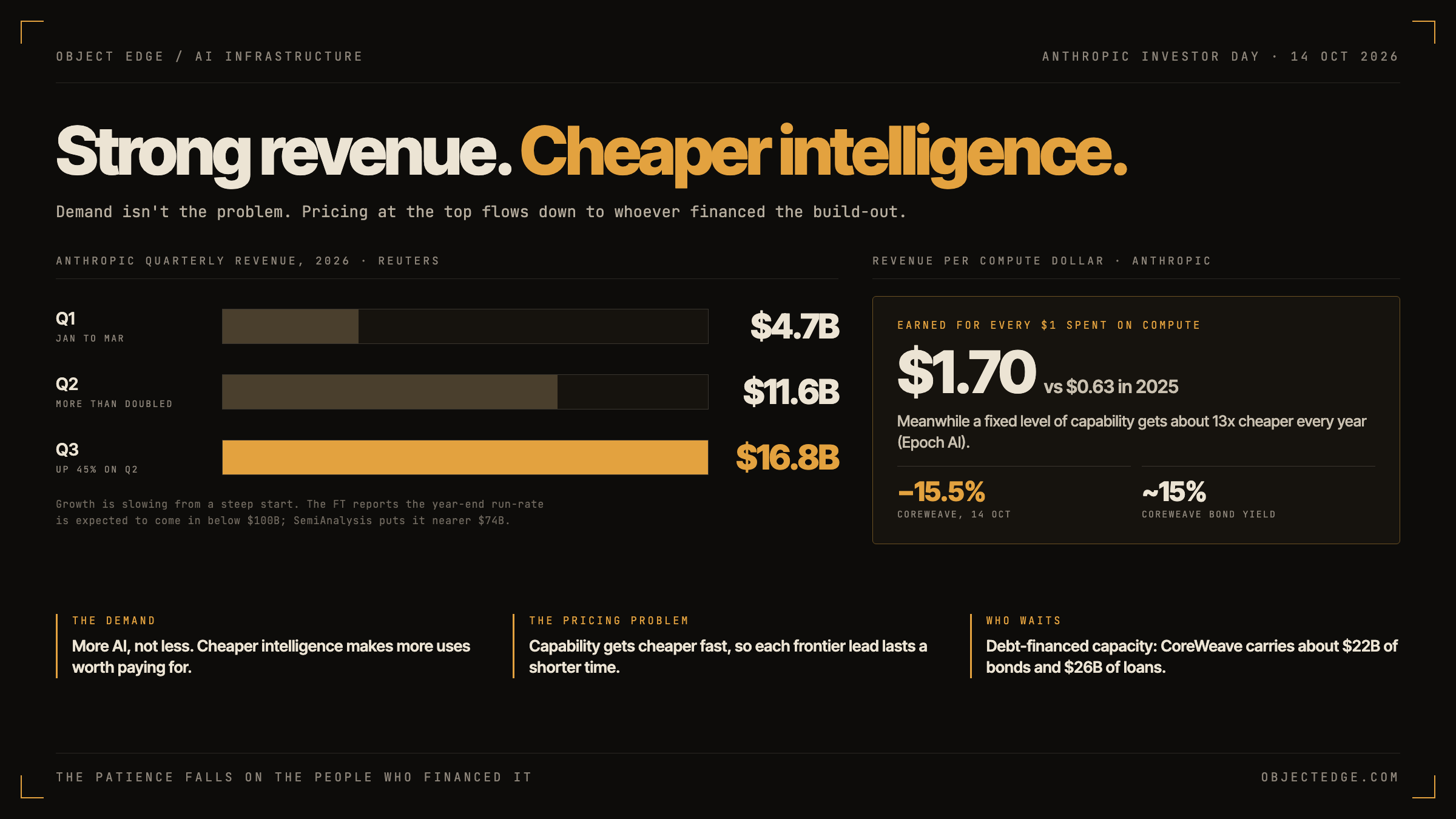
Anthropic's revenue is strong. Why should infrastructure investors worry?
Anthropic's Q3 revenue rose 45% to $16.8B. The bigger risk to the AI infrastructure trade is that frontier intelligence keeps getting cheaper.
-
ai
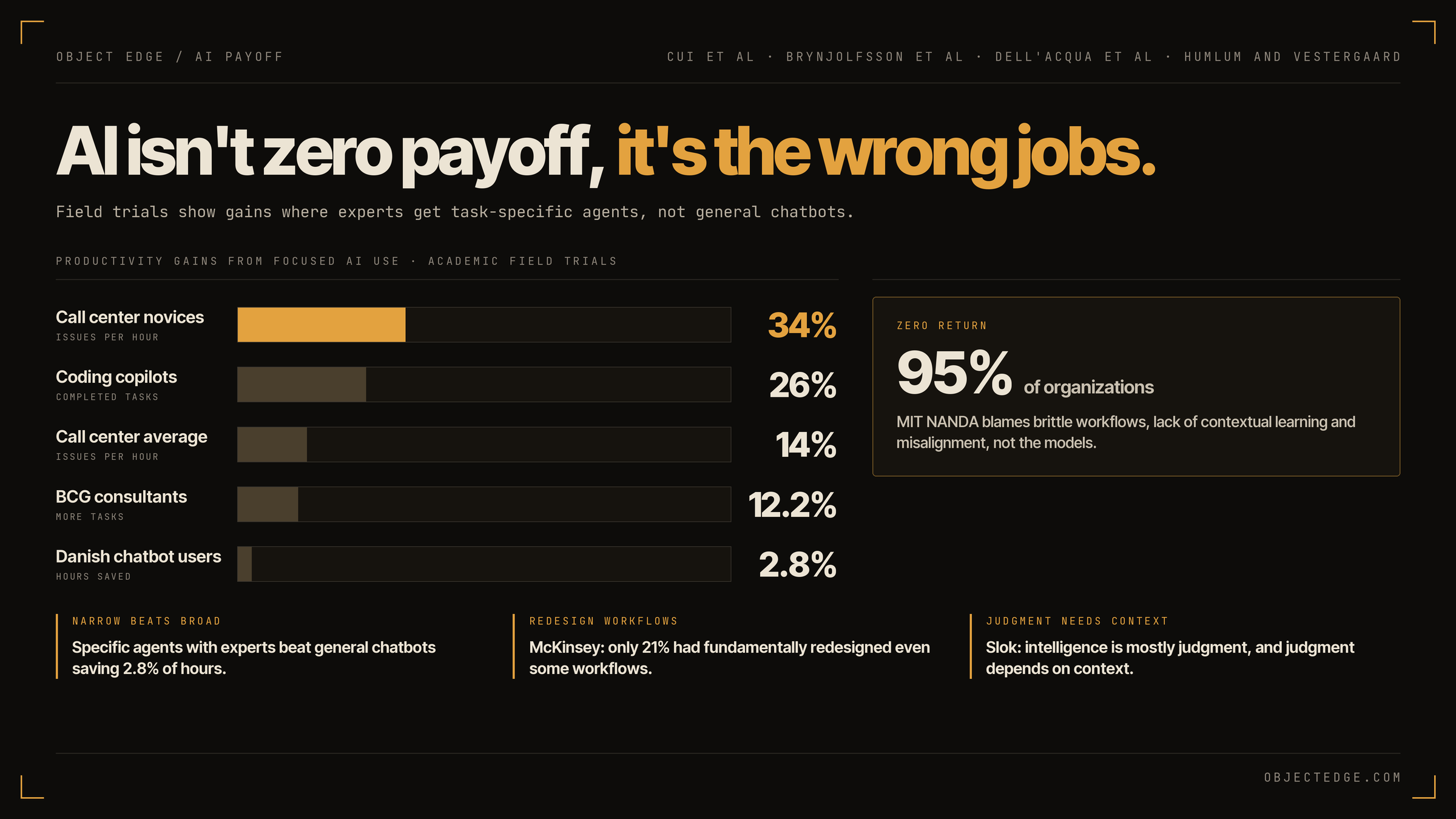
AI isn't delivering zero payoff. It's being handed the wrong jobs.
"Despite massive investments and widespread hype around artificial intelligence, the technology has delivered zero financial payoff to corporate America
-
ai
Software isn't dead. Knowing what to build is still the hard part.
AI has made writing code cheap. The hard part of software is still knowing what to build: the domain knowledge behind production-ready systems.