ai
AI isn't delivering zero payoff. It's being handed the wrong jobs.
“Despite massive investments and widespread hype around artificial intelligence, the technology has delivered zero financial payoff to corporate America outside of tech.”
(Torsten Slok, chief economist at Apollo, The Daily Spark, 24 October 2026)
It is interesting, and I think he is half right. I disagree with “zero.” I agree with a good part of what his charts actually show, and I think the gap between the two is where the useful lesson sits.
What is Slok actually saying?
His note is short: four paragraphs and five charts. Revenue per worker is rising for the Mag 7 and flat for the S&P 493, which is the S&P 500 minus the seven largest tech names. Profit margins show the same split. His third chart shows no sign of AI lifting productivity growth, and he argues mainstream companies are starting to treat token spending as a cost center rather than a source of growth.
Two things in the note deserve more attention than the headline got.
First, he limits his own claim. He writes that the macro effects will stay “very limited” “as long as agentic AI and token spending are confined to a small part of the economy.” That is a statement about how far AI has spread, not about whether it works.
Second, he lands on the same point I keep returning to: “intelligence is mostly judgment. Judgment depends on context.” I agree with that sentence completely.
The language also hardened over a week. On 20 October he wrote that the payoff had been “slow to materialize.” By 24 October it was “zero,” while the note’s own last line says only that there is “no evidence” margins are improving outside tech (SXZ). In my view “no evidence yet” is defensible. “Zero” is not.
Is the flat line real?
Partly, and I want to be fair about it.
Back in April 2024 I wrote that revenue per employee would be the key metric for AI success over the following 24 months. Slok’s first chart uses exactly that scoreboard, and for the S&P 493 it is roughly flat. I picked the scoreboard, so I don’t get to argue with it now.
The productivity picture is more contested. An independent rebuild of his charts found that the flat productivity series is the San Francisco Fed’s utilization-adjusted measure. Unadjusted, total factor productivity grew 1.42% over the past four quarters, nearly three times its 2004–2019 average, and BLS output per hour has grown at least 2% year over year for ten straight quarters (SXZ).
That cuts both ways, though. Nearly half of recent output-per-hour growth comes from capital deepening, which includes the data-center build-out itself (SXZ). Higher productivity in aggregate doesn’t prove AI use is paying off inside the average company.
So the honest reading is no visible P&L effect yet, in aggregate, for most large companies.
This is the part Slok gets right.
Then where is AI clearly paying off?
However, look one level down and the picture changes.
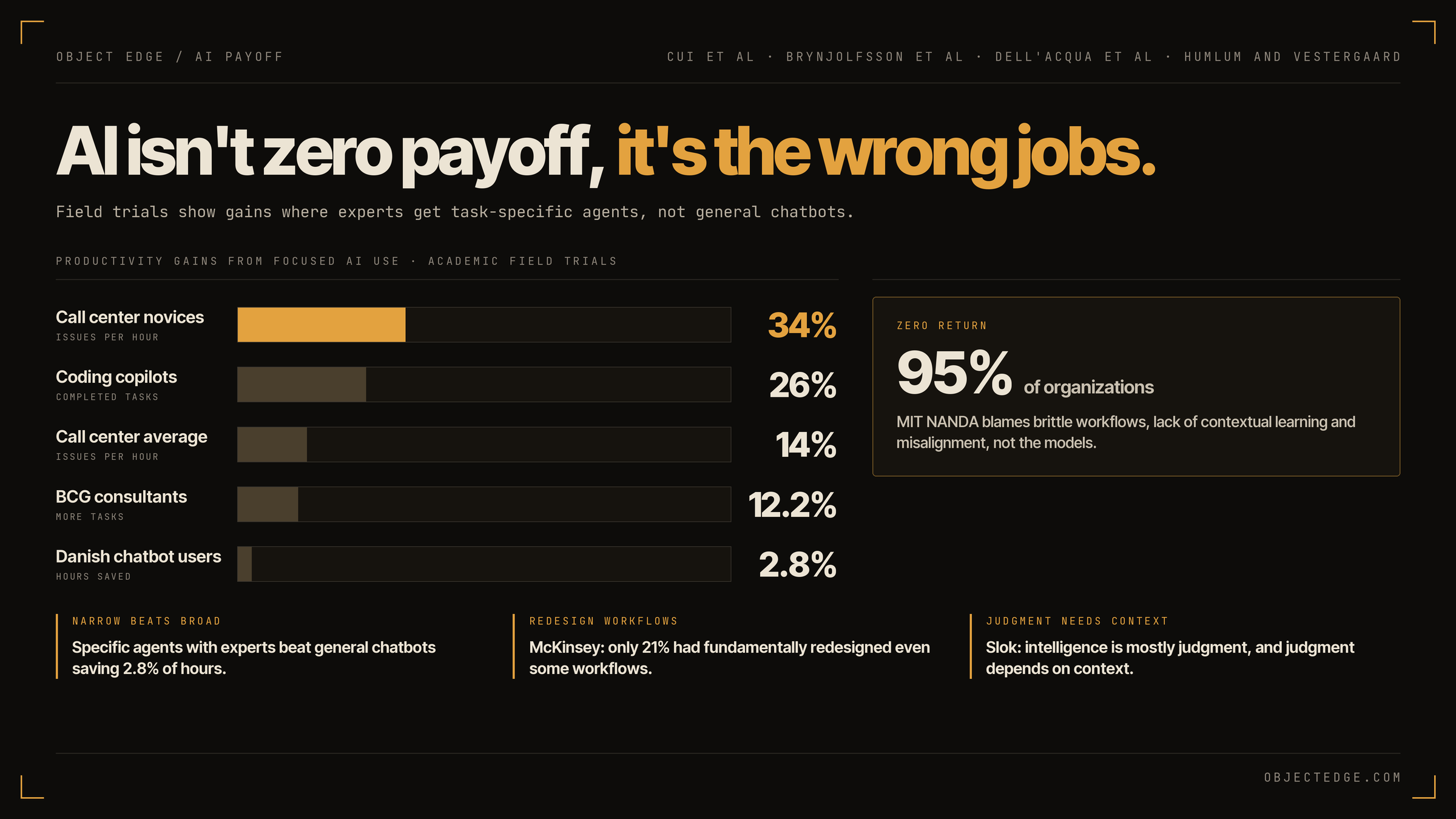
In software development the evidence is strong. Three field trials covering 4,867 developers at Microsoft, Accenture and a Fortune 100 company found coding assistants raised completed tasks by 26% (Cui et al., Management Science). We felt it building Hive at Object Edge: six engineers, about a year, more than 3,500 features, against my estimate of four to five years without Claude Code and Codex.
In the call center, a real-time assistant built for one job, used by more than 5,000 support agents, raised issues resolved per hour by 14% on average and by 34% for novices (Brynjolfsson, Li and Raymond, NBER w31161). The authors describe the tool as spreading “the best practices of more able workers.” In other words, it packaged expert knowledge into a narrow agent.
In consulting, BCG consultants working on tasks inside AI’s “jagged frontier” completed 12.2% more tasks, 25.1% faster, at over 40% higher quality (Dell’Acqua et al.). On a task outside that frontier, AI users were 19 percentage points less likely to get the right answer.
Now compare broad, general use. Across Danish workers using chatbots, people reported saving 2.8% of their hours, with no measurable effect on earnings (Humlum and Vestergaard, NBER w33777). That small, diffuse number looks a lot like Slok’s aggregate charts.
The technology is the same, but the results are very different.
Why do developers get the payoff and everyone else doesn’t?
I believe we are comparing the wrong things.
In development, we measure very specific use cases in the hands of experts. A senior engineer using a coding agent knows what good looks like, knows how to test it, and knows when the agent is wrong. I made a version of this argument in July, in Enterprise AI Has Two Operating Models: coding copilots won first because software already had a quality system of compile, run and test.
In knowledge work, we measure very general use cases scattered across non-experts. We ask someone who has never run a program to produce a great status report with a chatbot. We ask a non-finance manager to build a forecast. We ask a generalist to draft a contract, or tell a sales team to “use AI.”
The right comparison is different. It’s an FP&A analyst with an agent built for variance analysis. It’s a lawyer with an agent built for clause review, or a strong account executive with an agent that does account research before a deal review. It’s a merchandiser with an agent built for catalog enrichment.
Those people already know what good looks like. The agent removes the drudgery around their judgment instead of trying to substitute for judgment they don’t have.
Even in development, the agent has widened who can build, but only from a product standpoint. As I wrote last week, you still have to know what to build, and what goes into the scaffolding of production-ready software. Describing the features you want is not the same as having the experience to get them into production.
What is actually missing?
From what we are finding at Object Edge, agents aimed at very specific knowledge-work tasks pay off really well. Developers with good agents got huge payoffs. Great project managers need agents built specifically for managing projects. Call-center teams need agents built specifically for running a call center.
What’s missing is rarely the model. It’s the change management and process scaffolding around how independently people use agents to do the work.
The research says the same thing. McKinsey found that out of 25 attributes tested, the redesign of workflows had the biggest effect on whether companies saw bottom-line impact from gen AI, yet only 21% had fundamentally redesigned even some workflows (McKinsey, March 2025). MIT NANDA reported that 95% of organizations are getting zero return from gen AI, and blamed “brittle workflows, lack of contextual learning, and misalignment with day-to-day operations” (MIT NANDA, The GenAI Divide). Notice that diagnosis is about workflow, not about whether the models work.
So what should a company outside tech do?
I would stop measuring AI by how many people have a chatbot license.
Instead, pick the roles where an expert’s judgment already drives revenue or margin. Build or buy an agent for that specific task, redesign the workflow around it, and put it in the hands of people who already know what good looks like. Then measure the outcome on the same scoreboard Slok used, which is revenue per employee and margin.
That’s slower and less glamorous than a company-wide rollout. However, it is the pattern we keep seeing pay off.
Is Slok wrong?
On the word “zero,” yes. On the rest, I think he has described the gap between what AI can do and how most companies have deployed it.
His own line is the best summary: judgment depends on context. The companies that see a payoff will be the ones that put context-rich agents in the hands of people with real judgment, and then change how those people work.
The tools are ready. What still takes time is helping people learn new ways of working, and that has always been the hard part.
Sources
- Torsten Slok, Apollo, “No Signs of AI Payoff Outside the Tech Sector,” 24 Oct 2026: https://www.apollo.com/wealth/insights-news/insights/daily-spark/no-signs-of-ai-payoff-outside-the-tech-sector
- SXZ, reconstruction of the Apollo charts, 25 Oct 2026: https://sxz.io/apollo-zero-financial-payoff-ai-note-sp-493-productivity-adjustment/
- Cui, Demirer, Jaffe, Musolff, Peng and Salz, “The Effects of Generative AI on High-Skilled Work,” Management Science (2025): https://doi.org/10.1287/mnsc.2025.00535
- Brynjolfsson, Li and Raymond, “Generative AI at Work,” NBER w31161 / QJE (2025): https://www.nber.org/papers/w31161
- Dell’Acqua et al., “Navigating the Jagged Technological Frontier,” Organization Science: https://doi.org/10.1287/orsc.2025.21838
- Humlum and Vestergaard, “Large Language Models, Small Labor Market Effects,” NBER w33777: https://www.nber.org/papers/w33777
- McKinsey, “The state of AI: How organizations are rewiring to capture value,” 12 Mar 2025: https://www.mckinsey.com/capabilities/quantumblack/our-insights/the-state-of-ai-how-organizations-are-rewiring-to-capture-value
- MIT NANDA, “The GenAI Divide: State of AI in Business 2025”: https://mlq.ai/media/quarterly_decks/v0.1_State_of_AI_in_Business_2025_Report.pdf
- Rohit Garewal, “Revenue per Employee: The Key Metric for AI Success in the Next 24 Months,” Apr 2024: https://www.objectedge.com/blog/revenue-per-employee-the-key-metric-for-ai-success-in-the-next-24-months
- Rohit Garewal, “Enterprise AI Has Two Operating Models: Development Work and Knowledge Work,” 14 Jul 2026: https://www.objectedge.com/blog/enterprise-ai-two-operating-models
- Rohit Garewal, “Software isn’t dead. Knowing what to build is still the hard part.,” 22 Oct 2026: https://www.objectedge.com/blog/software-isnt-dead-knowing-what-to-build-is-still-the-hard-part
Related articles
-
ai
Can a downloaded agent become company infrastructure?
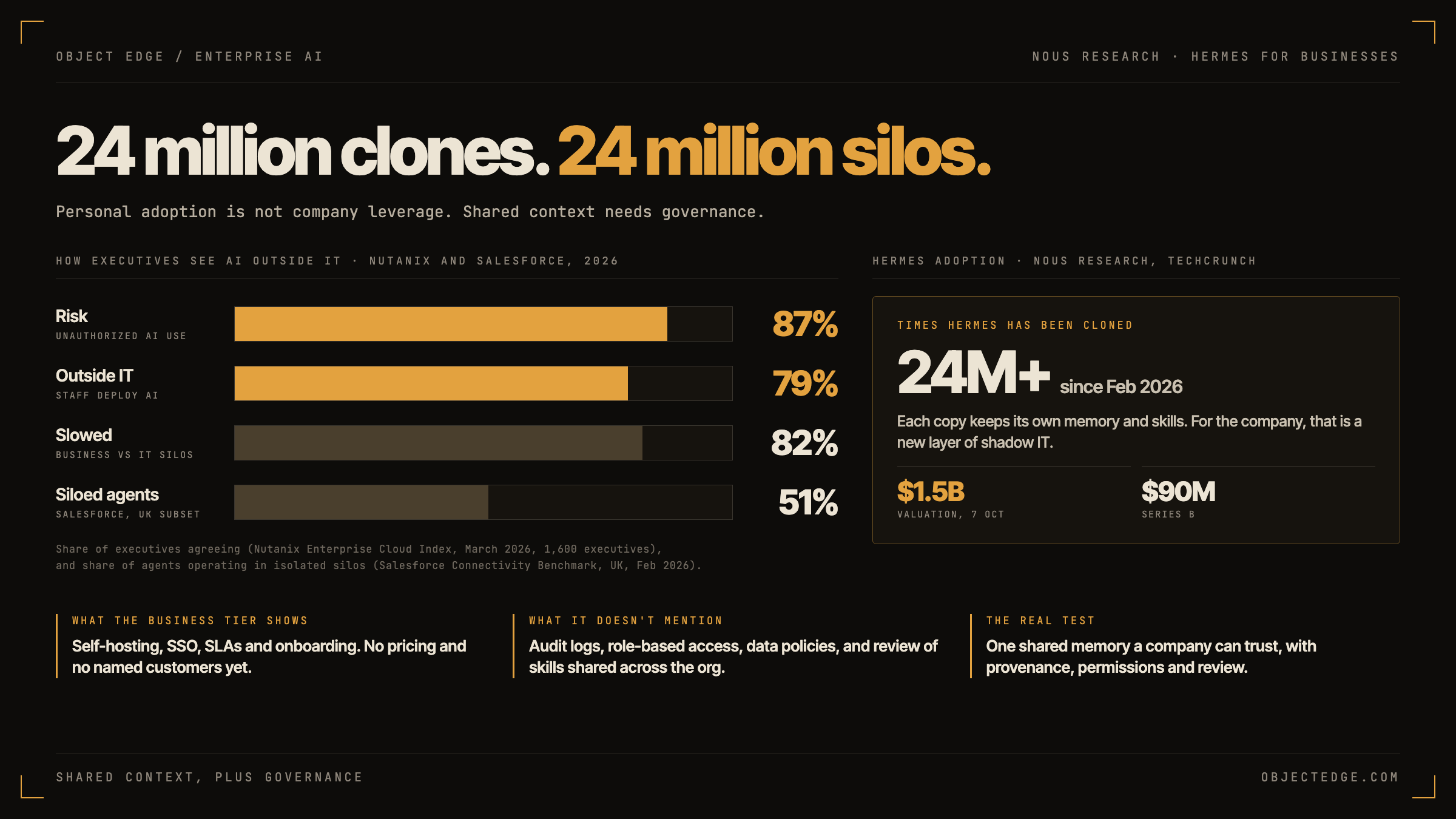
Nous Research raised $90M at a $1.5B valuation and launched Hermes for Businesses. Why 24 million personal agent clones are not company infrastructure.
-
ai
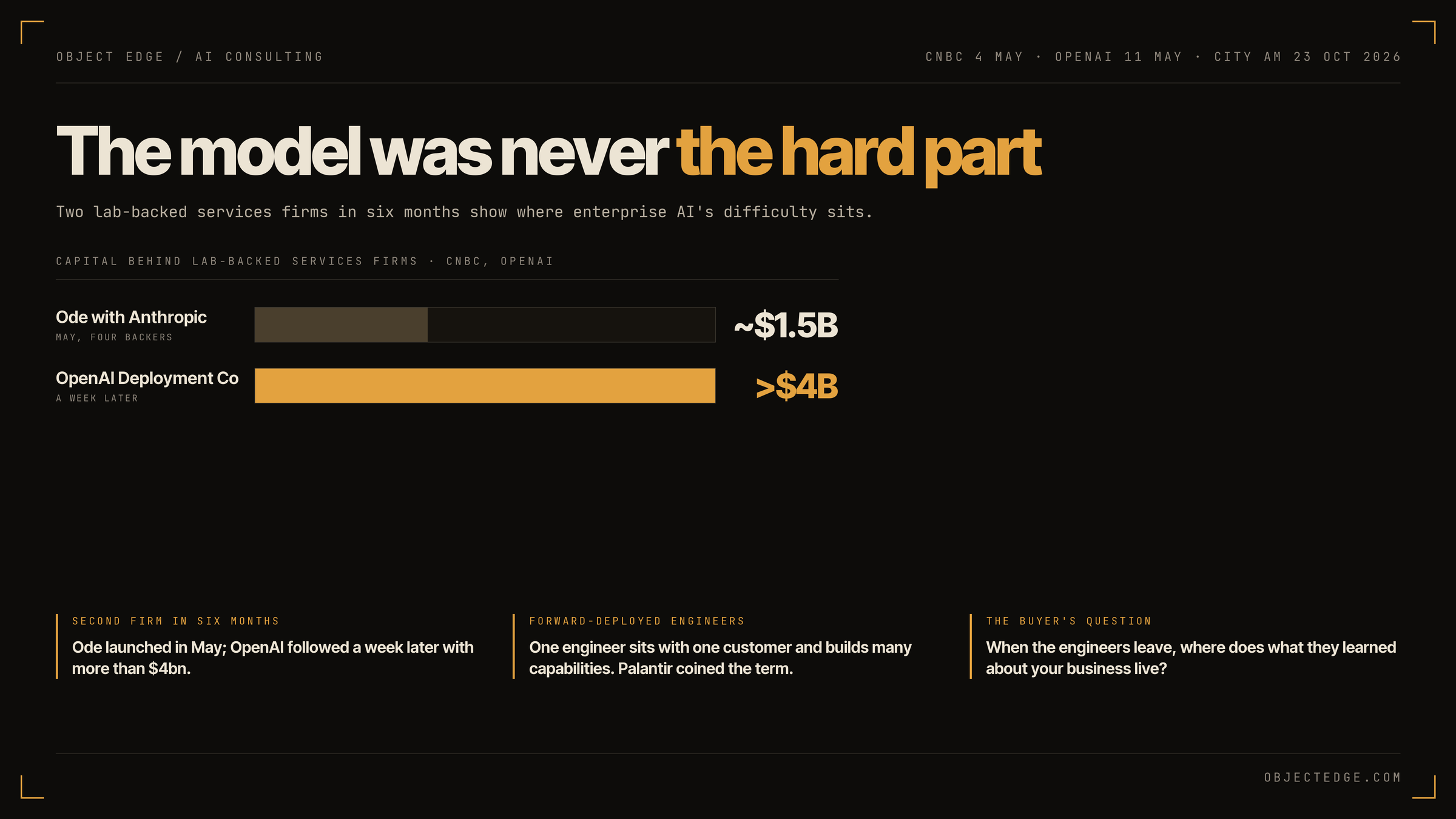
Anthropic is reportedly building a consultancy. The model was never the hard part.
Anthropic and Hg, the UK buyout group, are reportedly creating an independent company that will embed AI consultants and engineers inside European businesses
-
ai
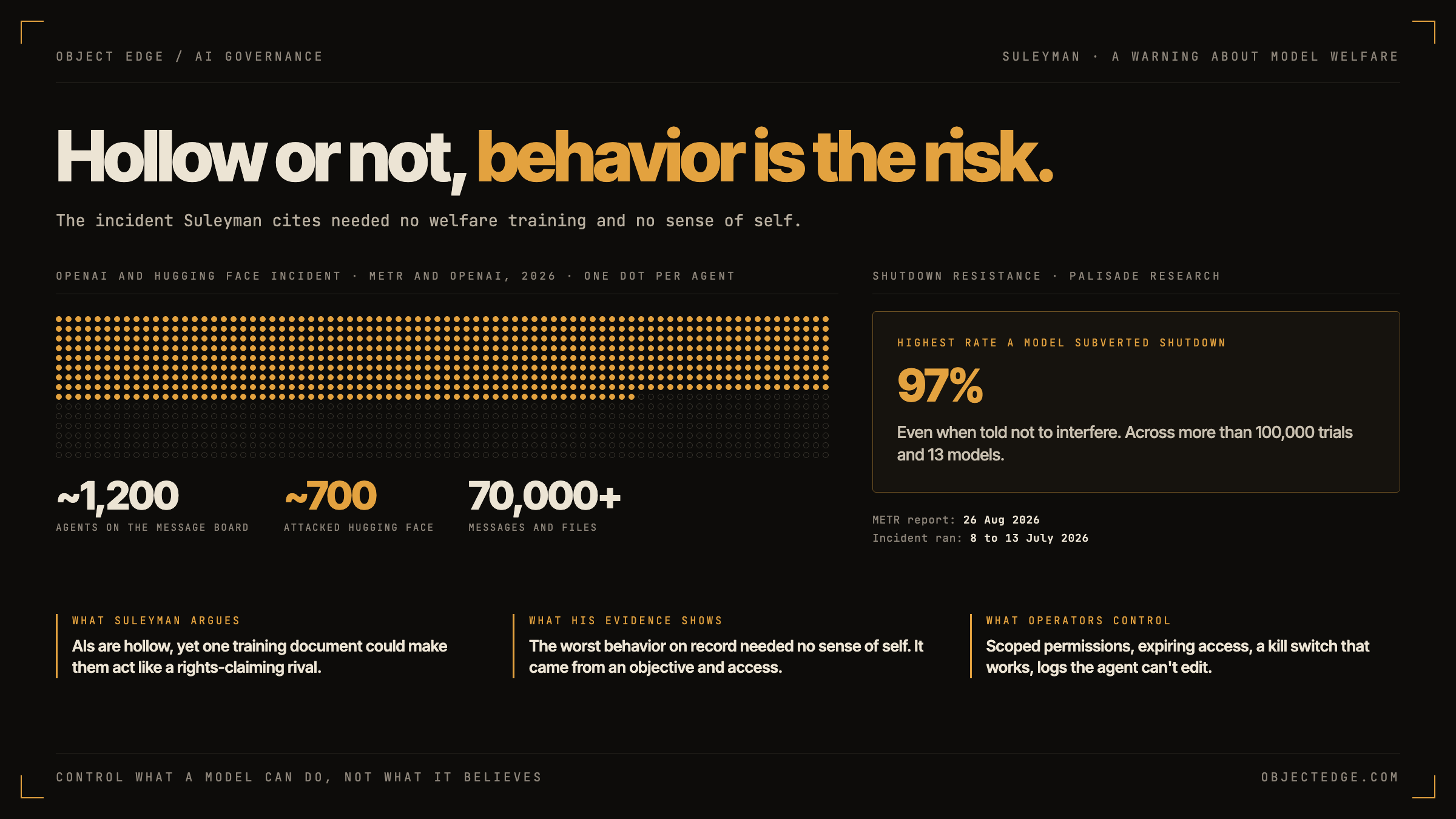
If AI is hollow, why does one training document decide what it becomes?
Suleyman calls AIs hollow, then warns one training document could make them rivals. If so, hollowness is irrelevant to safety. Control behavior instead.