ai
AI slop isn't AI writing. It's cognitive surrender.
“AI slop” has become one of the louder narratives around generative tools, and Merriam-Webster named “slop” its 2025 Word of the Year.
(Merriam-Webster, 15 Dec 2025; Addy Osmani, “Critical thinking when agents do the work”, 3 Nov 2026)
It is interesting, and I believe most of the conversation is pointing at the wrong thing. Content is not slop just because AI wrote it. That part is just efficiency. Slop is what happens when people give up the cognitive load and let the AI do the thinking, instead of adding their own expertise to the conversation.
Addy Osmani, who works on Claude Code at Anthropic and is openly pro-agent, put a name on that failure mode this week. He calls it cognitive surrender: “the AI’s output quietly becomes your own, you feel no need to check it.” His X Article has already crossed about 4.5 million impressions and 45,000 bookmarks. (Osmani, 3 Nov 2026)
What is cognitive surrender?
So what is cognitive surrender? It’s adopting an AI’s answer with so little scrutiny that you never formed a view of your own to compare it against. Steven Shaw and Gideon Nave at Wharton coined the AI framing earlier this year in a working paper that is not yet peer-reviewed. Osmani credits them, and he places surrender at the bottom of a ladder that starts somewhere useful. (Shaw & Nave, SSRN, Jan–Mar 2026)
At the top is offloading: you delegate the work but keep ownership of the result. Osmani says he does this all day, and that you should too. In the middle is deferral, where the tool’s output becomes your new input and stops being a hypothesis. At the bottom, the AI’s answer quietly becomes yours.
That spectrum matters, because polish is no longer a useful signal. Outputs arrive well-written and mostly correct, which means they no longer demand a second look. As trust, or laziness, rises, people drift down the ladder. The AI does not create that debt. The posture you bring to it does. (Osmani, May 2026 and 3 Nov 2026)
Is the worry about AI authorship, or about abandoned judgment?
Here’s what I think is happening. The value of a piece of writing, or a strategy note, or a client recommendation, comes from a unique point of view the person producing it actually has. Without one, you are depending on an algorithm that picks the next best word, and that is essentially the average of what is on the internet.
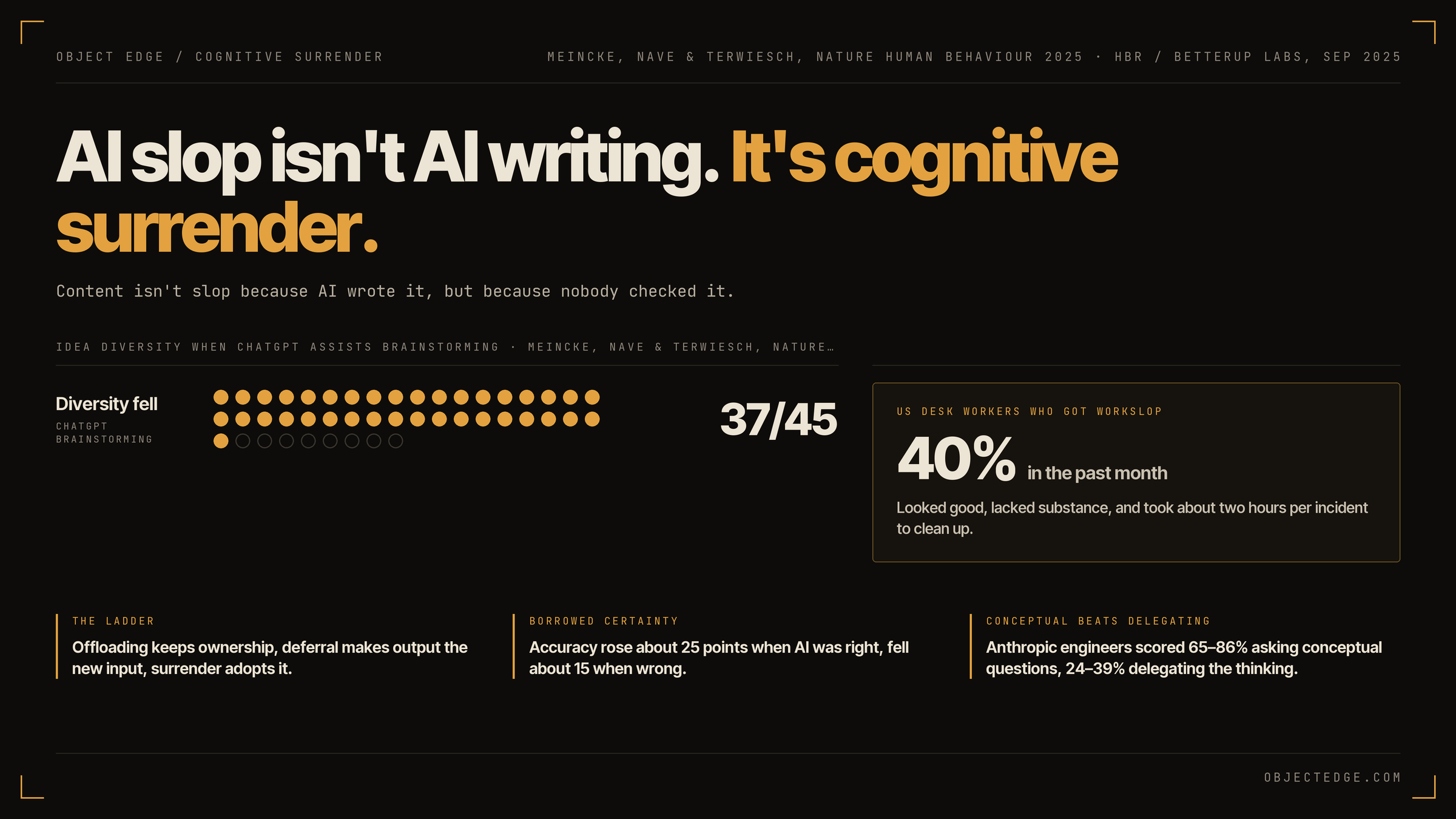
The research around homogenisation is useful texture for that claim, not a mathematical proof of it. Doshi and Hauser found that writers with access to GPT-4 ideas produced stories that scored as more creative, and also more alike than stories written without AI. Meincke, Nave and Terwiesch found that idea diversity fell in 37 of 45 comparisons when ChatGPT assisted brainstorming; in one task, nine people independently named their toy “Build-a-Breeze Castle.” Individually you can look better. Collectively the pool gets narrower. (Doshi & Hauser, Science Advances, 2024; Meincke, Nave & Terwiesch, Nature Human Behaviour, 2025)
That is why I do not treat “AI wrote it” as the diagnosis. A person who brings real expertise to the conversation can use an agent as a faster draftsman and still put something distinctive into the world. A person who hands over the thinking produces something that looks finished and says almost nothing.
What does the evidence actually show?
Shaw and Nave ran three experiments with 1,372 people. Accuracy rose about 25 points when the AI was right and fell about 15 when it was wrong, and confidence rose either way. In other words, people borrowed the model’s certainty and treated it as their own. The authors themselves say surrender is not always irrational; the issue is calibration. The paper is a preprint, the puzzles were easy to check, and the AI was wrong half the time by design, so I would not over-read the numbers. The pattern still matches what I see in practice. (Shaw & Nave, 2026)
A Microsoft Research and Carnegie Mellon survey of 319 knowledge workers, published at CHI 2025, found something that sits close to the expertise point. Higher confidence in the AI went with less critical thinking. Higher self-confidence went with more. That is a correlation in self-reported data, not a cause. Still, it lines up with a simple operator intuition: people who know the domain keep asking hard questions; people who do not know it stop. (Lee, Sarkar, Tankelevitch et al., CHI 2025)
Anthropic’s trial with 52 engineers learning a new library pointed the same way. People who asked conceptual questions scored 65–86%. People who delegated the thinking scored 24–39%. How you use the tool predicts whether you keep the skill. (Shen & Tamkin, Anthropic / arXiv, Jan 2026)
Why is “slop” getting louder now?
Partly because the volume is real, and partly because the cost of abandoned thinking is showing up in other people’s inboxes. Graphite estimates that about half of new English web articles are now primarily AI-written, based on a Common Crawl sample checked with AI detectors, with the usual caveats that come with detector methods. Harvard Business Review’s “workslop” piece, drawing on BetterUp Labs and Stanford, found that 40% of US desk workers had received AI-generated content that looked good but lacked substance in the past month, and that each incident took about two hours to clean up. Workslop, in their framing, leaves colleagues to do the real thinking. (Graphite, 2025–26; HBR / BetterUp, Sep 2025)
The story is no longer niche. However, volume is not the same as the failure mode.
A polished draft that carries a real point of view is not slop. A polished draft that carries none is. Osmani’s rule is the right one for that line: “If you wouldn’t put your name on it, it doesn’t go out.” You can offload the work and much of the auditing. You cannot offload the accountability. (Osmani, 3 Nov 2026)
What should a builder or a buyer ask?
The useful questions are dull ones. Did I form a view before I asked the model? Am I asking it to help me think, or to think instead of me? Would I put my name on this if a client, a colleague, or a reader had to live with the consequences?
Where being wrong is cheap, full handoff can be fine. Where other people have to deal with the result, the reasoning has to stay yours. That is not an anti-AI stance. Osmani builds agent tools for a living and says the people sitting them out are making a bigger mistake than the people leaning in. The people leaning in without a point of view are making a different one. (Osmani, May 2026)
The part that doesn’t change
Every wave of tooling makes it cheaper to produce something that looks done. The scarce thing was never the output. It was the person who still had something to say, and who was willing to do the thinking that made the output theirs.
How we try to keep that discipline inside Object Edge is a post for tomorrow. For now the frame is enough: AI writing is efficiency. Cognitive surrender is slop.
Sources: Addy Osmani, “Critical thinking when agents do the work” (X Article, 3 Nov 2026) and “Cognitive Surrender” (addyosmani.com, 5 May 2026); Shaw & Nave, “Thinking—Fast, Slow, and Artificial” (SSRN / PsyArXiv working paper, 2026); Lee, Sarkar, Tankelevitch et al., CHI 2025; Shen & Tamkin, Anthropic / arXiv, Jan 2026; Doshi & Hauser, Science Advances, 2024; Meincke, Nave & Terwiesch, Nature Human Behaviour, 2025; Harvard Business Review / BetterUp Labs, Sep 2025; Graphite AI-article research, 2025–26; Merriam-Webster Word of the Year, 15 Dec 2025.
Related articles
-
ai
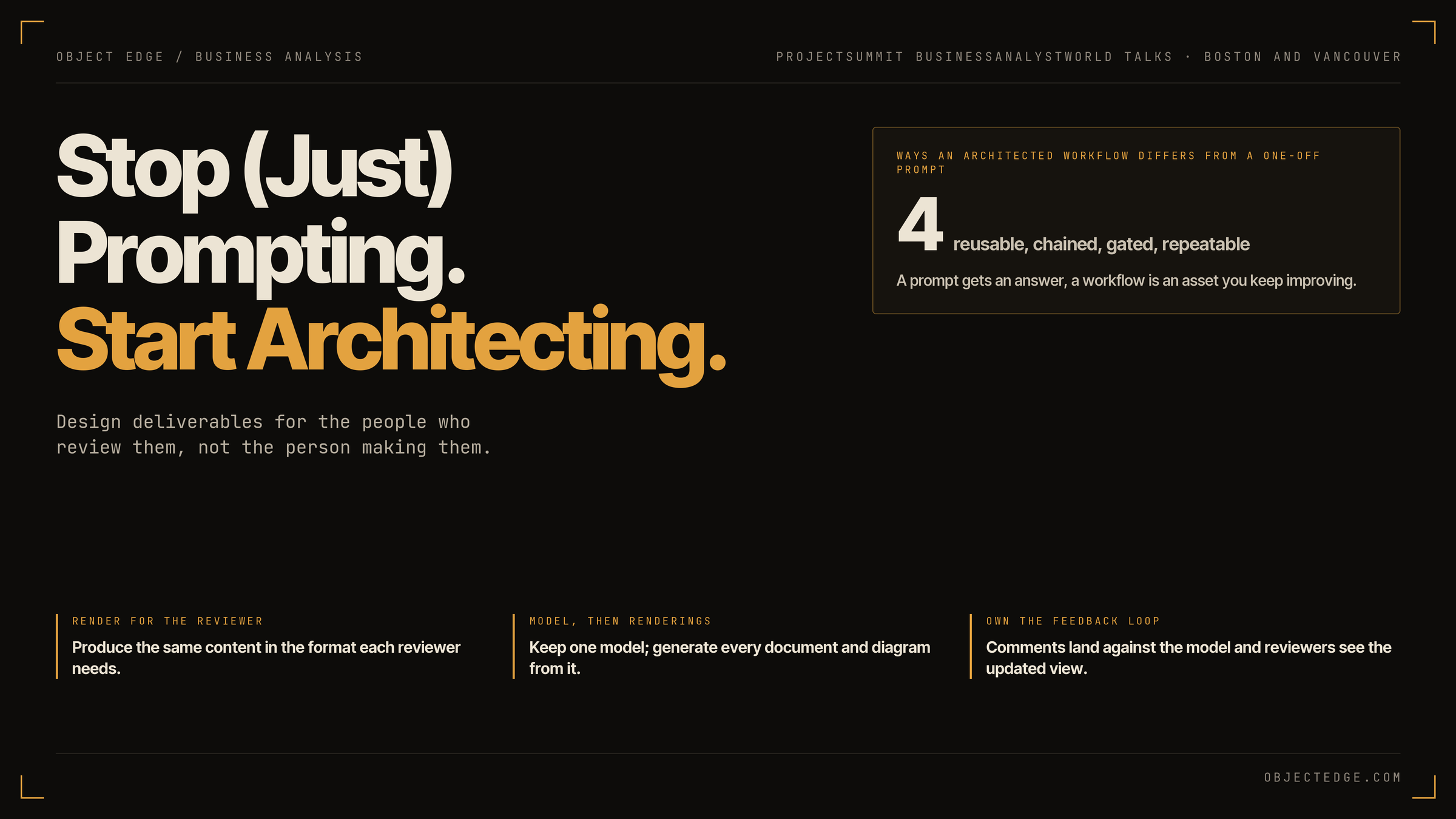
Stop (Just) Prompting. Start Architecting.
A business analyst's guide to going beyond prompting: design deliverables for stakeholders, separate the model from its renderings, and own the feedback loop.
-
ai
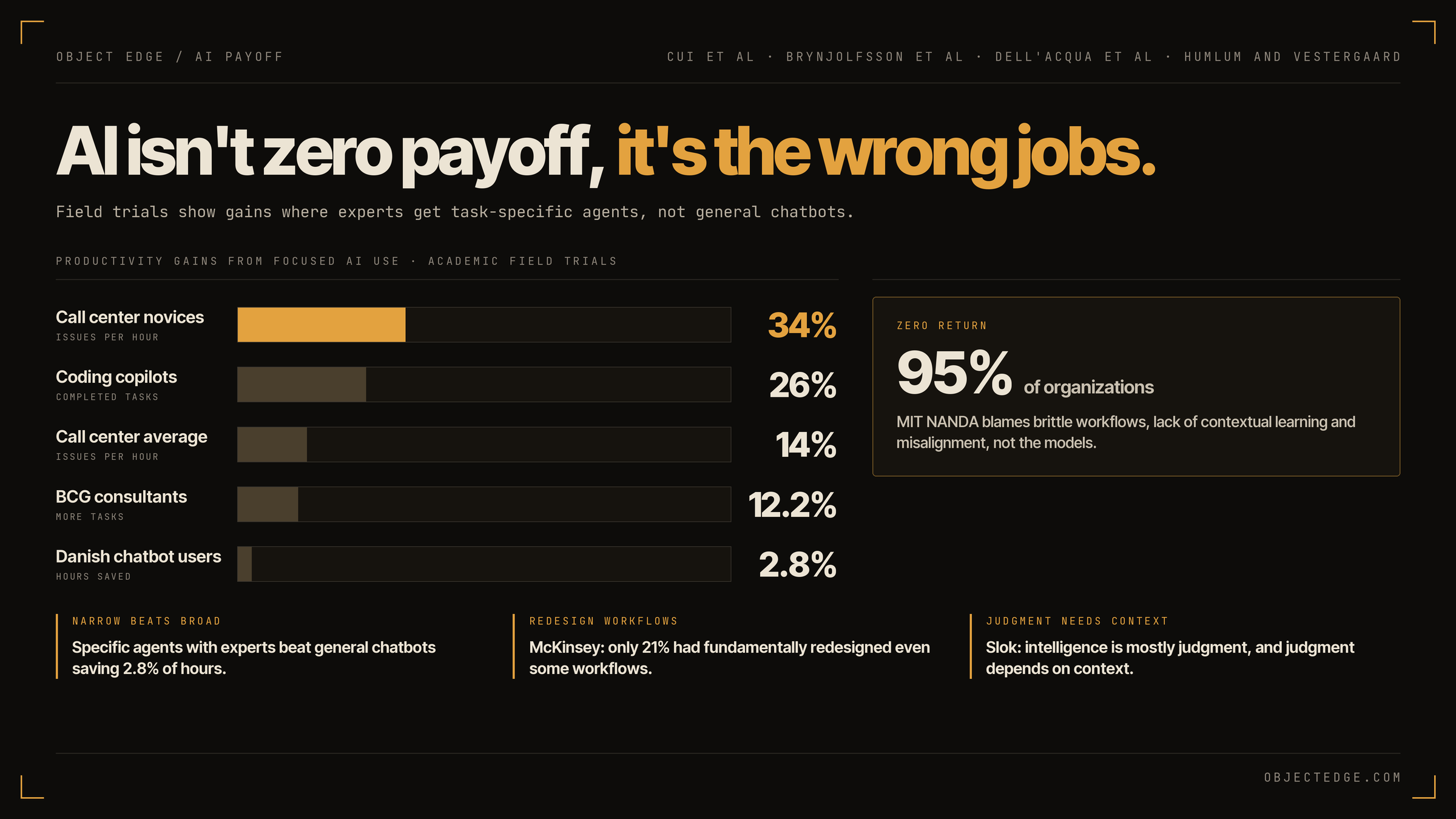
AI isn't delivering zero payoff. It's being handed the wrong jobs.
"Despite massive investments and widespread hype around artificial intelligence, the technology has delivered zero financial payoff to corporate America
-
ai
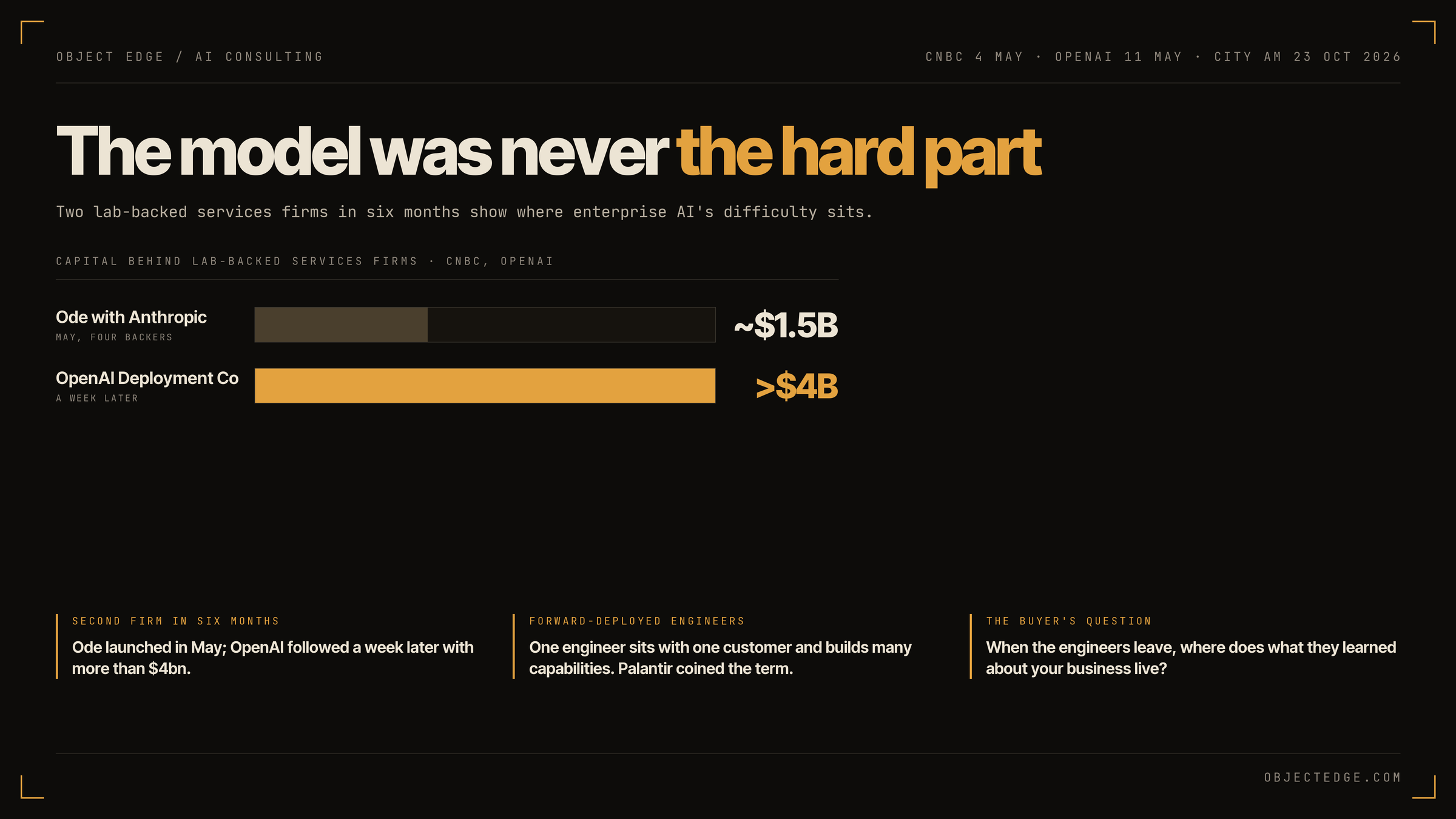
Anthropic is reportedly building a consultancy. The model was never the hard part.
Anthropic and Hg, the UK buyout group, are reportedly creating an independent company that will embed AI consultants and engineers inside European businesses